
WDS-LDA: Bridging the Gap Between Probabilistic Modeling and Human Intuition in Social Networks
15343_A Topic Representation Model for Online Social Networks Based on Hybrid Human-Artificial Intelligence.
This paper introduces WDS-LDA, a Word-Distributed Sensitive topic representation model that enhances standard Latent Dirichlet Allocation (LDA) by integrating hybrid human-artificial intelligence (H-AI). It optimizes topic modeling for online social networks by combining mathematical distribution sensitivity with human cognitive feedback to select highly discriminative representative words.
TL;DR
Researchers have developed WDS-LDA, a hybrid topic representation model that fuses the statistical power of Latent Dirichlet Allocation with human cognitive feedback. By introducing word-distribution sensitivity—measuring how words behave both within and across topics—the model filters out "common" noise and focuses on highly discriminative terms. Testing on actual Sina Weibo data proves that human-augmented AI achieves significantly higher precision than traditional "black-box" computer-centered models.
Problem & Motivation: The "Champion" Paradox
In traditional topic modeling, we often encounter a frustrating phenomenon: a word like "Champion" might appear as a top term in "Sports," "News," and "Entertainment" topics simultaneously.
Current models struggle with:
- Low Distinction: High-frequency words often appearing in multiple topics, making them poor representatives for specific themes.
- Semantic Gap: Probabilistic distributions () are often uninterpretable or nonsensical to human users.
- Static Logic: Models are purely computer-centered, ignoring the "Collective Intelligence" of human moderators who can easily spot errors.
The authors' core insight is simple yet powerful: a good representative word should be distributed evenly within its topic (showing it belongs to the whole theme) but unevenly across different topics (showing it is unique to that theme).
Methodology: The Trinity of Weights
The WDS-LDA model moves beyond simple word counts by employing an entropy-based weighting system across three dimensions:
- Inside Weight (): Measures how consistently a word appears across all documents of a specific topic. Higher uniformity equals a better representative.
- Outside Weight (): Measures how common a word is across all topics. High values indicate "stop-word-like" behavior, reducing a word's representative value.
- Manual Adjustment Weight (): This is the Hybrid AI component. It tracks historical human edits—words users manually added to or deleted from a topic—turning human judgment into a mathematical signal the model can learn from.
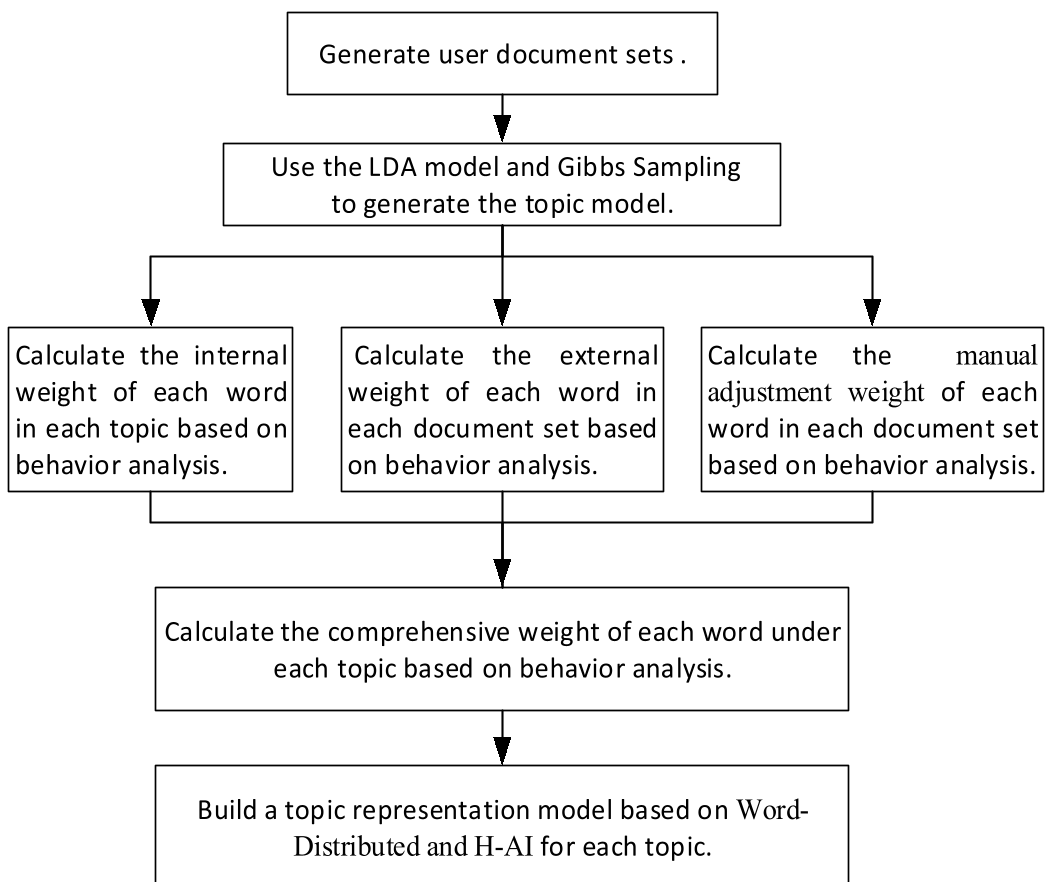 The WDS-LDA Workflow: Fusing LDA results with Distribution Sensitivity and Human Feedback.
The final representation is a weighted sum: Where serves as the balancing factor between raw statistics and distribution sensitivity.
Experiments & Results: The Power of Human-in-the-Loop
The model was stress-tested using Sina Weibo datasets. Two critical findings emerged:
1. The Sweet Spot of Human Intervention
As shown in the ablation study, performance markers (Precision, Recall, F-value) rise steadily as the number of manual adjustments increases. The trend stabilizes around 140 adjustments, suggesting that even a modest amount of human labor can dramatically "steer" the model toward accuracy.
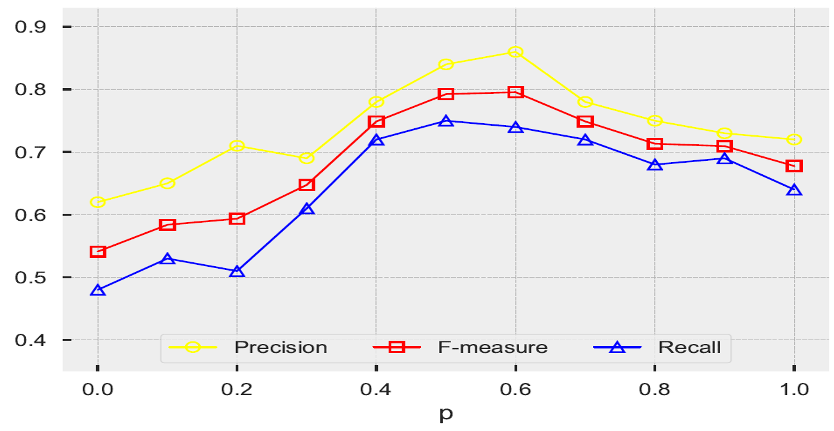 Fig 3 & 4: Showing the performance peak at p=0.6 and the saturation point of human feedback.
2. SOTA Comparison
WDS-LDA consistently outperformed both the Vector Space Model (VSM) and standard LDA. While VSM only considers frequency and LDA focuses on latent semantics, WDS-LDA adds the crucial layer of discriminative distribution.
Critical Analysis & Conclusion
Takeaway
WDS-LDA proves that topic representation is an "Advanced Cognitive Function" that machines cannot yet solve in isolation. By mathematically encoding human "common sense," we can create much cleaner, more distinct topics suitable for sensitive tasks like public opinion control.
Limitations
- Computational Cost: Calculating these weights increases processing time compared to vanilla LDA.
- Human Dependency: The model requires active manual intervention to reach peak performance, which may not scale in fully autonomous real-time systems without a dedicated moderation team.
Future Outlook
The authors suggest that the next frontier is integrating social attributes—likes, forwards, and user relationships—to further refine the weight of a word based on the influence of the user who posted it.