
TSIM: Leveraging Hypergraph Learning to Uncover Topical Influencers in Social Media
17122_Topic-Sensitive Influencer Mining in Interest-Based Social Media Networks via Hypergraph Learning.
The paper introduces Topic-Sensitive Influencer Mining (TSIM), a comprehensive framework designed to identify topical influential users and images in interest-based social networks like Flickr. It leverages a hypergraph learning approach to model complex, multi-modal relationships between users and content, achieving SOTA performance in influencer identification and social recommendation tasks.
In the modern digital landscape, influence is rarely "generic." A user might be a powerhouse in "Landscape Photography" but completely irrelevant in "Street Fashion." Traditional social network analysis often fails to capture this granularity. This paper, authored by a team of IEEE Fellows, introduces TSIM (Topic-Sensitive Influencer Mining), a framework that moves beyond simple follower counts to uncover who actually drives topical engagement.
TL;DR
The TSIM framework uses hypergraph learning to unite visual content, textual tags, and social link information (comments/favorites). By modeling these as high-order relations, it identifies influential users and images with surgical precision. Testing on Flickr data, the authors proved that their method significantly boosts the accuracy of friend suggestions and photo recommendations.
The Core Problem: Why Direct Social Links Aren't Enough
Most prior work treats social networks as simple graphs where Nodes = Users and Edges = Follower/Following. However, social media is multimodal and heterogeneous.
- Textual Sparsity: Tags on photos are often noisy or missing.
- Pairwise Limitations: Simple edges can't represent the complex relationship where multiple users interact with a specific set of images belonging to one photographer.
- Topic Blindness: Generic popularity (like total views) doesn't help in niche recommendation.
Methodology: The Power of the Hypergraph
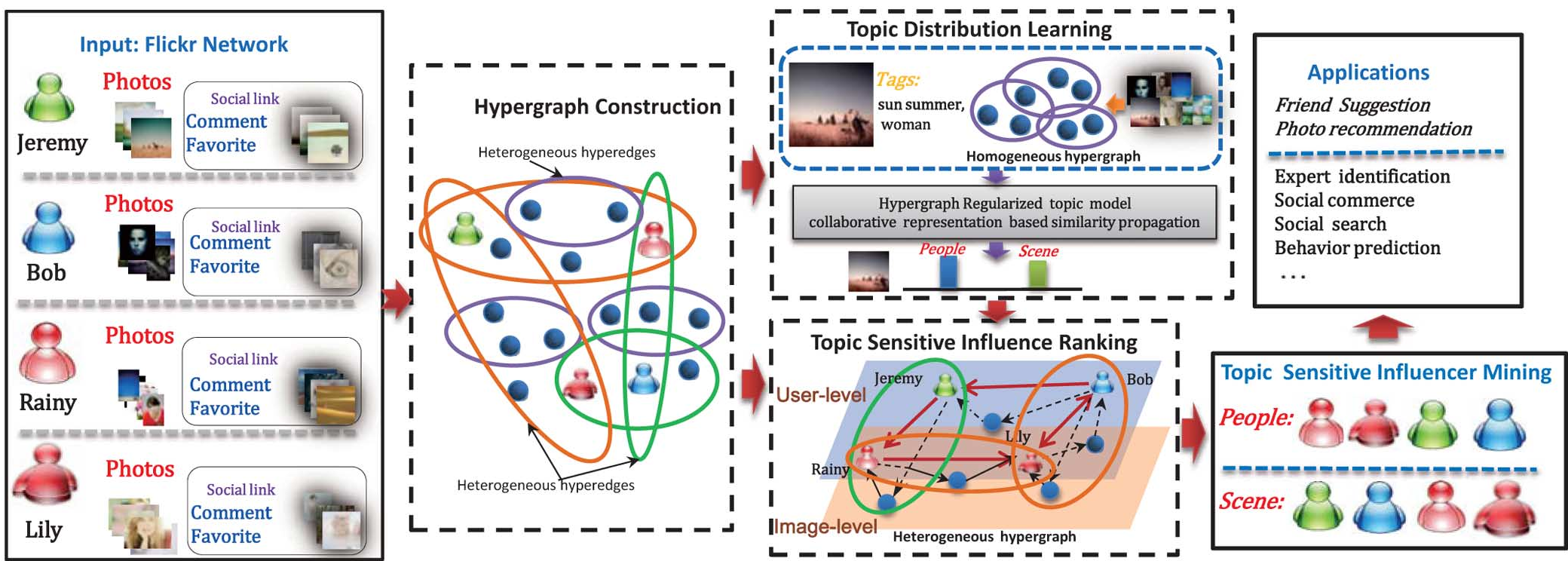
The authors argue that a hypergraph is the natural mathematical structure for social media. In a hypergraph, an "edge" (called a hyperedge) can connect any number of vertices simultaneously.
1. Hypergraph Construction
The paper defines two types of hyperedges:
- Homogeneous Edges: Connect images based on visual similarity (using GIST, LBP, and color moments) and shared tags.
- Heterogeneous Edges: Connect users to images they have "favorited" or "commented" on, effectively capturing the flow of influence.
2. HRTM: Topic Distribution Learning
To solve the "noisy tag" problem, the authors propose the Hypergraph Regularized Topic Model (HRTM). Unlike standard LDA or PLSI, HRTM enforces a "smoothness" constraint: if two images are visually similar according to the hypergraph, their topic distributions should be similar. This "manifold logic" allows the model to correctly identify topics even when tags are sparse.
3. Influence Ranking via Affinity Propagation
Once topics are known, the system passes "influence messages" across the network. Using a modified Affinity Propagation algorithm, user nodes negotiate their influence:
- Responsibility: "How much do I think I influence you on this topic?"
- Availability: "How much do I agree that you influence me?"
Experiments & Results
The researchers conducted extensive evaluations using a real-world Flickr dataset (50K images, 70K social links).
Topic Learning Performance
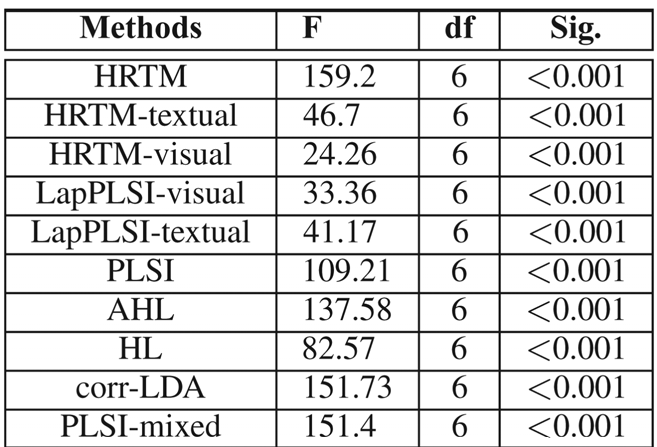
HRTM consistently outperformed standard baselines (PLSI, Corr-LDA). The visual-textual fusion was key—using visual similarity to regularize textual topics reduced the impact of user-generated noise.
Real-World Application: Recommendations
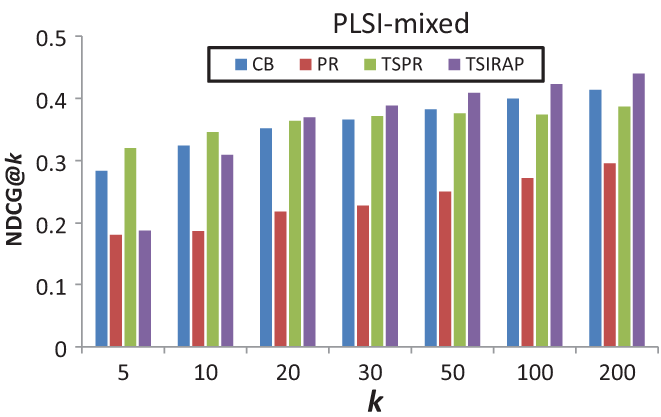
The true test for TSIM was its ability to fuel recommendation engines. In Friend Suggestion, TSIM achieved a MAP@50 of 0.2186, significantly higher than the standard PageRank (0.0921) or Content-Based (0.1888) approaches. This proves that understanding topical influence is vital for identifying who a user might want to follow.
Critical Insight & Conclusion
The genius of TSIM lies in its realization that in "interest-based" networks, content is the bridge for influence. By using hypergraphs to model the synergy between what we post (visual content) and how we react (social links), the authors have created a state-of-the-art method for mapping the "Expertise Economy."
Limitations: The model is computationally intensive compared to simple PageRank, and the topic mining depends heavily on the quality of initial "informative" seed images. Future iterations may benefit from integrating deep visual features (like CNN/ViT embeddings) into the hypergraph construction.