
Beyond Modularity: Measuring Why Twitter Communities Actually Talk
Measures for topical cohesion of user communities on Twier
This paper introduces a novel framework to evaluate the topical cohesion of user communities on Twitter. It proposes a model that integrates social interaction types (retweets, replies, mentions) with Latent Semantic Analysis (LSA) and defines three new metrics— (Expertise), (Representativeness), and —to measure how semantically consistent "graph-detected" communities actually are.
TL;DR
Just because users interact doesn't mean they share a common goal. This paper challenges the status quo of community detection by introducing Topical Cohesion Measures. By combining graph theory with Natural Language Processing (NLP), the authors provide a toolkit () to evaluate whether a detected cluster of users is a genuine interest group or just a structural coincidence.
Background: The Meaning Gap in Social Graphs
In the world of Online Social Networks (OSN), we’ve become very good at finding "clusters" using math. Algorithms like Louvain or Infomap can partition millions of users into groups based on who retweets whom. However, a glaring problem remains: semantic emptiness. A community detected via graph topology often lacks a unified voice or topic.
The authors argue that a true community must satisfy two conditions:
- Strong Social Ties: Frequent interactions (Retweets, Replies, Mentions).
- Common Interest: A shared topical focus.
Methodology: The Synthesis of Graph and Text
The paper proposes a three-step workflow to bridge the gap between structure and meaning.
1. Constructing the Interaction Graph
Instead of using the "follow" graph (which is often stale), the authors use active interactions. They define a weighted edge as a blend of Retweets (), Replies (), and Mentions (): This ensures the graph reflects current engagement, not just past curiosity.
2. Topic Extraction via LSA
Using Latent Semantic Analysis (LSA) on a corpus of 8.6 million tweets, the authors project every tweet into a 200-dimensional topic space. Each user is then assigned a "Dominant Topic" based on their most frequent message category.
3. Measuring Cohesion
The core innovation lies in the three new metrics:
- Expertise (): What percentage of users in group share the group's main topic? (Internal Cohesion).
- Representativeness (): What percentage of all users interested in Topic are actually in this group? (Topic Dominance).
- : A "Topical Specificity" score. Like TF-IDF, it highlights topics that are frequent in one group but rare in the rest of the network.
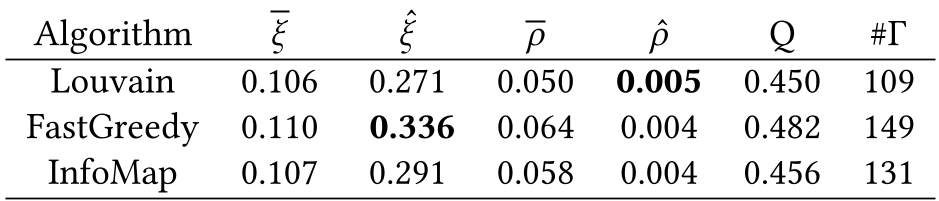 The study compared Louvain, FastGreedy, and InfoMap, finding Louvain to be the most efficient for large-scale interaction data.
Key Insights from the Data
The authors tested their metrics on a massive dataset centered around the 2016 US Election. The results were sobering for traditional analysts:
- The "Large Group" Fallacy: Massive communities (some with 90k+ users) exhibited very low Expertise (). They are catch-all buckets rather than specialized interest groups.
- Reply Diversity: The Reply Graph () showed the lowest cohesion. This suggests that "replying" is often an act of cross-topic engagement (or debate) rather than internal community reinforcement.
- Topical Specificity: The score successfully identified "niche" groups—those that aren't the biggest, but are the most devoted to a single, specific issue.
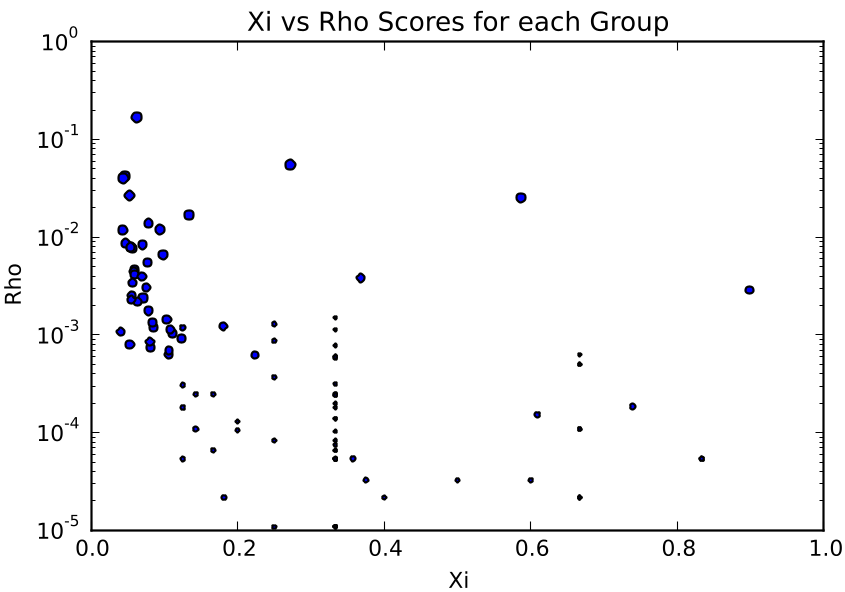 Analysis shows that as group size increases, topical expertise () tends to drop, while representativeness () increases—a classic trade-off between scale and focus.
Critical Analysis & Future Work
The strength of this work is its Inductive Bias: it assumes that communities should be topically coherent. This is a vital shift for business intelligence and brand monitoring.
However, the study has limitations:
- Mono-thematic Assumption: It assumes each user/group has only one main topic. In reality, a "political" community might also be a "sports" community.
- LSA vs. Modern Embeddings: While LSA was standard in 2017, today’s LLMs (like BERT or RoBERTa) would likely provide even more nuanced semantic clusters.
Conclusion
This paper provides a necessary reality check for social network analysis. By moving beyond modularity and introducing the approach, Gadek et al. have given us the tools to distinguish between a noisy crowd and a coherent community. For future researchers, the next step is clear: we must allow for multi-topical communities and overlapping interests.