
Evidence-Based Crowdsourcing: Why the Crowd Outperforms Specialists in Topic Relevance
Studying Topical Relevance with Evidence-based Crowdsourcing
This paper introduces an evidence-based crowdsourcing methodology for IR test collection creation, specifically targeting the TREC Common Core track. By employing a "CrowdTruth" disagreement-aware framework and optimizing document granularity, the authors developed a high-quality dataset of 23,554 topic-document pairs that achieves reliability comparable to or exceeding single expert assessors.
TL;DR
In the quest to evaluate Information Retrieval (IR) systems, the industry has long treated expert NIST assessors as the "Gold Standard." However, this study reveals that a well-structured crowd, using paragraph-level granularity and evidentiary highlighting, can produce more reliable and nuanced relevance rankings than single experts. By treating worker disagreement as a feature—not a bug—the authors created a massive test collection for the TREC Common Core track that captures the inherent ambiguity of human language.
The Subjectivity Crisis in IR Evaluation
For decades, the Text REtrieval Conference (TREC) has used "Gold Standard" annotations provided by NIST assessors. The problem? NIST typically uses only one or two assessors per topic. This creates a "single-point-of-failure" for subjectivity. If the assessor is having a bad day or interprets a vague query narrowly, the entire system evaluation is skewed.
The authors identified that the core difficulty isn't just "gathering more data," but solving ambiguity. Traditional majority-voting in crowdsourcing washes out the healthy disagreement that occurs when a document is somewhat relevant—which is exactly the data IR systems need to be robust.
Methodology: Breaking the Document, Saving the Insight
The researchers didn't just ask workers "Is this relevant?" They systematically dismantled the task through eight pilots to find the "sweet spot" of human cognition.
1. Granularity is King
One of the most profound insights is the shift from Full Document to Paragraph Level assessment. Crowd workers often struggle with "TL;DR" syndrome for long documents. By breaking documents into paragraphs, workers provided more focused judgments.
- Ordered vs. Random: Counter-intuitively, showing paragraphs in random order improved accuracy (see Figure 11 in the paper). Why? It prevents "contextual laziness" where a worker blindly labels paragraph B as relevant just because paragraph A was.
2. The Power of "Evidence" (H1.1)
The authors introduced a requirement for workers to highlight the specific text that justified their relevance choice. This "evidence-based" approach forced workers to engage deeply with the content, significantly boosting F1 scores compared to simple "Yes/No" tasks.
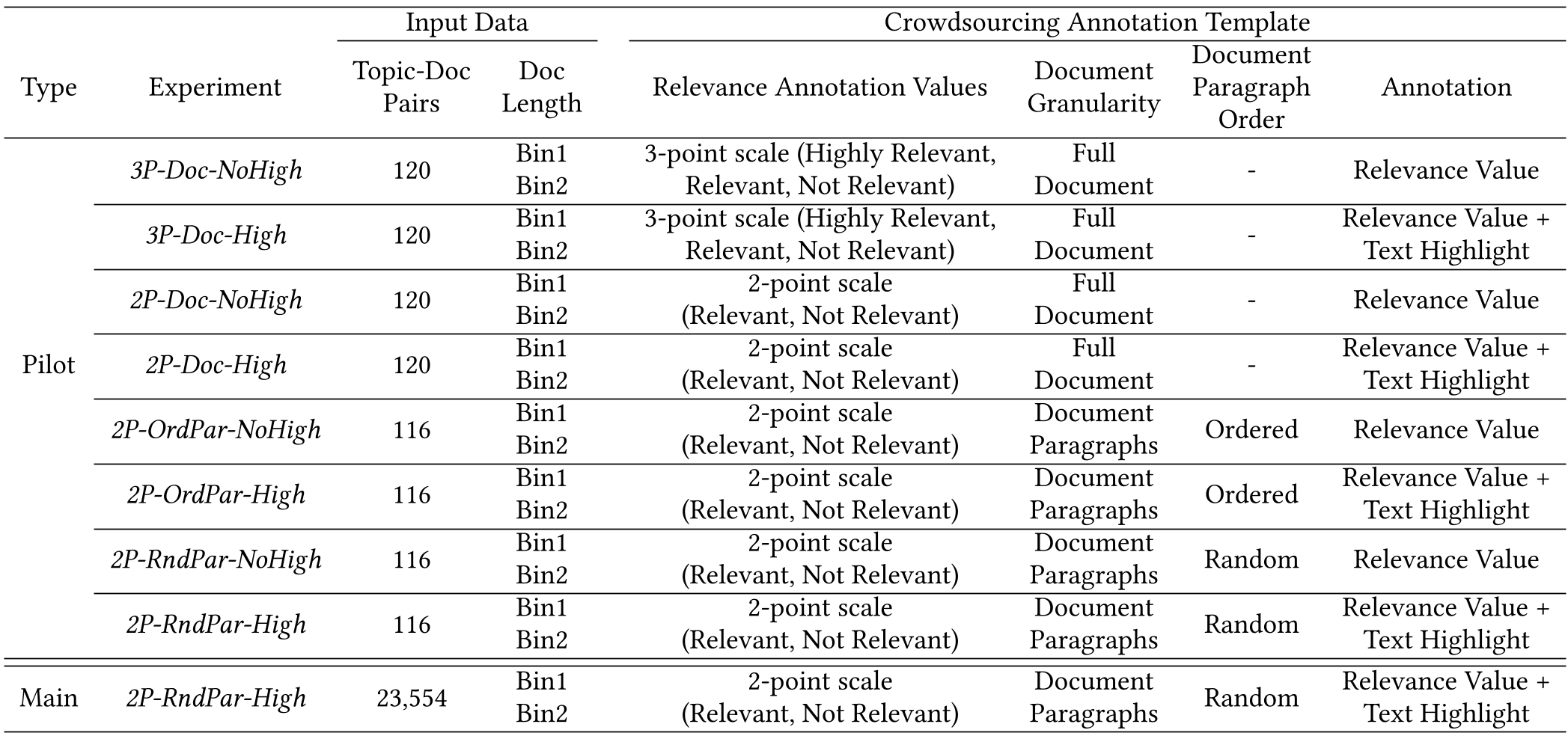 Table: Comparison of the various pilot configurations tested.
Results: Crowdsourcing the "Ground Truth"
Using the CrowdTruth framework, which uses vectors to represent worker assessments, the authors could calculate a "TDP-RelVal" score—effectively a ranking of how relevant a document is based on collective confidence.
Key Performance Findings:
- The Crowd vs. NIST: On binary relevance, the crowd achieved F1 scores up to 0.95, whereas NIST's internal consistency (when compared against high-level reviewers) hovered around 0.80.
- Scale Matters: While 5 workers are sufficient for binary tasks, ternary scales (Highly Relevant vs. Relevant vs. Not Relevant) require 7-8 workers to stabilize due to the increased subjective "noise" in the "Relevant" middle ground.
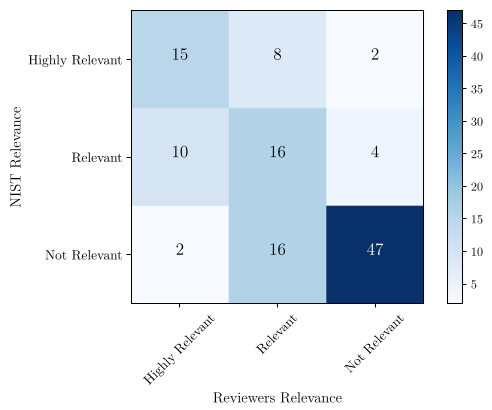 Figure: The diagonal shows agreement, but the off-diagonal cells highlight the massive gray area even professional NIST assessors face.
Critical Analysis: Why This Matters for AI
This work challenges the "Expert Worship" in data science. It suggests that for tasks involving human perception (like relevance, toxicity, or helpfulness in LLMs), aggregated diverse opinions are superior to single expert dictates.
Limitations: The study focused on short documents (under 1,000 words). Applying this to 50-page legal documents or scientific papers remains a challenge for the "paragraphization" strategy, as some relevance is holistic rather than local.
Conclusion
The transition from "voting" to "evidence-based disagreement modeling" represents a paradigm shift in dataset creation. By utilizing paragraph-level granularity and the 2P-RndPar-High template, researchers can now build IR test collections that are not only cheaper but more representative of real-world user perspectives.
Takeaway: If you want a reliable "Ground Truth," don't hire one expert; hire ten workers, randomize their input, and make them show their work.