
The Fragility of Giants: Using Topology to Identify Key Influencers in Scientific Networks
Topological analysis in scientific social networks to identify influential researchers
This paper presents a topological study of a Brazilian scientific social network to identify influential researchers using complex network analysis. By modeling co-authorship relationships among 169 Computer Science researchers, the authors utilize Closeness Centrality to pinpoint key individuals crucial for collaboration and information flow.
Executive Summary
TL;DR: This paper analyzes a scientific social network of Brazilian Computer Science researchers through the lens of complex network theory. It identifies that while academic networks are resilient to random changes, they are precariously dependent on a few "super-connectors." Removing these key individuals causes a dramatic breakdown in the flow of knowledge.
Academic Context: This work situates itself in the domain of Scientometrics and Network Science, moving beyond simple citation counts to analyze the structural topology that facilitates collaboration. It confirms that academic networks follow a Scale-Free power-law distribution, making them robust yet vulnerable to targeted loss of talent.
The Network Intuition: Why Focus on Topology?
In a research environment, collaboration is more than just a list of names on a paper; it is a communication channel. The authors argue that the loss of a researcher isn't just a loss of individual capacity—it can be a structural catastrophe.
If a "bridge" researcher leaves, two entire research groups might stop talking to each other. To solve this, the authors utilize the Closeness Centrality metric, which calculates how "near" a researcher is to all others in the network. A high closeness score implies that the individual can spread information with minimal "noise" or effort.
Methodology: Modeling the Brazilian CS Landscape
The study extracted data from the Lattes Platform (a comprehensive Brazilian researcher database) focusing on 169 researchers.
1. The Weight of Collaboration
Instead of treats all co-authorships as equal, the authors used a weighted distance formula: This captures the strength and frequency of collaboration. A smaller distance represents a more intense and reliable collaborative bond.
2. Network Visualization
The authors used graph databases (Neo4j) to visualize the structure. As seen in the architecture below, the network is not a uniform web but a collection of clusters connected by a few central nodes.
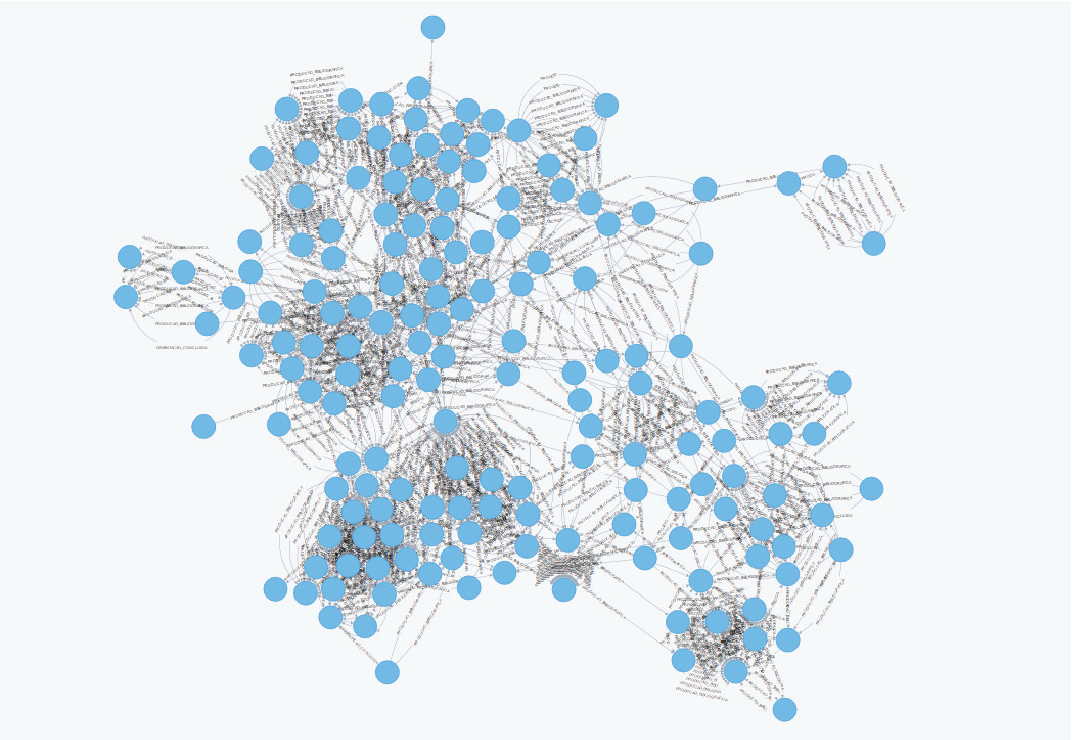 Fig 1. The modeled co-authorship network reveals high-density clusters and sparse bridging links.
Experimental Results: The Robustness Paradox
The core of the paper lies in its stress-testing of the network. The authors simulated two scenarios: Random Failure vs. Targeted Attack.
Resilience to Chance
When researchers were removed at random, the network barely flinched. The "average collaboration distance" remained stable. This is because most researchers are not central hubs; losing them is like losing a leaf from a tree—the branch survives.
Sensitivity to Influence
However, when the authors targeted the "hubs" (those with the highest Closeness Centrality), the story changed.
- The Breaking Point: By the 36th removal, the "Main Connected Component" shattered.
- Result: The network disconnected into isolated islands of researchers who could no longer "reach" each other through the co-authorship graph.
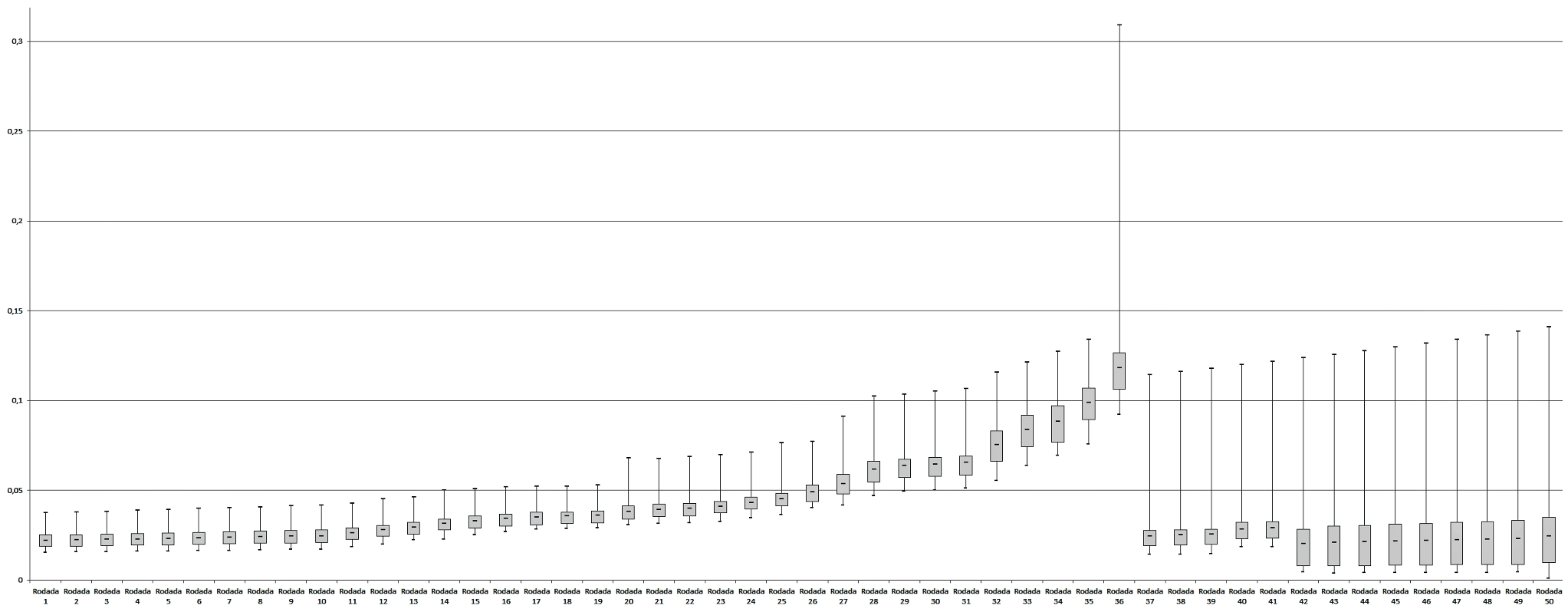 Fig 2. The boxplot shows the exponential increase in collaboration distance as central researchers are removed.
Key Insights & Future Directions
The Academic Takeaway: The "Scale-Free" nature of this network—defined by a few researchers having the vast majority of connections—means that institutional stability depends heavily on a small elite. If these individuals are lured away or retire, the collaborative output of the entire ecosystem is at risk.
Limitations:
- Sample Size: 169 researchers is a small subset; larger datasets like DBLP or arXiv are needed to validate if these patterns hold at a global scale.
- Metric Diversity: The study leans heavily on Closeness Centrality. Future work should integrate Betweenness Centrality (to find brokers) and PageRank (to find prestige).
Conclusion: This topological approach provides a roadmap for university administrators to identify "at-risk" collaboration pathways. To build a truly robust scientific community, we must move away from a "hub-and-spoke" model and encourage more cross-links between the periphery and the center.