
Deciphering the Digital Social Fabric: A Deep Dive into Cyworld, MySpace, and Orkut
Analysis of topological characteristics of huge online social networking services
This seminal paper presents a comparative topological analysis of three massive Online Social Networking Services (SNSs)—Cyworld, MySpace, and Orkut—covering over 10 million users each. Using complete data from Cyworld and snowball-sampled data from the others, the study uncovers unique scaling behaviors and evolutionary patterns that distinguish online relationships from traditional social networks.
TL;DR
In this foundational 2007 study, researchers from KAIST provided the first large-scale look at the "topological DNA" of massive online social networks. By analyzing millions of users, they discovered that online social structures are heterogeneous, exhibiting "multi-scaling" behaviors that flip traditional social network theories on their head. They proved that as these networks grow, our digital world actually gets smaller through a process called graph densification.
The Motivation: Are Online Friends "Real" Friends?
In the mid-2000s, SNS platforms were exploding. However, the academic community was flying blind. Most social network analysis was based on small, manual surveys or "indirect" networks like scientific co-authorship. The KAIST team asked a fundamental question: Does the topology of a network with 10 million users follow the same mathematical laws as a real-life village or a small interest group?
They identified a critical gap: sampling bias. Most researchers were using "snowball sampling" (following links like a crawler) without knowing if the resulting slice of data actually represented the whole. With exclusive access to the complete Cyworld database, they could finally peel back the curtain.
Methodology: The Power of Complete Data
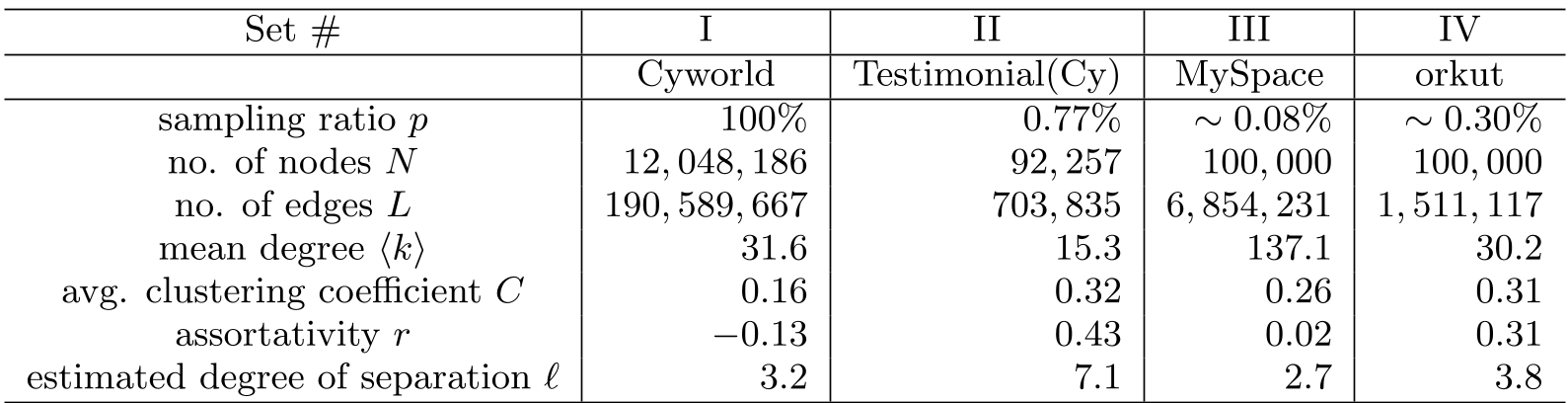
The researchers compared three giants: Cyworld (South Korea's dominant, private-centric platform), MySpace (music and pop-culture oriented), and Orkut (Google’s invitation-only community).
They utilized three distinct lenses:
- Degree Distribution: How many friends does a typical user have?
- Assortativity: Do "popular" people only hang out with other "popular" people?
- Evolutionary Snapshots: How do these metrics change over five years of growth?
Methodology The Core: The Discovery of Multi-Scaling
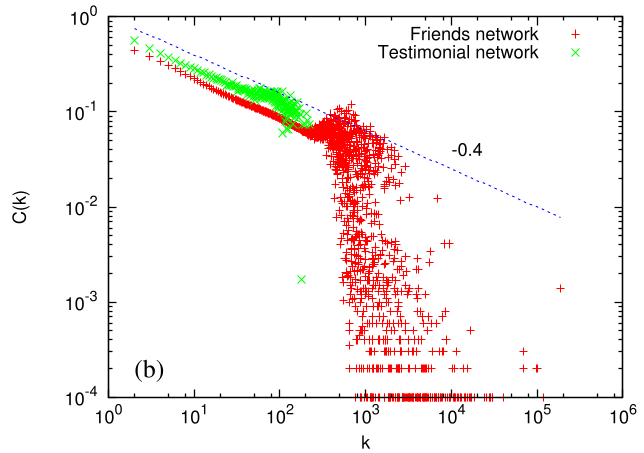
The most striking finding was the Multi-Scaling Behavior in degree distribution. While the World Wide Web usually follows a single power-law exponent, Cyworld’s data showed a "kink" in the graph.
Users with fewer than 100 friends followed a different mathematical rule than those with thousands. This "kink" occurs right around Dunbar’s Number (k≈150)—the theoretical limit of stable social relationships a human can maintain. This suggests that online networks are a hybrid of "real-life" social groups and "mass-media" style broadcast relationships.
Experiments & Results: Densification and Shrinking Worlds
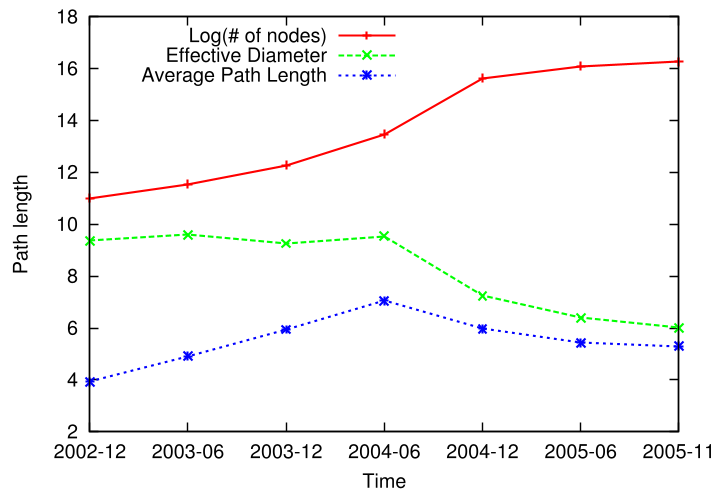
A common intuition is that as a network grows larger, the "distance" between any two people should increase. The authors found the opposite: The Small World is getting smaller.
By reconstructing historical snapshots, they observed Graph Densification. As the user base stabilized, the number of edges per node increased, and the "effective diameter" (the 90th-percentile of path lengths) actually shrank. In Cyworld, the average degree of separation was a mere 3.2—significantly lower than the famous "six degrees of separation" found in physical mail experiments.
Critical Analysis & Conclusion
The "Testimonial" Insight
The authors also analyzed a subset of data: Testimonials. Unlike a simple "friend link," a testimonial requires effort—writing a public note of appreciation. This sub-network showed positive assortativity (popular people connecting with popular people), which is a classic hallmark of "true" social networks, whereas the broad friendship network was neutral or negative. This implies that online platforms contain multiple layers of "intimacy" that simple graphs fail to capture.
Limitations & Future Outlook
While groundbreaking, the study's sampling of MySpace and Orkut was relatively small (100k nodes) compared to the 12M of Cyworld. Furthermore, the 2007 context didn't account for the rise of "asymmetric" networks like Twitter (Follower/Following models), which shifted the dynamics from "mutual friendship" to "information dissemination."
Summary Takeaway: This paper proved that online social networks are complex, multi-layered organisms. They don't just mimic real-life; they extend it, creating a "hyper-connected" reality where the distance between individuals continually collapses as the network matures.