
Beyond the Snapshot: Predicting Social Links via Topological Evolution
4226_A Topological Data Evolution Based Method to Predict Links in Social Networks.
The paper proposes a novel unsupervised link prediction method based on Topological Data Evolution. By capturing the historical state of the network at the exact moments new edges were formed and applying K-means clustering to these evolutionary patterns, the method achieves significant improvements over traditional static topological metrics across ten real-world coauthorship networks.
TL;DR
Most link prediction algorithms look at a social network as it is "now." This paper argues we should look at how it "grew." By reconstructing the network's state at every historical point an edge was added, the authors build a predictive model based on the evolutionary patterns of the graph. Their method consistently outperforms classical static benchmarks, particularly when provided with long-term historical data.
The Problem: The "Static" Blind Spot
In social network analysis, link prediction is the art of guessing who will connect next. Traditionally, researchers use an unsupervised approach: they take the current state of a graph, calculate similarity scores (like Adamic-Adar or Preferential Attachment), and rank the pairs.
The Motivation: The authors identify a fundamental flaw: the network state we see today is the result of many connections that formed under very different structural conditions. If Author A and Author B connected in 2013 because they had one common neighbor, but today they have five, a static model only sees the five. This ignores the "entry threshold"—the actual structural catalyst that caused the link in the first place.
Methodology: Capturing the "Moment of Creation"
The proposed method, referred to as H, deviates from the standard workflow by inserting an evolutionary recovery step.
1. Historical Reconstruction
For every existing edge in the training set, the algorithm "rewinds" the graph to the moment just before that edge appeared. It then calculates a suite of topological metrics for that pair based only on the graph as it existed at time .
2. Pattern Discovery through Clustering
Instead of using these scores directly to rank new pairs, the method creates a multi-dimensional dataset of these "creation-moment" scores. It applies K-means clustering to identify common environments where links tend to form.
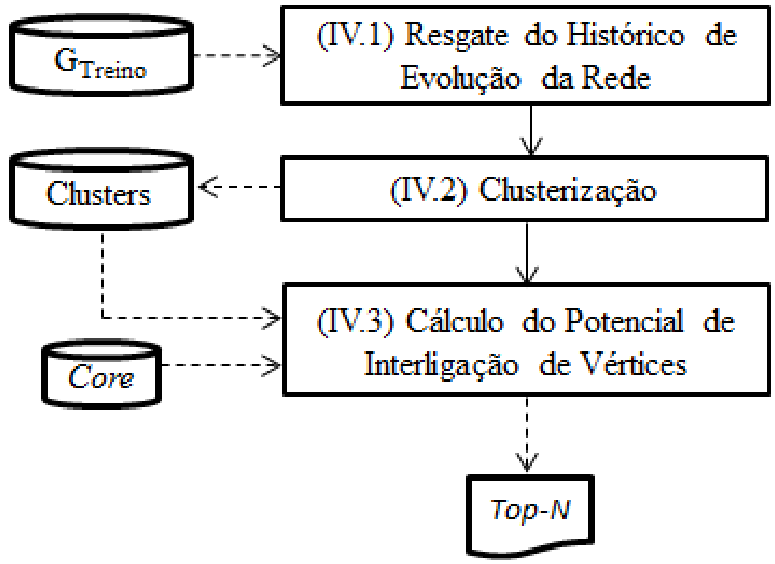 Figure: The detailed workflow of the proposed Method H, highlighting the historical recovery and clustering stages.
3. Density-Based Scoring
To predict new links, the method takes a non-connected pair, identifies which historical "cluster" it falls into, and assigns a score based on the cluster's density. The intuition is simple: if a pair looks like a group of historical pairs that successfully connected, it gets a high score.
Experiments & Results: History Matters
The authors tested their hypothesis on five coauthorship datasets from arXiv (Astro-ph, Cond-mat, etc.). They compared their method (H) against a classic static combination of metrics (C) and a random predictor (PR).
Key Findings:
- Consistent Superiority: Method H outperformed the classic approach in 21 out of 25 scenarios.
- The Power of Time: As the training window increased (providing more historical evolution data), Method H's performance advantage became even more pronounced, winning 100% of the tests in the longest training scenarios.
- Statistical Significance: Using the Wilcoxon Signed Ranks test, the authors confirmed that the improvement wasn't just luck—the historical data provides a signal that static snapshots simply cannot capture.
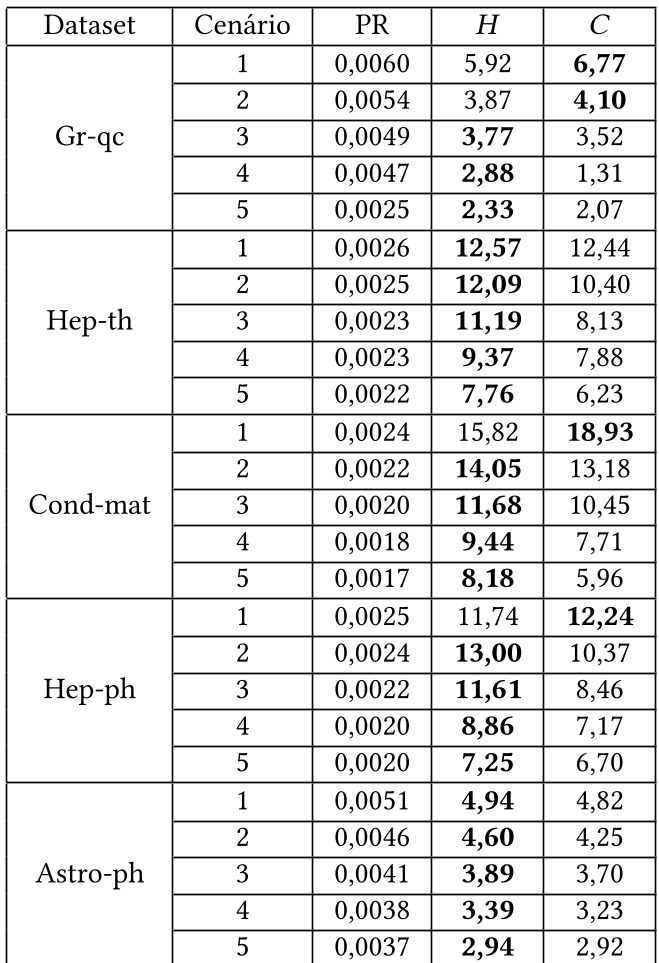 Table: Comparison of the Factor of Improvement (IMP) over the random predictor across different arXiv datasets.
Critical Insight & Conclusion
This work confirms a powerful heuristic: to predict the future of a network, you must model the specific conditions of its past growth. While the computational complexity is higher ( due to historical reconstruction), the gains in accuracy are significant for high-stakes recommendation systems.
Limitations: The study currently relies on K-means, which assumes spherical clusters. Future iterations using density-based clustering (like DBSCAN) or supervised learning on top of these evolutionary features could further push the SOTA.
Takeaway for Practitioners: If you are building a recommendation engine, don't just feed your model the current graph. Feed it the trajectory of how your users connected. The "why" is buried in the history.