
The Social Brain: Why Your Cortex Looks Like a Friendship Circle
Topological relationships between brain and social networks
This study utilizes graph-theoretical "network motif" analysis to demonstrate significant topological similarities between mammalian cortical networks and social friendship networks. By comparing significance profiles (SPs) of subgraphs, it identifies that both systems are characterized by an overrepresentation of cliques and balanced reciprocal connections, outperforming several other network types.
TL;DR
Is the human brain a unique biological masterpiece, or does it follow the same organizational rules as a high school clique? A landmark study by Sakata and Yamamori suggests the latter. By applying Network Motif Analysis, researchers discovered that the wiring of mammalian brains is topologically almost identical to social "friendship" networks, driven by a shared evolutionary preference for balanced reciprocity.
Problem: The Search for Universal Design Rules
In the realm of complex systems, "everything is connected," but not everything is connected the same way. For decades, neuroscientists viewed cortical networks as a separate category of complexity. While global features like "Small-World" properties (short paths and high clustering) were common, they didn't explain the specific local logic of the brain. The fundamental question remained: Is the brain's architecture a result of unique biological constraints, or is it a specific instance of a broader class of communication networks?
Methodology: The "DNA" of Networks
The researchers used Significance Profiles (SPs) to look at triads—small subgraphs of three nodes. By comparing the frequency of these triads in real networks against randomized versions that preserve basic stats (like degree distribution), they could isolate which "motifs" were overrepresented.
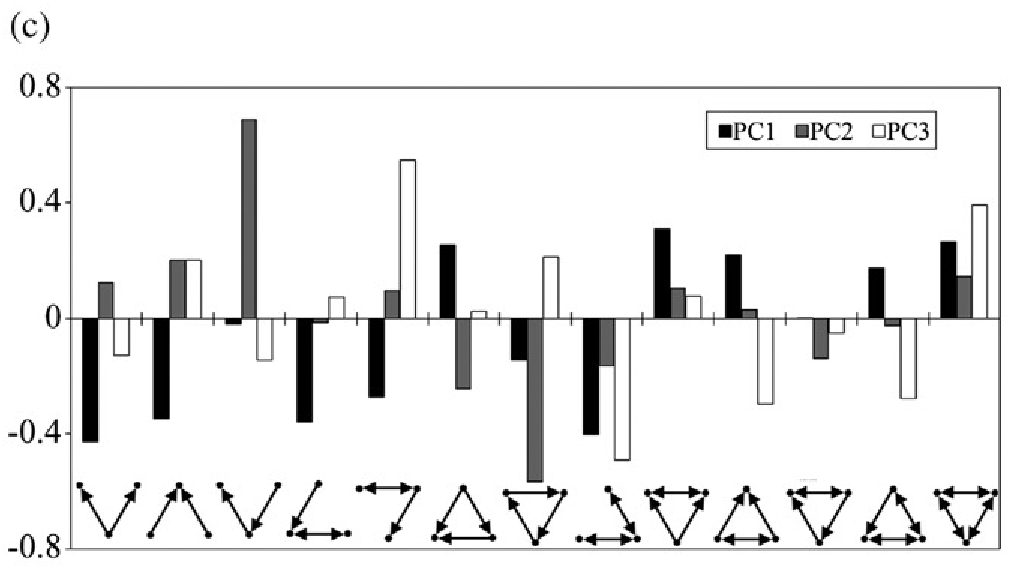 Figure: PCA showing brain networks (Brain macaque, cat, rat) clustering with friendship networks (Social +), separate from disliking networks and electronic circuits.
The study utilized:
- PCA and Hierarchical Clustering: To map the "topological distance" between brains, social groups, and man-made circuits.
- Weighted Dyad Analysis: Moving beyond "on/off" connections to look at the strength (weight) of bidirectional ties.
Key Insights: Friendships vs. Disliking
The study’s most striking finding is that social networks are not monolithic; their topology depends entirely on the emotional valence of the relationship:
- Friendship Networks: Rich in cliques (where everyone knows everyone) and balanced mutual ties.
- Disliking Networks: Characterized by "V-shapes" and "loops," lacking the dense reciprocal clusters found in friendships.
Surprisingly, brain networks are "friendship" networks. They prioritize the same motifs—specifically balanced mutual connections. Using an "imbalance index," the authors showed that if Area A connects strongly to Area B, Area B is highly likely to connect back to Area A with similar strength.
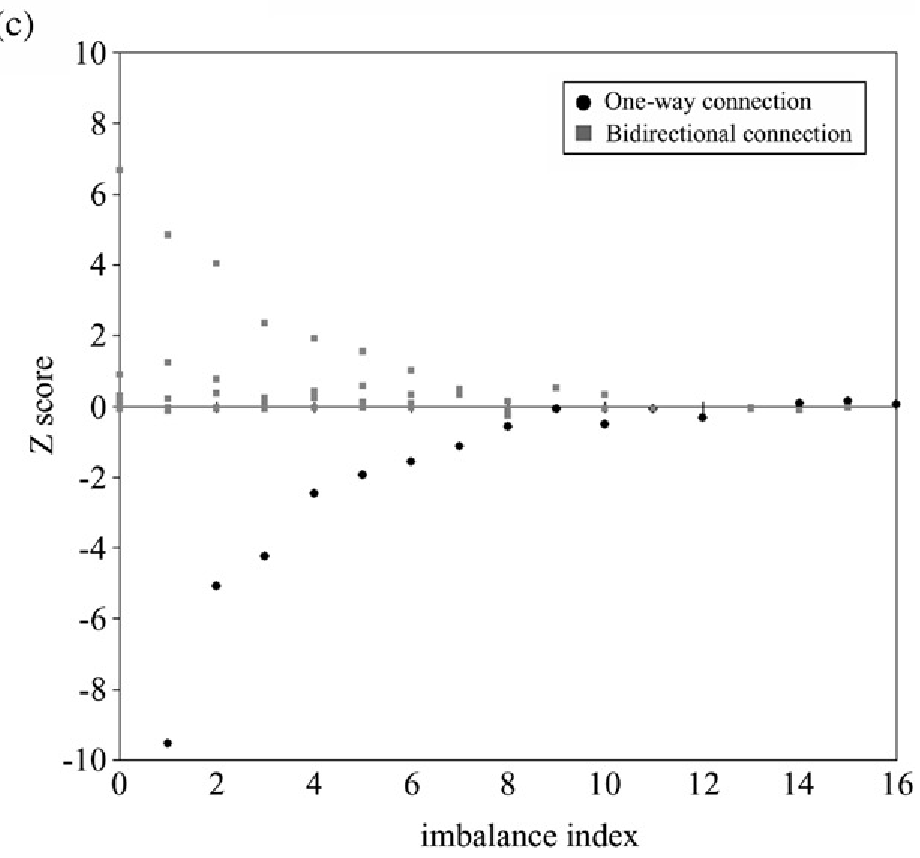 Figure: Analysis of weighted dyads demonstrates that balanced connections (low imbalance index) are overrepresented, while imbalanced ones are suppressed.
Experiments and Results: The Power of Local Selection
- Superfamily Classification: The PCA (Principal Component Analysis) accounted for 86.7% of the variance, firmly placing mammalian brains and social friendship networks in the same cluster.
- Robustness: Through a "neighbor selection" experiment, they proved that only 30-40 nodes are needed to identify these local design principles, suggesting that these motifs are robust building blocks of the entire system.
- SOTA Achievement: Unlike prior bipartite or electronic models, the brain-social model explains why higher-order cliques (fully connected groups of 4 to 9 nodes) are so abundant in biological intelligence.
Deep Insight & Conclusion
Why does this similarity exist? The authors argue that both brains and friendship circles are interactive communication systems. To achieve functional flexibility and effective information processing, these networks utilize Reciprocity as their primary inductive bias.
Takeaways
- Positive Selection: Evolution likely selects for balanced mutuality to maintain stability in communication.
- Social Intuition in Biology: The same "attractant" forces that lead people to form tight-knit friend groups might have biological parallels in axonal growth markers (attractants/repellents).
Limitations & Future Work
While the topological matches are compelling, the assortative coefficients (the tendency of nodes to connect to similar nodes) differ between the two. Future research on larger-scale "whole-brain" connectomes is required to see if these friendship-like motifs hold true as we scale from local circuits to the entire nervous system.