
Topological Tree Clustering: Beyond the Ranked List in Social Discovery
Topological Tree Clustering of Social Network Search Results
This paper introduces the Topological Tree method for clustering social network search results. It transforms linear ranked lists into a hierarchical, 1D-Self Organizing Map (SOM) structure that preserves both parent-child relationships and topological similarity between neighboring topics.
TL;DR
Search results in social networks are usually stuck in the "ranked list" era—a format that forces users to dig through pages of noise. This paper presents the Topological Tree, a method that uses neural network-inspired self-organization to cluster search results into a visual hierarchy. Unlike standard folders, these "trees" have topology, meaning topics that are conceptually similar are placed physically close to each other, creating a natural flow for information discovery.
The Problem: The "Page 3" Graveyard
In social networking (e.g., LinkedIn, MySpace), finding groups or partners is hindered by three major bottlenecks:
- Keyword Fatigue: Users rarely look past the first few pages of search results.
- Stale Directories: Human-curated taxonomies cannot keep pace with the explosive growth of web content.
- Metadata Dependence: Search effectiveness is capped by how well users tag their own profiles.
Existing visual alternatives like Graph representations (nodes and edges) often become "hairballs" that don't scale, while basic clustering just produces a messy "Other" category.
Methodology: Neural Networks that Grow Like Trees
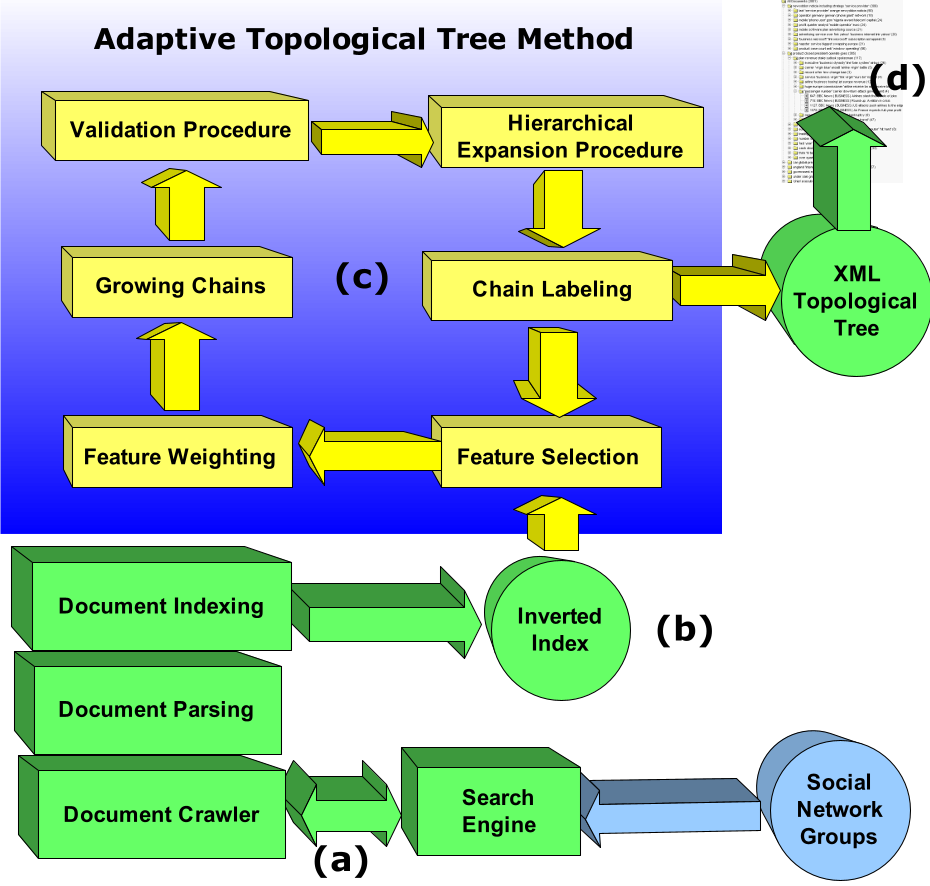
The core innovation is the Growing Chain (GC) algorithm. It functions as a one-dimensional Self-Organizing Map (SOM) that can spawn children.
1. The Growing Process
Rather than forcing documents into a fixed grid, the algorithm starts with a small number of nodes and adds new ones where the "error" (entropy) is highest. This ensures the complexity of the tree matches the complexity of the data.
2. Mathematics of Similarity
The system identifies the Best Matching Unit (BMU) for every search result using the dot product of document vectors: It then updates the neighborhood, ensuring that similar nodes "huddle together."
3. Structural Validation
To prevent the tree from becoming unwieldy, the author uses a validation criterion to penalize unnecessary complexity:
Experiments: Sorting the MySpace "Developer" Chaos
The author tested the system against a live MySpace search for "developer." While the standard UI gave a flat list of 1,000+ groups, the Topological Tree organized them into thematic clusters.
Key Visual Insight: In a standard tree, categories feel random. In a Topological Tree, the "Top-Down" flow makes sense. One branch might flow from Software Development to Web Design to Graphic Arts, reflecting the intrinsic overlap in those professional communities.

Critical Analysis & Conclusion
The Topological Tree is a sophisticated solution to a "Search UI" problem. Its strength lies in its inductive bias: the assumption that information is easier to consume when hierarchical structure is paired with thematic proximity.
Limitations:
- Preprocessing Overhead: High-dimensional vectorization and iterative SOM training are computationally heavier than simple ranking.
- Labeling: The quality of the tree depends heavily on the automated labeling algorithm; poor labels can make even a perfectly clustered tree confusing.
Takeaway for the Future: As we move into an era dominated by unstructured data and LLMs, the need for structured visualization of search results is returning. The Topological Tree provides a blueprint for how neural networks can not only find information but also organize it into human-navigable knowledge maps.