
Generative Cooling: Topology Optimization Redefines Thermal Management for Large-Scale LIBs
Topology optimization method to devise liquid-cooling plate for managing thermal field of a large-sized lithium-ion battery
This study develops a multi-objective topology optimization (MOTO) method to design liquid-cooling plates (LCP) for large-sized 106 Ah lithium-ion batteries. The optimized channel designs, TP_1 and TP_2, outperform bionic leaf-like and butterfly-like structures in both thermal regulation and hydraulic efficiency, specifically achieving up to a 38.81% reduction in power consumption and a 17.87% lower temperature rise compared to bionic benchmarks.
TL;DR
As the demand for high-capacity Energy Storage Systems (ESS) surges, managing the thermal field of 100Ah+ lithium-ion batteries has become a critical safety bottleneck. This paper introduces a Multi-Objective Topology Optimization (MOTO) framework that moves beyond traditional "human-intuitive" channel designs. By mathematically balancing heat dissipation and flow resistance, the authors developed streamlined liquid-cooling plates that slash pumping power by nearly 39% while providing significantly better temperature regulation than bionic or traditional structures.
The "Intuition" Trap in Cooling Design
For years, engineers have looked to nature for inspiration—leaf veins and butterfly wings are popular bionic templates because they evolved for efficient fluid transport. However, lithium-ion batteries present a unique challenge: localized heat generation at the tabs and anisotropic thermal conductivity.
The authors argue that prior works focusing on small cells (<50 Ah) fail to address the thermal gradients of massive 106 Ah prismatic cells. Even "bio-inspired" designs often lead to vortex formation at fixed-angle junctions, which increases flow resistance and creates "dead zones" in heat transfer.
Methodology: The Math of Porous Media
The core of this work lies in treating the design domain as a porous medium where each element has a "pseudo-density" ().
- : Solid domain (no flow).
- : Fluid domain (channel).
By solving a modified Navier-Stokes equation integrated with an energy conservation model, the optimization algorithm (SNOPT) "grows" channels where they are most needed. The objective function is a weighted sum: Where maximizes heat extraction and minimizes pressure drop.
 Figure 1: Evolution of channel density based on weighting factors. Denser networks (higher ) prioritize thermal performance at the cost of higher friction.
Vertical vs. Horizontal: Why Direction Matters
A standout insight of this research is the comparison between flow directions. In large cells, the battery tabs (Al-alloy) generate significant Ohmic heat.
- Horizontal Flow (TP_1): The standard "left-to-right" approach.
- Vertical Flow (TP_2): Placing the inlet near the tabs.
The vertical configuration proved superior. By introducing fresh coolant directly at the hottest area (the tabs) and leveraging gravity/shorter vertical paths, TP_2 achieved a 267% improvement in the comprehensive performance factor () over the butterfly-like bionic plate.
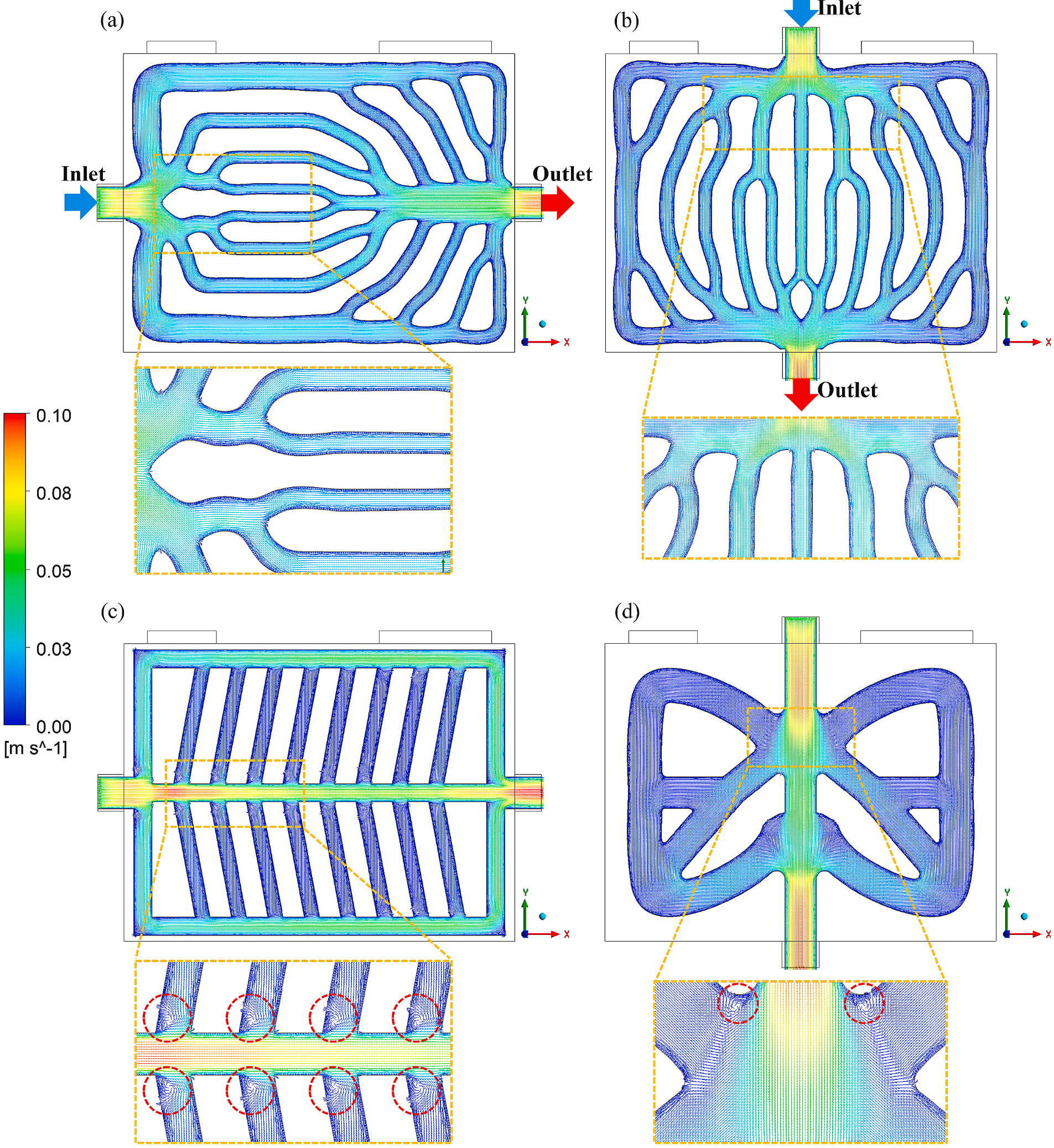 Figure 2: Velocity vectors showing streamlined flow in TO-based designs vs. vortex formation in bionic channels.
Experimental Proof and SOTA Benchmarking
To prove the theory, the authors 3D-printed four plates using AlSi10Mg and tested them on a 106 Ah LFP battery rig. The results were striking:
- Cooling Power: TP_1 reduced temperature rise by 17.87% compared to bionic designs.
- Energy Efficiency: At 1.5C discharge, the power required to pump coolant was 38.21% lower for the TO-plate than the leaf-vein design.
- Uniformity: While bionic designs (BL) showed slightly better temperature standard deviation (), the TO designs were vastly superior at preventing the battery from hitting the critical 40 °C threshold.
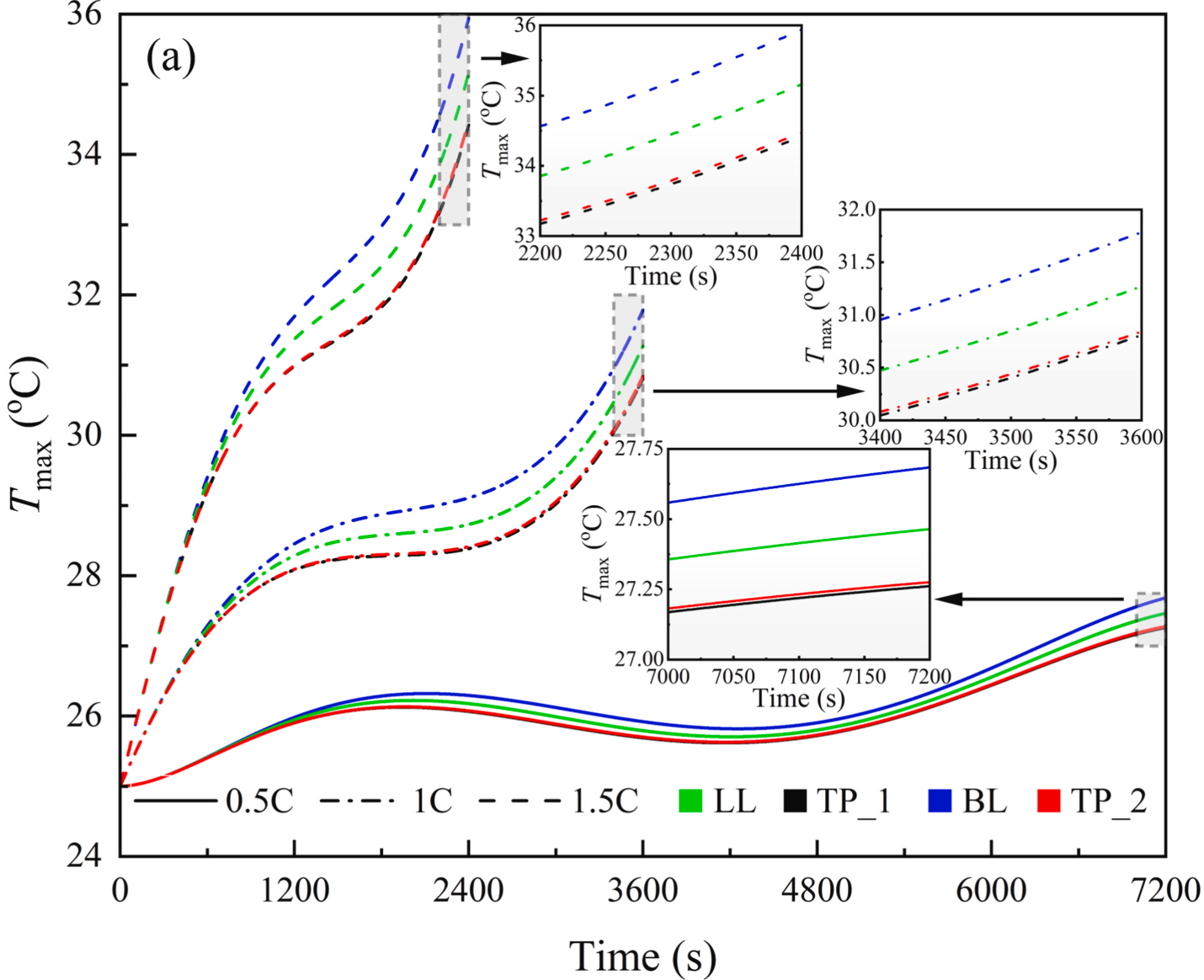 Figure 3: Key metrics (Tmax, Pressure Drop, and j/f factor) across different discharge rates.
The Academic Perspective: Why This Works
The success of these topology-optimized channels stems from their organic curvature. Unlike the sharp branching angles found in bionic or parallel designs, the TO algorithm produces "filleted" transitions that minimize flow separation. This follows Bernoulli’s principle more effectively, maintaining a uniform pressure gradient and ensuring that coolant velocity doesn't drop off prematurely at the end of a branch.
Conclusion & Future Outlook
This paper demonstrates that for the next generation of ESS, we must move away from "drawing" channels to "evolving" them. The TO approach provides a systematic way to handle the high heat flux of large-sized batteries.
Limitations: The study assumes constant thermophysical properties and does not fully explore extreme sub-zero pre-heating scenarios. Future work likely lies in "Double-Layer" topology optimization or the integration of micro-fin structures within these optimized paths to further break the laminar boundary layer.
Final Takeaway: In the battle for battery longevity and safety, the geometry of the flow path is a primary weapon, and mathematics is a better architect than human intuition.