
TopRec: Precision Recommendations via Expert-Guided Community Mining
TopRec: Domain-Specific Recommendation through Community Topic Mining in Social Network
TopRec is a novel domain-specific recommendation framework that utilizes community topic mining to address data sparsity and user heterogeneity. It combines a semi-supervised probabilistic topic model (based on PLSA) with Domain-Specific Collaborative Filtering (using Probabilistic Matrix Factorization) to deliver superior Top-N recommendations.
TL;DR
TopRec is a two-stage recommendation framework that first identifies which "domain communities" a user belongs to using social links and expert priors, and then performs localized Collaborative Filtering within those domains. By breaking the global user-item matrix into interpretable, topic-aligned subgroups, it overcomes the "one-size-fits-all" limitation of traditional CF and handles sparse data with 40%+ better precision.
The "Heterogeneous Taste" Problem
Most recommendation engines operate on a fundamental assumption: if two users liked the same book, they will like the same electronics. The authors of TopRec argue this is a fallacy. In real-world platforms like Epinions or Ciao, user interests are multi-faceted and domain-specific.
The two primary challenges the authors identify are:
- Domain Heterogeneity: User similarity in one category (e.g., "Software") does not imply similarity in another (e.g., "Music").
- The Sparsity Trap: In massive catalogs, most items have zero or few ratings, making global similarity calculations mathematically unstable and inaccurate.
Methodology: Community Topic Mining (The "How")
TopRec solves this by treating recommendation as a multi-stage routing problem.
1. Semi-Supervised Topic Modeling
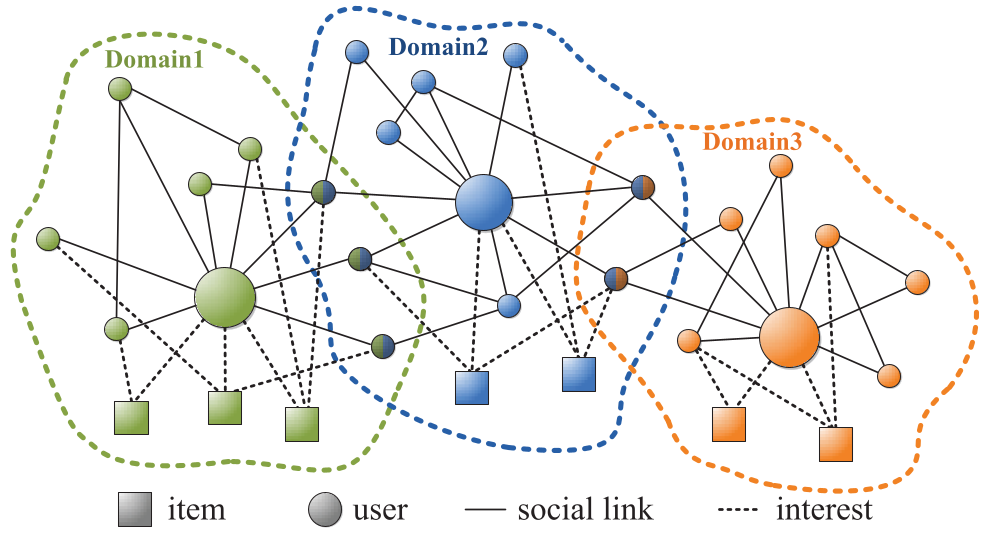
Instead of using a pure unsupervised approach like standard LDA or PLSA—which often results in "latent" topics that have no human meaning—TopRec introduces Expert Guidance. They select "Informative" and "Reliable" users as anchors for specific categories. These experts' rating distributions act as a Dirichlet prior, forcing the model to align its discovered communities with actual product domains (e.g., "Sports," "Electronics").
2. Social-Graph Regularization
The model assumes connectivity coherency: users connected in a social trust network should have similar topic distributions. This is implemented as a regularization term in the objective function (), which penalizes differences in topic memberships between trusted friends.
3. Domain-Specific PMF
Once users are mapped to domains, the system trains multiple Probabilistic Matrix Factorization (PMF) models—one for each domain. This allows the latent features to capture the nuances of that specific category without being diluted by noise from unrelated domains.
Experimental Battleground
The researchers tested TopRec against several heavyweights, including standard PMF and MCoC (Multiclass Co-Clustering).
Key Findings from Epinions & Ciao:
- The Multi-Faceted Advantage: Versions of TopRec that allowed users to belong to multiple domains (TopRec-M) performed significantly better than single-domain versions (TopRec-S).
- The Power of Trust: Adding the social network (TopRec-Net) provided the final boost, especially for "cold" users who had few reviews but many social connections.
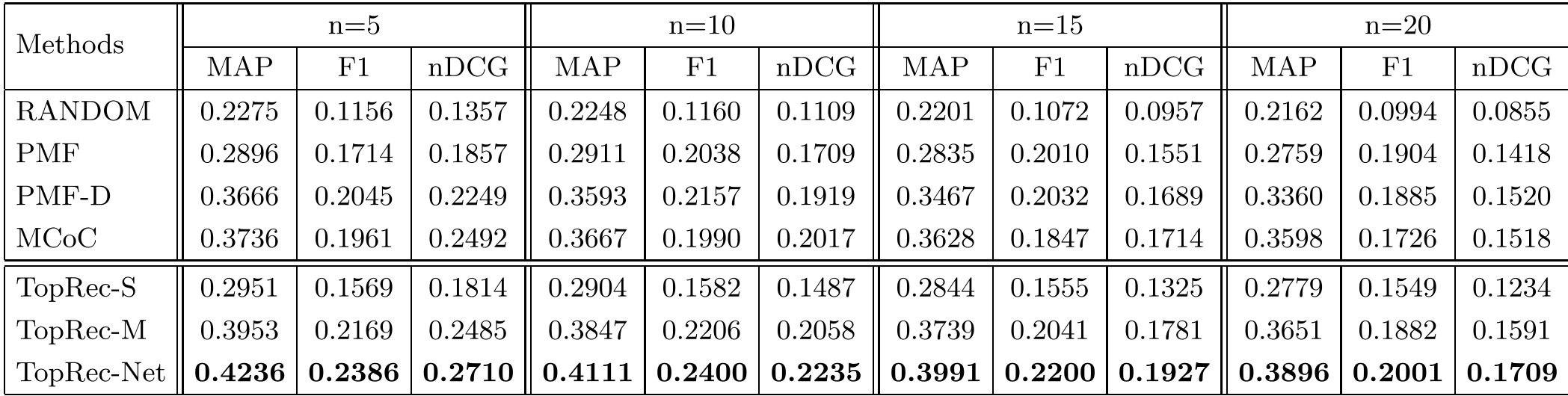 In the table above, TopRec-Net maintains superior MAP and nDCG scores across various recommendation list lengths ().
Critical Insights: Why it Works
The brilliance of TopRec lies not just in the math, but in the Inductive Bias it introduces. By using experts to "label" the latent space, the model avoids the common "drifting" problem of unsupervised clustering.
Furthermore, by predicting a user's interest in a domain before predicting their rating for an item, the system acts as a high-pass filter. It removes the "noise" of popular items from domains the user doesn't care about, allowing long-tailed, relevant items to surface in the Top-N list.
Limitations & Future Outlook
While TopRec is powerful, it currently relies on manually identifying "experts." In ecosystems where expert status isn't clear, the framework would need an automated way to identify "anchor users." Additionally, the current model assumes static domains; future iterations might benefit from Dynamic Topic Mining as product categories evolve.
Conclusion: TopRec reminds us that for AI to understand human taste, it must acknowledge that we are different people depending on whether we are shopping for a new laptop or a new garden hose. Domain-specific context is the key to unlocking the next level of recommendation accuracy.