
Torrents on Twitter: Leveraging Social Synchronicity to Revolutionize P2P Performance
Torrents on Twitter: Explore Long-Term Social Relationships in Peer-to-Peer Systems
This paper explores the integration of long-term social relationships into Peer-to-Peer (P2P) file-sharing systems, specifically focusing on "Twitter-triggered" BitTorrent swarms. Through extensive measurement of over 100,000 swarms, the authors identify a "stable peer" minority and demonstrate that social-aware choking algorithms can significantly improve download speeds and completion times.
TL;DR
Is the "social" in peer-to-peer sharing a myth? A deep dive into BitTorrent traces reveals that 95% of peers are total strangers who never meet twice. However, by analyzing Twitter-triggered swarms, researchers found a "synchronicity effect" that boosts peer encounter rates by 700%. By slightly modifying the BitTorrent choking algorithm to prioritize social friends, download speeds can be accelerated by over 300%.
The "Meet-Once" Trap: Why Traditional P2P Cooperation Fails
For years, P2P researchers hypothesized that we could optimize BitTorrent by leveraging long-term relationships between peers. If Peer A helps Peer B today, Peer B should return the favor tomorrow.
The problem? Peers almost never meet twice.
The authors' measurement study spanning 80 days and 100,000 torrents found that:
- Ephemeral Attendance: 70% of peers only return to the network after 10 days, by which time the original torrent is likely "dead."
- Random Arrivals: Most peers follow a Poisson distribution for arrivals, meaning their online behavior is entirely random with no long-range dependence (Hurst parameter ).
- Low Overlap: In a standard swarm, the chance of two peers being online at the same time more than once is less than 5%.
The Insight: Social Networks as a "Temporal Synchronizer"
The study identifies a crucial shift: Twitter-triggered torrents. When a user tweets a torrent link, their followers receive instant notifications and join the swarm nearly simultaneously.
This "Social Pulse" creates Temporal Locality. Instead of random arrivals spread across weeks, social friends join in bursts. This synchronization transforms the P2P landscape:
- Encounter Rate: Increases from 5% to 35%.
- Overlap Duration: Over 60% of social peers overlap for more than 15 hours, providing a massive window for effective "tit-for-tat" cooperation.
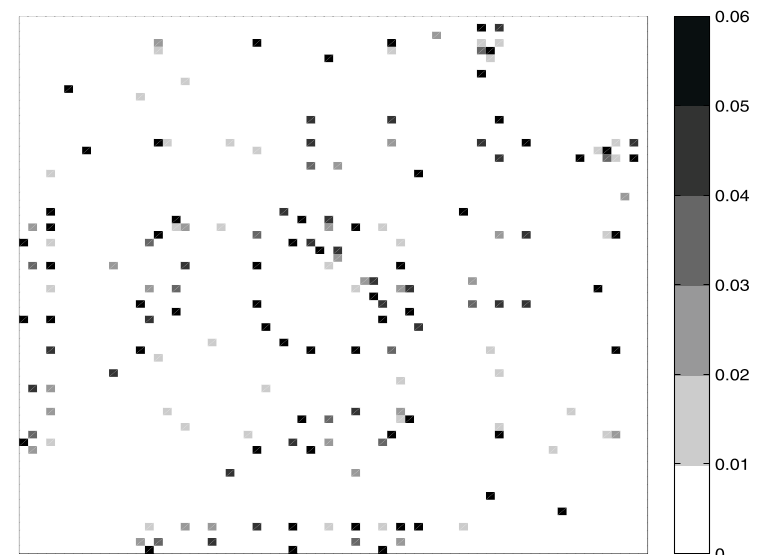 Figure 1: The similarity matrix shows that while most peers (light areas) have zero correlation, a small group of "Stable Peers" (dark clusters) exhibit high temporal overlap.
Methodology: Social-Aware Choking
The authors propose a simple yet radical change to the BitTorrent protocol. Current BitTorrent leechers use a "tit-for-tat" strategy: I upload to you only if you upload to me.
In the Social-Aware Protocol:
- Biased Neighbor Selection: The tracker prioritizes filling a peer's neighbor list with social friends (e.g., 8 out of 10 neighbors).
- Upload-Based Unchoking for Friends: Instead of unchoking based on who gives the most (download rate), a leecher unchokes friends based on upload rate (behaving like a "seeder" toward friends). This fosters a "friends-help-friends" ecosystem.
Experimental Results: Massively Faster Downloads
Using PlanetLab for real-world emulation, the researchers compared a "Social Swarm" (using the new protocol) against a "Normal Swarm."
- Completion Time: In social swarms, 70% of peers finished a 900MB download within 800 seconds. In normal swarms, that same 70% mark wasn't even reached by 4,000 seconds.
- Startup Delay: 90% of social peers received their first piece of data within 60 seconds, whereas normal peers faced significantly higher wait times due to the reliance on random optimistic unchoking.
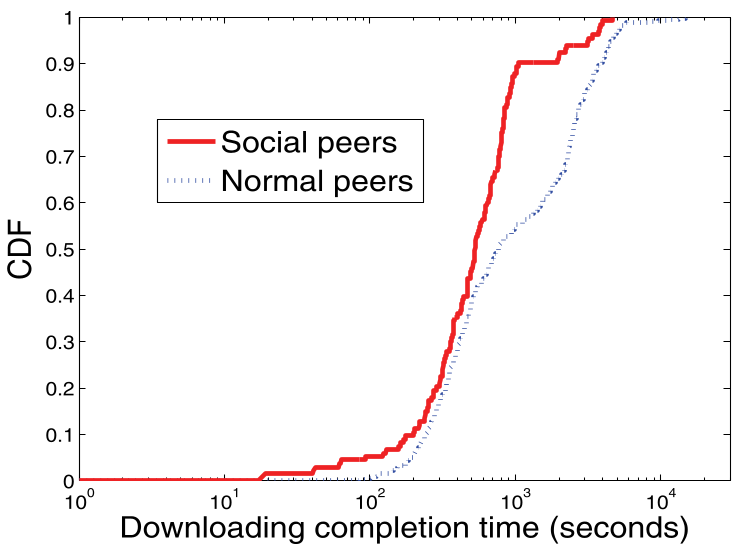 Figure 2: The CDF clearly demonstrates the massive gap in completion times between social-aware swarms and standard BitTorrent protocols.
Critical Insight & Future Outlook
The genius of this work isn't just the algorithm—it's the observation of human-induced synchronicity. By leveraging the fact that social media forces people to act at the same time, we can fix the fundamental "broken" assumption of P2P: that peers are online together long enough to care about each other.
Limitations: The study relies on peers being willing to share their social identity (Twitter IDs) with a tracker, raising privacy concerns. Furthermore, the risk of "Social Free-Riding" (friends exploiting friends) remains an open behavioral question.
The Takeaway: As content consumption becomes increasingly social and "instant," the future of efficient file sharing lies not in better math, but in aligning network protocols with the social pulses of human behavior.