
Torrents on Twitter: Bridging the Gap in P2P Social Relationships
Torrents on Twitter: Explore Long-Term Social Relationships in Peer-to-Peer Systems
This paper investigates the feasibility of leveraging long-term relationships in P2P file sharing, specifically BitTorrent (BT). By analyzing massive real-world traces, the authors propose a social-network-based enhancement that significantly improves download performance by integrating Twitter-triggered torrent information.
TL;DR
Conventional wisdom suggests that BitTorrent peers return daily, allowing for long-term cooperation. This paper shatters that myth, revealing that 95% of peers are "one-hit wonders" with random arrival patterns. However, the authors find a "silver bullet": Twitter. By analyzing torrents shared on social media, they demonstrate that social ties create the temporal overlap necessary to accelerate downloads by over 500% in optimal conditions.
The Myth of the "Returning Peer"
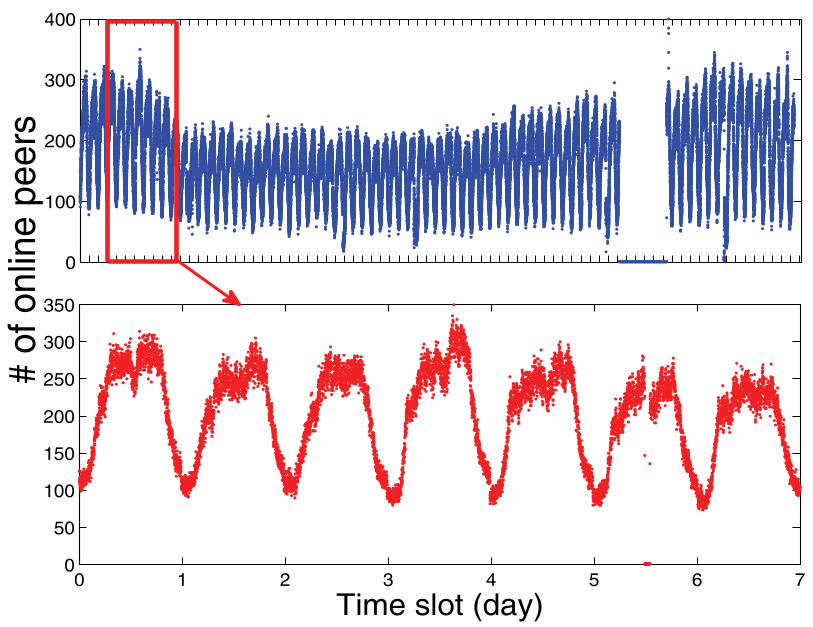
For years, P2P researchers designed systems based on the assumption that peers exhibit stable, periodic behaviors. The "Pitfall" discovered here is startling: most peers are highly transient. As shown in the CDF of offline durations, over 70% of peers return to the network only after 10 days—by which time their original torrent is likely "dead."
The research identifies two distinct classes of users:
- Stable Peers (<30%): Exhibit high Hurst parameters (0.7-0.9), signaling strong self-similarity and predictability.
- Unstable Peers (>70%): Arrivals resemble a random Poisson process (Hurst 0.5).
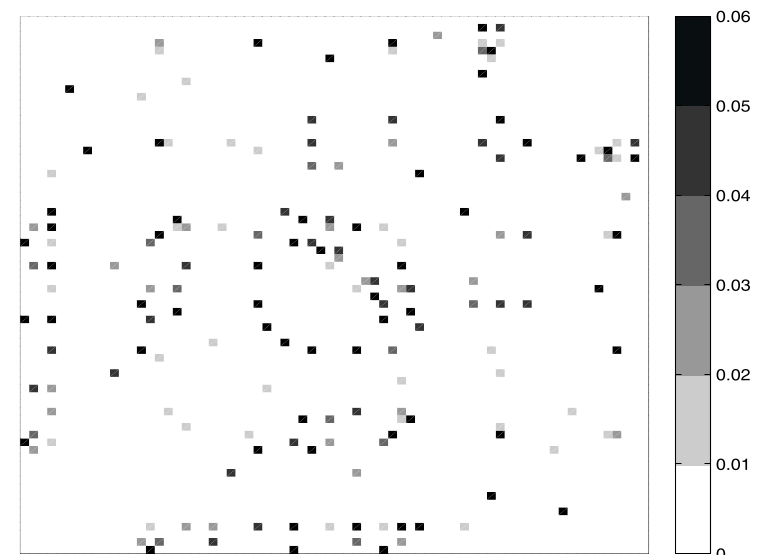 The similarity matrix highlights that most peers (light areas) have nearly zero overlap in their online patterns.
The Twitter Opportunity: Temporal Locality
If most peers are random, how can we organize cooperation? The authors look toward social networks. In "Twitter-triggered swarms"—where a download link is broadcast via a tweet—the encounter rate jumps from a measly 5% to 35%.
Because followers often see a notification and act simultaneously, their online patterns "sync up." This creates a window of opportunity where friends are online at the same time, ready to share pieces of the same file.
Rethinking the Choking Algorithm
The core technical contribution is a modification to the standard BitTorrent choking protocol. Traditionally, BT uses a "tit-for-tat" strategy: I give to you only if you give to me right now.
The authors propose a Social-Aware Choking:
- For Strangers: Use the standard competitive downloading-rate metric.
- For Friends: Use an uploading-rate-based metric (similar to how seeders behave). In essence, friends act as mini-seeders for each other, bypassing the strict "quid pro quo" that often bottlenecks early-stage downloads.
 The logic of identifying peer arrivals and overlaps to build the Global Matrix G.
Evidence from PlanetLab
The results are dramatic. In controlled experiments on PlanetLab:
- Completion Time: Social swarms finished downloads orders of magnitude faster than normal swarms.
- Startup Delay: 90% of social peers received their first piece within 60 seconds, whereas 40% of normal peers were still waiting.
- Hybrid Vitality: You don't need a swarm full of friends. Even a small cluster of social peers in a sea of strangers still sees significant performance gains.
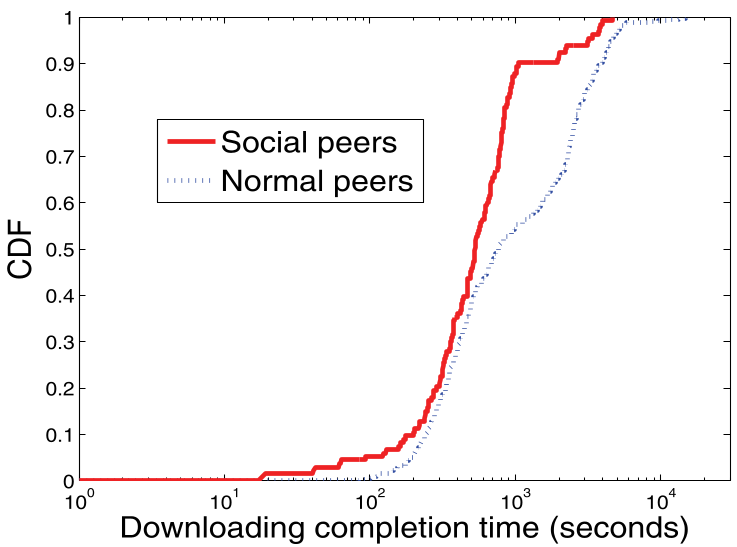 Comparison of download completion times: the social-enhanced protocol (left curve) drastically outpaces the standard protocol (right curve).
Insight and Future Outlook
This paper provides a critical reality check for P2P researchers: Don't assume stability where there is randomness. The true value of this work lies in the realization that "Long-term relationships" are not a property of the P2P protocol itself, but of the social fabric outside the protocol.
As we move toward decentralized web (Web3) and edge computing, integrating social graphs into data distribution isn't just an "extra feature"—it's the only way to solve the coordination problem in a world of transient, random nodes.
Limitations: The study relies on Twitter (now X) data from a specific era; modern API restrictions and changes in social behavior (e.g., shifts to private groups like Discord) could impact the "broadcast" effect observed here. Still, the fundamental link between social notification and temporal locality remains a robust Insight.