
TOSS: Bridging the Gap Between Online Influence and Offline Encounters for 86% Traffic Offloading
TOSS: Traffic offloading by social network service-based opportunistic sharing in mobile social networks
The paper introduces TOSS (Traffic Offloading by Social network service-based opportunistic Sharing), a framework designed to offload cellular traffic by integrating online Social Network Services (SNS) with offline Mobile Social Networks (MSN). By strategically selecting "seed" users based on their online influence and offline mobility, the system encourages peer-to-peer content sharing via local interfaces like Bluetooth or Wi-Fi Direct.
TL;DR
As cellular networks struggle with the "duplicated download" problem of viral content, TOSS emerges as a sophisticated framework that combines online social behavior with offline physical encounters. By treating the delay between a social media post and a user's click as a "buffering window," TOSS proactively pushes content to influential "seeds" who then distribute it locally, saving up to 86.5% of cellular bandwidth.
The Core Insight: The "Social" in Two Dimensions
Most traffic offloading research treats users as moving particles. TOSS recognizes that we live in two social networks simultaneously:
- Online SNS (Social Network Service): Where we follow influencers and browse timelines.
- Offline MSN (Mobile Social Network): Where our devices physically meet others on campuses, in conferences, or on roads.
The authors discovered a massive opportunity in User Access Delays. Their analysis of 2.2 million Sina Weibo users showed that while some people check their feeds instantly, many have "access delays" of several hours or even days. This delay is the perfect window for opportunistic prefetching.
Methodology: Who Should Get the "Seed" Copy?
The technical heart of TOSS is identifying the "Opinion Leaders" who are also "Mobility Leaders." The system calculates:
- Spreading Impact (): The probability that a user will re-share a post, calculated across up to 4-hop paths.
- Mobility Impact (): The rate at which two users encounter each other physically.
- Access Utility (): Modelled via a Weibull distribution, representing when a specific user is most likely to actually want to see the content.
System Architecture
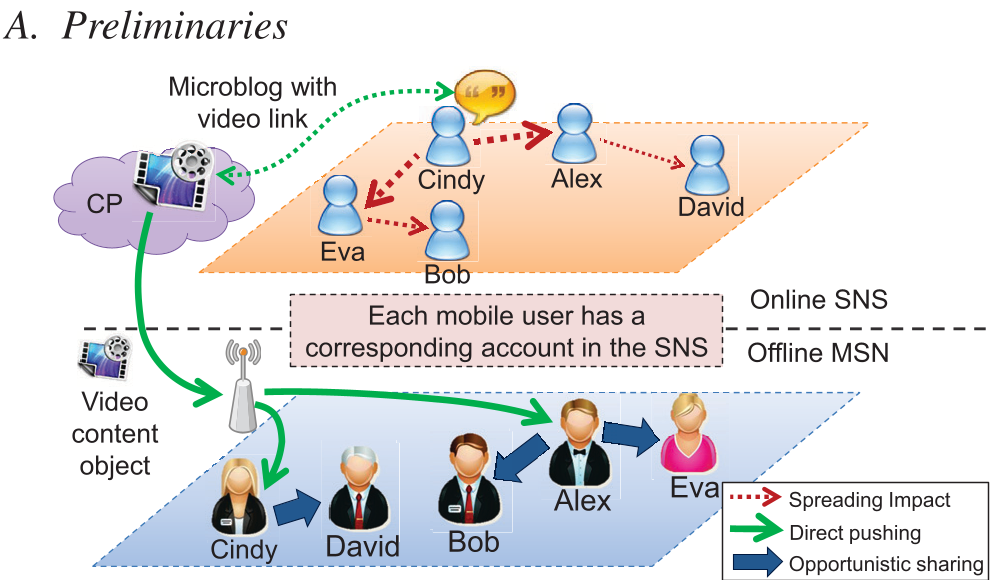 In the figure above, TOSS detects that Cindy (SNS influencer) can reach David, while Alex (Mobility leader) is chosen as a seed because he frequently encounters Bob and Eva.
Experimental Validation: From Weibo to the Streets
The researchers didn't rely on simulations; they mapped real Sina Weibo data onto four famous mobility traces:
- High Mobility (Infocom): Conference attendees with frequent contacts.
- Structured Mobility (MIT): Daily routines on a university campus.
- Sparse Mobility (Beijing/SUVnet): Vehicles moving in a city.
Performance Comparison
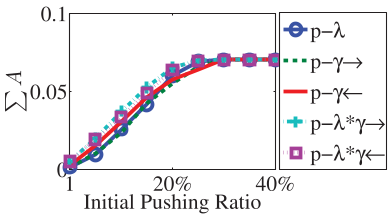 The charts demonstrate that the Hill-Climbing (p-H) approach and the combined SNS-MSN impact strategy () consistently reach maximum user satisfaction with fewer seeds than traditional PageRank or random methods.
Key Results & Takeaways
- Massive Savings: TOSS reduces cellular load by 63.8% to 86.5% depending on the mobility trace.
- Satisfaction Pareto: By targeting just 80-90% satisfaction, the number of required seeds drops drastically, making the system highly efficient for "best-effort" content delivery.
- Low Mobility Resilience: Even in vehicle networks (SUVnet) where contacts are rare, leveraging online social relationships still provides significant offloading gains.
Critical Analysis & Future Outlook
While TOSS is a breakthrough in cross-layer optimization, it assumes users are willing to share content "gratuitously." In a real-world deployment, Incentive Mechanisms (like micro-payments or data credits) would be necessary to reward users for acting as data relays.
Furthermore, the potential privacy risk of the "Central Controller" knowing both SNS identities and GPS traces is a hurdle. Future iterations using Federated Learning or Differential Privacy could solve these concerns while maintaining the massive efficiency gains TOSS provides.
Conclusion
TOSS proves that the "Social" in Social Networks isn't just for human interaction—it's a goldmine for network optimization. By predicting when we will look at our phones and who our phones will meet, operators can finally get ahead of the traffic curve.