
DEH Platform: Redefining Digital Heritage through Spatial Storytelling and Collaborative Authoring
A Touring and Navigation Service Platform for Mobile Digital Culture Heritage (M-DCH)
This paper presents "Demodulating and Encoding Heritage" (DEH), a Mobile Digital Culture Heritage (M-DCH) platform integrating LBS and GIS technologies. It introduces a hierarchical content structure (POI, LOI, AOI, SOI) and a unique "write-privilege" grouping function to facilitate collaborative mobile heritage touring and education.
TL;DR
The DEH (Demodulating and Encoding Heritage) platform transitions Digital Cultural Heritage from static "E-Heritage" to "Ubiquitous Heritage" (U-Heritage). By introducing structured spatial entities (POI, LOI, AOI, SOI) and a unique collaborative grouping mechanism with leader-write privileges, it enables a new paradigm for mobile touring and educational cultural preservation.
Context & Motivation: Why Mobile DCH?
Traditional cultural heritage preservation often suffers from being "locked" in databases. The authors argue that the true value of heritage is realized through on-site exploration. While existing Location-Based Services (LBS) exist, they typically lack a formal methodology to link individual points into cohesive stories or sequences. Furthermore, common social networks like Line or WeChat are designed for social consumption (Read), not collaborative knowledge production (Write), making them unsuitable for guided educational environments.
Methodology: The Architecture of Heritage
The DEH platform's core innovation lies in its hierarchical interpretation of digital content:
- POI (Point of Interest): The atomic unit containing text/media.
- LOI (Line of Interest): A temporal or spatial sequence of POIs (a "guided path").
- AOI (Area of Interest): A cluster of related POIs where the visiting order is random.
- SOI (Story/Site of Interest): The highest abstraction, composing multiple units to tell a full narrative.
The "Leader-Write" Grouping Function
Unlike standard social networks, DEH allows a Group Leader to modify the contents created by members. This is a critical design choice for the "Teacher-Student" scenario, where an instructor must refine a student's authored content before it is verified and made public.
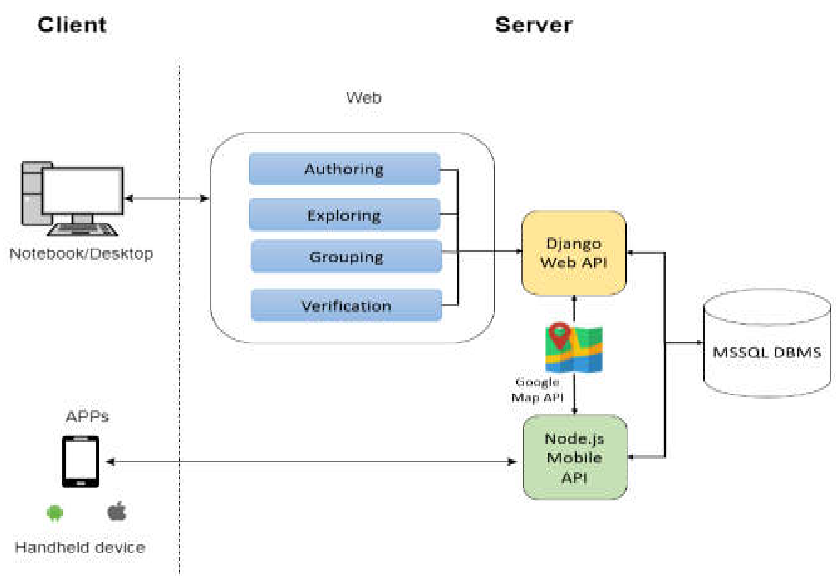 Figure 1: The dual-API architecture (Django/Node.js) supporting both Web and Mobile clients.
Engineering a Robust LBS Experience
The paper details several technical solutions to ensure a seamless mobile experience:
- Automated Verification Lifecycle: Content undergoes a state-transition process (Value 0: Pending, 1: Verified, -1: Failed). If an author modifies a verified piece, it automatically reverts to "Pending."
- Proximity Calculation: The system implements the Haversine Formula within SQL queries to calculate orthodromic distances, enabling users to find "the nearest POIs within kilometers."
- Constraint Management: To handle mobile bandwidth constraints, the system enforces size limits (2MB for images, 15MB for video) and provides server-side image resizing.
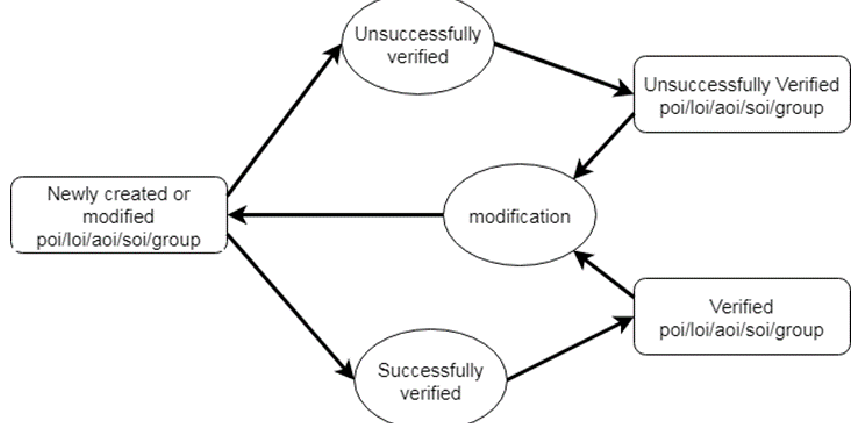 Figure 2: The state-machine for content verification ensuring credibility.
Experimental Usage & Results
The platform supports various roles: Players (general users), Docents (narrators who can offer professional services), and Experts (vetted contributors).
The grouping function effectiveness is highlighted through the "Notify/Manage" interface, where leaders can handle "Invite-to-join" or "Apply-group" requests and manage shared content dynamically.
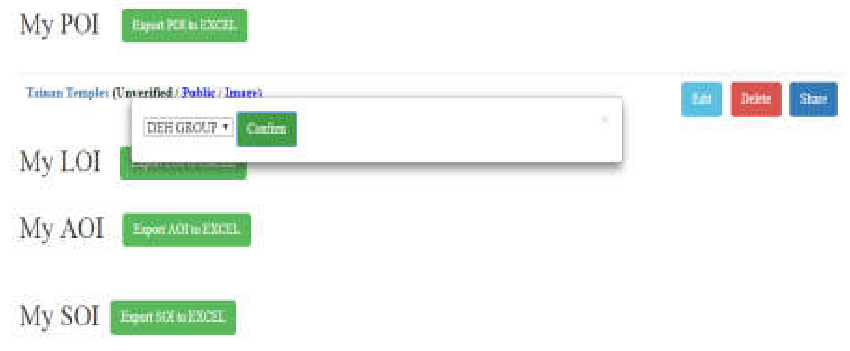 Figure 3: The Web interface for cross-filtering heritage content by role, language, and subject.
Critical Insight: The Future of U-Heritage
The DEH platform stands out by recognizing that cultural heritage is not just data, but geospatial narrative. By enforcing location consistency (checking if the user-entered address matches the GIS data), the authors prevent the "data pollution" common in open-access platforms.
Limitations: The current verification process relies on human experts/verifiers. As the platform scales, an automated AI-driven verification for "suitability" (scanning for violence/pornography) will be necessary to reduce human overhead.
Conclusion
DEH provides a comprehensive blueprint for mobile heritage systems. By focusing on Write-privileges for leaders and Spatial-Temporal structures (LOI/SOI), it bridges the gap between expert-led education and casual tourism, ensuring that culture is not just seen, but correctly interpreted and collaboratively built.