
GA-LSTM_CSInf: Fusing Social Influence and Time Series for Next-Gen Tourism Recommendation
Tourism Service Recommendation Based on User Influence in Social Networks and Time Series
This paper introduces GA-LSTM_CSInf, a hybrid recommendation framework that fuses multi-modal travel data. It leverages a Genetic Algorithm-optimized LSTM for time-series popularity forecasting, a social influence-aware SVD, and category-based Matrix Factorization to provide highly personalized tourism service recommendations.
TL;DR
The paper presents GA-LSTM_CSInf, a fusion model that redefines tourism service recommendation by combining deep learning (LSTM) for seasonal forecasting with advanced social network analysis. By quantifying the "Opinion Leader" effect through explicit and implicit social metrics, the model achieves a staggering performance leap over traditional Matrix Factorization techniques on real-world Yelp data.
Problem & Motivation: Beyond Static Distance
Most travel recommendation systems focus on "Where" (geography) and "What" (content), but they often forget "When" and "Who".
- Seasonality: A beach is a top recommendation in July but a poor one in January.
- The Influence Gap: Not all social ties are equal. Recommendations from an "Influencer" or expert carry more weight than those from a casual acquaintance.
The authors recognized that current SOTA methods often treat social networks as simple graphs, missing the nuanced influence of "Opinion Leaders" and the periodic nature of travel popularity.
Methodology: The GA-LSTM_CSInf Architecture
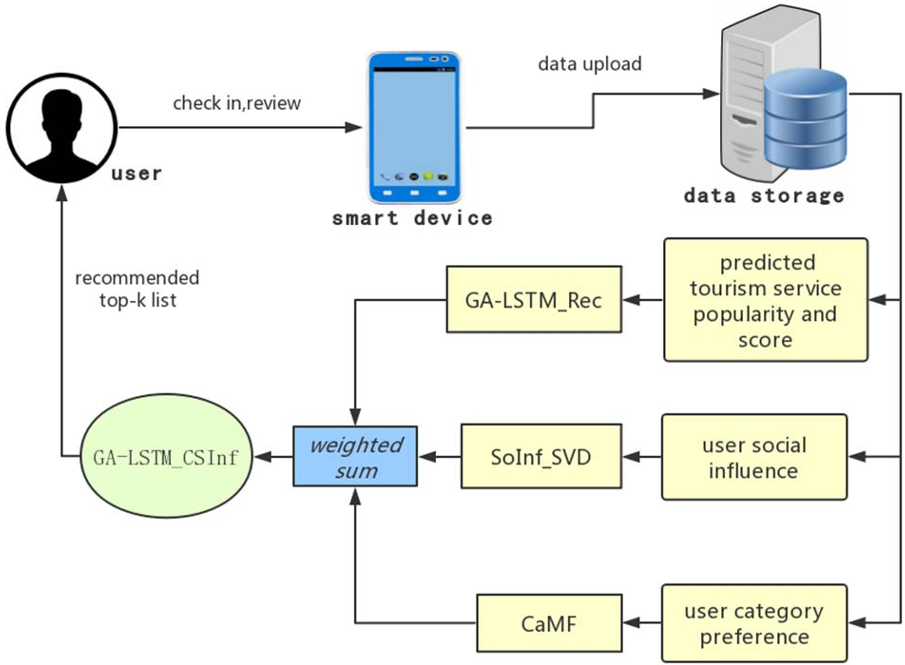
The model is a weighted fusion of three distinct intelligence modules:
1. Temporal Prediction (GA-LSTM)
Traditional LSTMs are sensitive to hyperparameters. The authors use a Genetic Algorithm (GA) to evolve the optimal look_back window, epoch count, and hidden units. This ensures the model accurately captures the "Pulse" of a tourist spot’s popularity over a 12-month cycle.
2. Multi-dimensional Social Influence (SoInf_SVD)
This is the core innovation. Social influence is split into:
- Explicit (ExSoInf): Using a tuple of
<Useful, Funny, Cool, Fans>to measure direct community acknowledgement. - Implicit (ImSoInf): Using a PageRank derivative to measure the structural importance of a user within the link graph.
These are integrated into an SVD framework, where a friend's rating is weighted by their calculated influence score.
3. Category Preference (CaMF)
By mapping users to service categories (e.g., "Shopping" vs. "Hiking") using Matrix Factorization, the model captures broad behavioral patterns that raw item-based scores might miss.
Experiments & Results
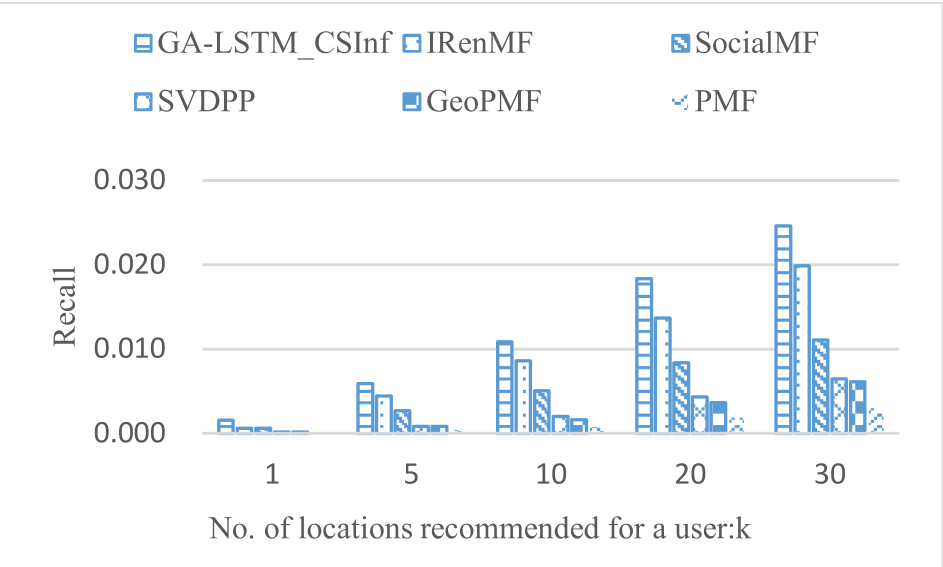
The authors tested their model against classic baselines like SVD++, PMF, and specialized models like IRenMF.
- Precision and Recall: The fusion model outperformed all competitors. The most significant gains were seen at low K values (Top-1 recommendation), indicating the model is highly effective at identifying the "perfect match."
- Ablation Study: The researchers found that SoInf_SVD (Social Influence) provided the highest accuracy boost, confirming that travel decisions are deeply social.
Critical Analysis & Conclusion
Takeaway
The success of GA-LSTM_CSInf proves that tourism is not a static recommendation problem. By treating user influence as a dynamic, multi-factor metric and aligning it with temporal trends, the system mirrors how humans actually make travel plans: "What is popular now, and what do the experts recommend?"
Limitations & Future Work
While the model uses "Compliments," it does not yet utilize Sentiment Analysis of the reviews themselves. Future iterations could leverage NLP (Natural Language Processing) to distinguish between a "popular" spot that people hate and a "niche" spot that people love. Furthermore, the model is designed for individual users; extending this to Group Recommendation (planning for families or friends) remains a high-value frontier.
Conclusion
GA-LSTM_CSInf represents a shift toward "Context-Aware Social Intelligence." For developers and researchers in the LBSN (Location-Based Social Network) space, this paper provides a robust blueprint for weighting social authority and temporal cycles to solve the information overload problem.