
SNA-Powered Tourism: Transforming Trip Planning into a "Social Machine"
Tourist Tour Planning Supported by Social Network Analysis
This paper introduces a novel extension to tourist tour planning by leveraging Social Network Analysis (SNA). It proposes a methodology to estimate tourist satisfaction with individual Points of Interest (POIs) using a "tourist-reviewer" network and achieves an average satisfaction accuracy of over 82% by applying the "islands in the net" grouping algorithm combined with centrality ranking.
TL;DR
Static algorithms are no longer sufficient for the modern traveler. This paper proposes a paradigm shift: treating tourist tour planning as a Social Network Analysis (SNA) problem. By modeling the relationship between tourists and experienced reviewers as a dynamic network of "islands," the system predicts POI satisfaction with over 82% accuracy, outperforming traditional isolated profile matching.
From Machines to "Social Machines"
Traditional city trip planners often treat users as data points in a vacuum, using simple keyword matching or weighted averages to suggest destinations. However, the authors argue that we are entering the era of "Social Machines." The core insight is Homophily: the tendency of individuals with similar social profiles (age, gender, occupation) and niche tastes (e.g., a shared love for archaeology) to enjoy the same locations.
The challenge? How to filter through thousands of reviewers to find the "soulmate" reviewer for a specific tourist.
The Architecture: The Tourist-Reviewer Network
The system operates by constructing a Dyadic Two-Mode Network. In this graph, there are two distinct sets of nodes—Tourists () and Reviewers (). Links only exist between these two groups, never within them.
Calculating Similarity Weights
The tie strength (weight) between a tourist and a reviewer is determined by:
- Touristic Interest Similarity (): Matching preferences for POI categories (e.g., Nature, Art, Monuments) on a scale of 0-3.
- Personal Similarity (): Exact matches in demographic attributes like occupation or hobby.
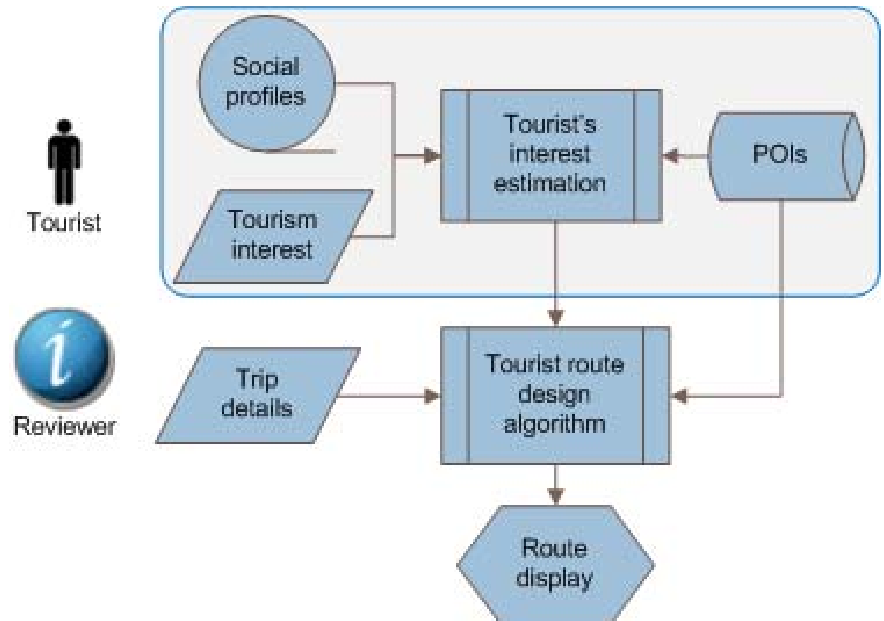 Figure 1: The architecture of the SNA-supported tour planning system, highlighting the estimation module.
Methodology: Raising the Water Level
To identify the most relevant reviewers, the authors employ the "Islands in the Net" method. Imagine the network is submerged in water; the "water level" represents a similarity threshold.
- Iterative Filtering: As the threshold rises, weak links are "flooded," leaving behind isolated "islands" of highly similar actors.
- Tie-Breaking with Centrality: Sometimes, a tourist remains connected to multiple reviewers at the same "height" (a flat island). To resolve this, the system applies Authority Centrality. It identifies which reviewer is the most "authoritative" within that social cluster to provide the final recommendation.
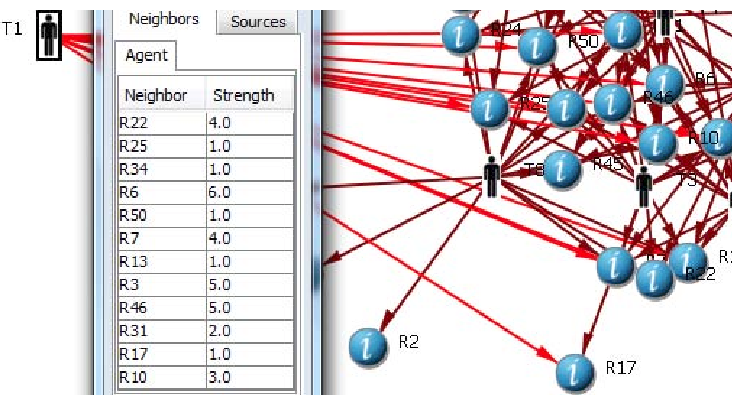 Figure 2: Visualizing the reduction of links for Tourist T2 as the similarity water level is raised.
Experimental Results: Proving the Social Link
The researchers tested their approach using data from 200 POIs in Kosova. The results were categorized into three instances of varying network density.
| Metric | Islands Only | Islands + Centrality | Improvement |
|---|---|---|---|
| Instance 1 | 76.94% | 84.44% | +7.50% |
| Instance 2 | 75.39% | 78.57% | +3.18% |
| Instance 3 | 80.00% | 83.33% | +3.33% |
The data confirms that simply finding a "similar" person isn't enough; using SNA to find the most authoritative similar person significantly bumps the satisfaction factor.
Critical Insights & Future Outlook
The beauty of this approach is its reliance on Web 3.0 data. By tapping into existing social media profiles (Facebook/LinkedIn), the barrier to entry for the user is lowered while the accuracy of the "interest estimation" increases.
Limitations:
- Cold Start: The paper doesn't explicitly address how to handle a tourist with zero social profile data or unique tastes that don't overlap with any reviewer.
- Scalability: Raising the "water level" iteratively for millions of nodes in a global application would require significant computational optimization.
Conclusion: This work successfully bridges technical graph theory with the human-centric world of travel. It paves the way for "Social Recommenders" that understand we don't just want to see "popular" sights—we want to see the sights that people like us cherish.