
SocialTube: Redefining P2P Video Sharing Through the YouTube Social Graph
2608_Toward Efficient Short-Video Sharing in the YouTube Social Network.
The paper proposes SocialTube, an interest-based, hierarchical P2P (Peer-to-Peer) short-video sharing system designed specifically for the YouTube ecosystem. By leveraging user subscription relationships and video interest categories, it builds a two-level overlay to reduce server bandwidth costs while maintaining a high Quality of Service (QoS).
TL;DR
SocialTube is a specialized P2P short-video sharing architecture that moves away from inefficient "per-video" networks. By organizing users into a two-tier hierarchy based on subscriptions and interests, it slashes server bandwidth by 44% and keeps maintenance overhead low, even under high churn.
Background: The Scalability Crisis of Short Video
As VoD services like YouTube exploded, server costs hit astronomical levels—approaching $1 million per day as early as 2009. While P2P (Peer-to-Peer) architectures were proposed to alleviate this, they were built for long-form movies. For YouTube's typical short clips (50% under 200 seconds), creating a new P2P network for every single video creates massive overhead and leaves users with no one to download from.
The authors' core insight: Users don't just watch random videos; they follow channels. By leveraging the "Subscription" and "Interest" graph, we can predict who has what video before they even ask.
Methodology: The Social-Aware Two-Tier Overlay
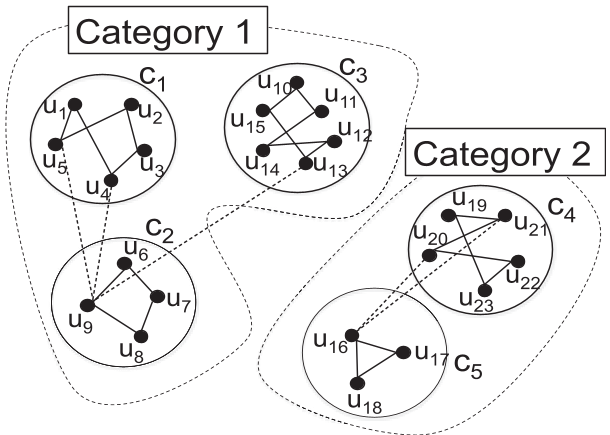
The brilliance of SocialTube lies in its Hierarchical Per-Community Structure. Instead of a chaotic mesh of per-video links, it organizes nodes into two logical layers:
1. The Channel Overlay (Lower Level)
Subscribers to a specific channel (e.g., ReutersVideo) form a persistent cluster. Since subscribers are highly likely to watch most videos from that creator, the "hit rate" for finding a peer provider within this cluster is extremely high.
2. The Interest Cluster (Higher Level)
Channels are grouped by categories (e.g., Gaming, Science). If a user wants a video they didn't subscribe to, SocialTube searches among users in the same interest category. This "small-world" approach ensures that even niche content can be found without hitting the central server.
Optimization: Smarter Caching and Reputation
To prevent the system from collapsing due to "free-riders" or inefficient storage, the paper introduces three critical sub-systems:
- Popularity-Based Prefetching: Calculating the Zipf distribution of a channel to pre-download the first chunks of the top 3-4 videos. This virtually eliminates startup delay.
- Demand/Supply Cache Management: Unlike FIFO or LRU, SocialTube discards videos that have an excess of providers (High Supply) and keeps videos where the server is currently doing the heavy lifting (High Demand).
- Reputation Scoring: A matrix-based system that ranks peers by their actual bandwidth contribution and the number of unique requesters they've served, effectively isolating selfish nodes.
Experimental Validation
Using PeerSim (10,000 nodes) and PlanetLab (real-world deployment), the authors demonstrated that SocialTube consistently outperforms classic baselines like PA-VoD and NetTube.
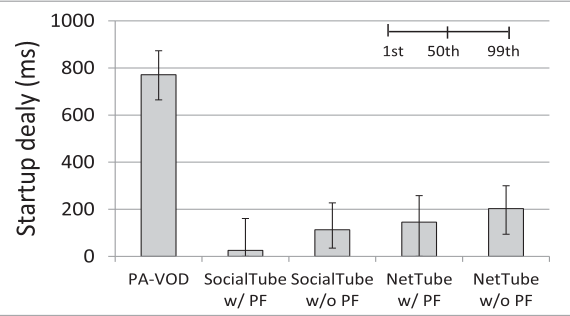
Key Results:
- Bandwidth Efficiency: SocialTube achieves a nearly 45% peer-contribution rate.
- Overhead Stability: While NetTube's maintenance cost balloons as a user watches more videos, SocialTube's overhead remains flat because the user stays within their subscription/interest clusters.
Critical Insight & Future Outlook
SocialTube proves that Social Logic > Network Logic. By aligning the P2P topology with human social behavior (following and interests), the system achieves a level of stability that content-agnostic systems cannot match.
However, the rise of "Recommendation Algorithms" (TikTok style) vs. "Subscription Models" (YouTube style) poses a new challenge: if users stop following channels and rely on AI feeds, the P2P clusters must become even more dynamic. Future work in this space will likely involve transformer-based interest prediction to pre-cluster nodes in real-time.
Conclusion
SocialTube is a landmark study in how to scale massive media platforms. It successfully bridges the gap between social network analysis and distributed systems, offering a practical solution for the next generation of high-traffic video sharing.