
Toward Multiscreen Social TV: Bridging Broadcast and Social Sense with Cloud Clones
100_Toward Multiscreen Social TV with Geolocation-Aware Social Sense.
The paper introduces a cloud-based, multiscreen Social TV system that integrates geolocation-aware social media analytics with traditional TV viewing. By leveraging a "Cloud Clone" architecture and Big Data mining, it enables users to seamlessly access real-time social insights (topics, entities, and sentiments) on a second screen via intuitive QR-code orchestration.
Executive Summary
TL;DR: This paper presents a groundbreaking architecture for a Multiscreen Social TV system that enhances the living room experience by bridging traditional TV broadcasts with real-time, geolocation-aware social media "sense." By utilizing a Cloud-centric platform, the system provides deep insights into what the world is saying about a show, delivered seamlessly to a second screen.
Background: Positioned at the intersection of Cloud Computing and Social Media Analytics, this work moves beyond simple "tweet-on-screen" features. It creates a robust, scalable backend capable of mining "Social Sense"—the collective intelligence, sentiment, and entity relationships hidden within the Big Data of microblogs.
Problem & Motivation: The Gap Between Screens
While we often "second-screen" (browsing phones while watching TV), the experience is fragmented. Existing systems fail because:
- Manual Overhead: Users have to manually search for hashtags or topics.
- Resource Constraints: Dynamic transcoding for varying mobile devices is computationally expensive.
- Static Content: Traditional TV lacks the real-time social pulse that modern viewers crave.
The authors' insight was to move the complexity away from the TV and the smartphone and into the Cloud, creating a virtual "bridge" that knows what the user is watching and what the internet is thinking.
Methodology: The "Cloud Clone" and "Social Sense"
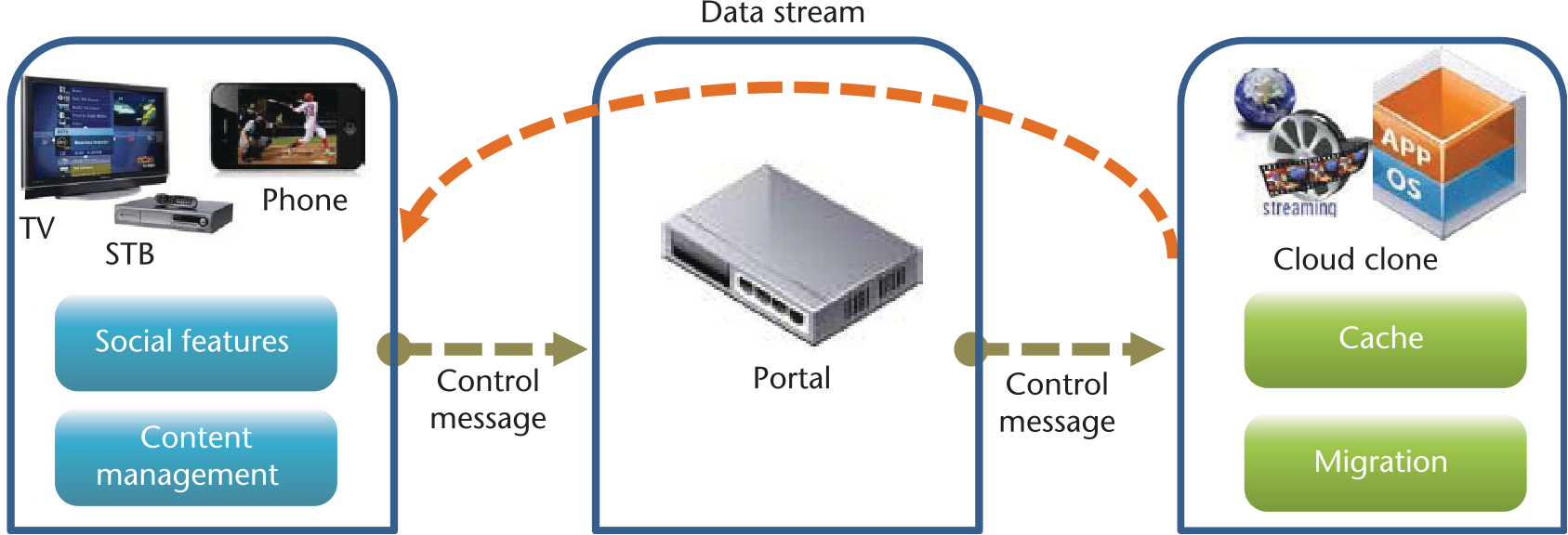
The core of the system is the Cloud Clone—a dedicated Virtual Machine (VM) for each user. This clone acts as a proxy, fetching content, transcoding it based on the mobile device’s specs, and maintaining the user's session state.
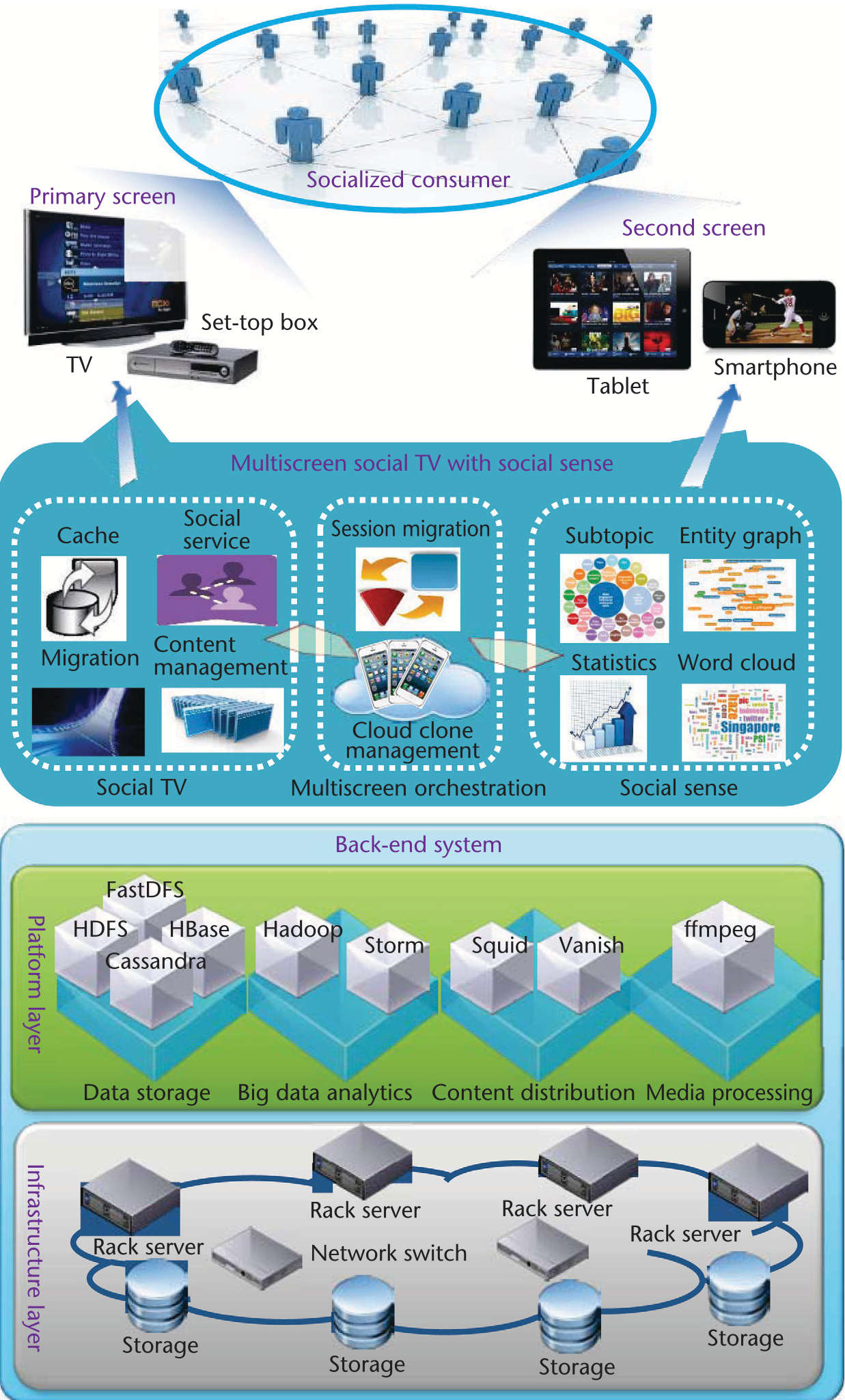
1. System Architecture
The architecture is divided into three layers: a backend IaaS/PaaS layer, the Multiscreen Social TV logic, and the consumer end-devices.
2. Cloud Clone Migration
To minimize latency and costs, the system uses a Markov Decision Process (MDP) to decide when to migrate a user's Cloud Clone to a closer data center. It balances the cost of transmission against the cost of migration.
3. Mining the Social Sense
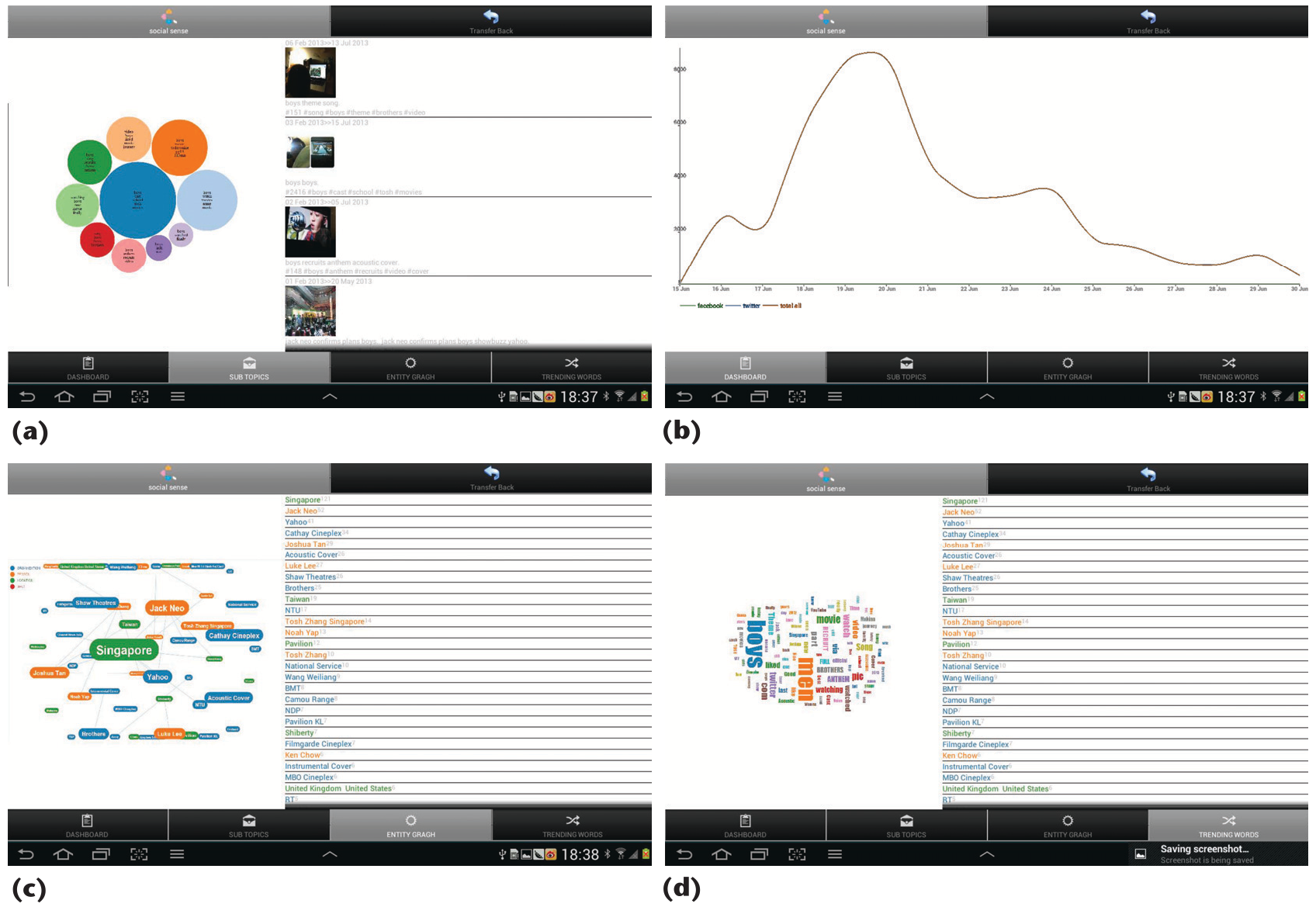
The Social Sense subsystem employs a multi-pronged crawling strategy (fixed/dynamic keywords and key users) and incremental clustering. It doesn't just show tweets; it generates:
- Topic Clouds: Emerging subtopics.
- Entity Graphs: Mapping people, organizations, and locations mentioned.
- Interest Degrees: Quantitative popularity trends.
Experiments & Results: Efficiency Gains
The prototype was tested on a massive private cloud testbed at NTU/NUS. The most striking results came from the User Experience study.
- Retrieval Speed: Traditional web solutions (log in -> search -> view) took 57.9 seconds on average. The proposed QR-based orchestration took just 9 seconds for new users and dropped to 4.9 seconds for experienced users.
- Knowledge Discovery: Using the film Ah Boys to Men as a case study, the system successfully parsed disparate tweets into a structured entity graph, allowing users to explore cast members and filming locations instantly.
Critical Analysis & Conclusion
Takeaway
The shift from "device-centric" to "cloud-clone-centric" is the paper's most significant contribution. By decoupling the UI from the processing, the authors achieved a level of cross-device fluidity that was ahead of its time.
Limitations
- Privacy: Centralizing all user session data in a "Cloud Clone" raises significant privacy and data security concerns.
- Platform Lock-in: The system relies heavily on the availability of social media APIs, which have become increasingly restricted since the paper's publication.
Future Outlook
This framework lays the groundwork for modern "Metaverse" TV experiences, where the "Social Sense" could be rendered as 3D overlays or interactive AR elements, further blurring the line between the viewer and the global conversation.