
IEML: Engineering a Coordinate System for the Human Mind and Collective Intelligence
Toward a Self-referential Collective Intelligence Some Philosophical Background of the IEML Research Program
Pierre Lévy proposes IEML (Information Economy MetaLanguage), a self-referential regular language designed to function as a universal semantic addressing system. It aims to augment human collective intelligence by enabling the automatic manipulation of meaning, transforming cyberspace into a measurable and navigable semantic space.
TL;DR
Pierre Lévy’s research program introduces IEML (Information Economy MetaLanguage), a radical attempt to "mathematize" semantics. Just as the invention of the zero and Indo-Arabic numerals revolutionized arithmetic, IEML provides a regular, computable language for meaning. Its goal is to move beyond the "cacophony of ontologies" on the Web toward a self-referential collective intelligence, where human knowledge becomes a navigable, measurable, and unified geometric space.
The Semantic Barrier: Why Our Web is "Blind"
Despite the explosion of Web 2.0 and social computing, Pierre Lévy argues that we are still in the "Roman Numeral" age of semantic management.
Our current systems suffer from three fundamental flaws:
- Opacity of Symbols: URIs (Uniform Resource Identifiers) are opaque strings. They address the location of data but not the intrinsic meaning.
- Natural Language Limits: Human languages are biologically optimized, not computationally optimized. They are ambiguous, context-dependent, and hard to manipulate through sheer logic at scale.
- Fragmentation of Knowledge: The humanities and social sciences lack a common "metric." Unlike physics, which has mass, energy, and spacetime, the "cultural space" has no universal coordinate system.
Methodology: The Geometry of Meaning
IEML is not just another ontology; it is a generative grammar of signifiers. It treats meaning as a set of algebraic transformations.
1. The Addressing Layers of Cyberspace
Lévy envisions cyberspace as an evolution of addressing systems:
- Layer 1 (Bits): Memory addresses (Von Neumann architecture).
- Layer 2 (Internet): Machine addresses (IP).
- Layer 3 (Web): Document addresses (HTTP/URLs).
- Layer 4 (IEML): Semantic addresses (USLs - Uniform Semantic Locators).
2. The Six Primitives
The language is built from six fundamental building blocks, combined through successive layers of syntax:
- The Dialectic of Fullness:
U(Virtual - Potential) vs.A(Actual - Manifested). - The Semiotic Triad:
S(Sign/Signifier),B(Being/Interpreter), andT(Thing/Referent). - The Null:
E(Empty) to account for syntactic roles.
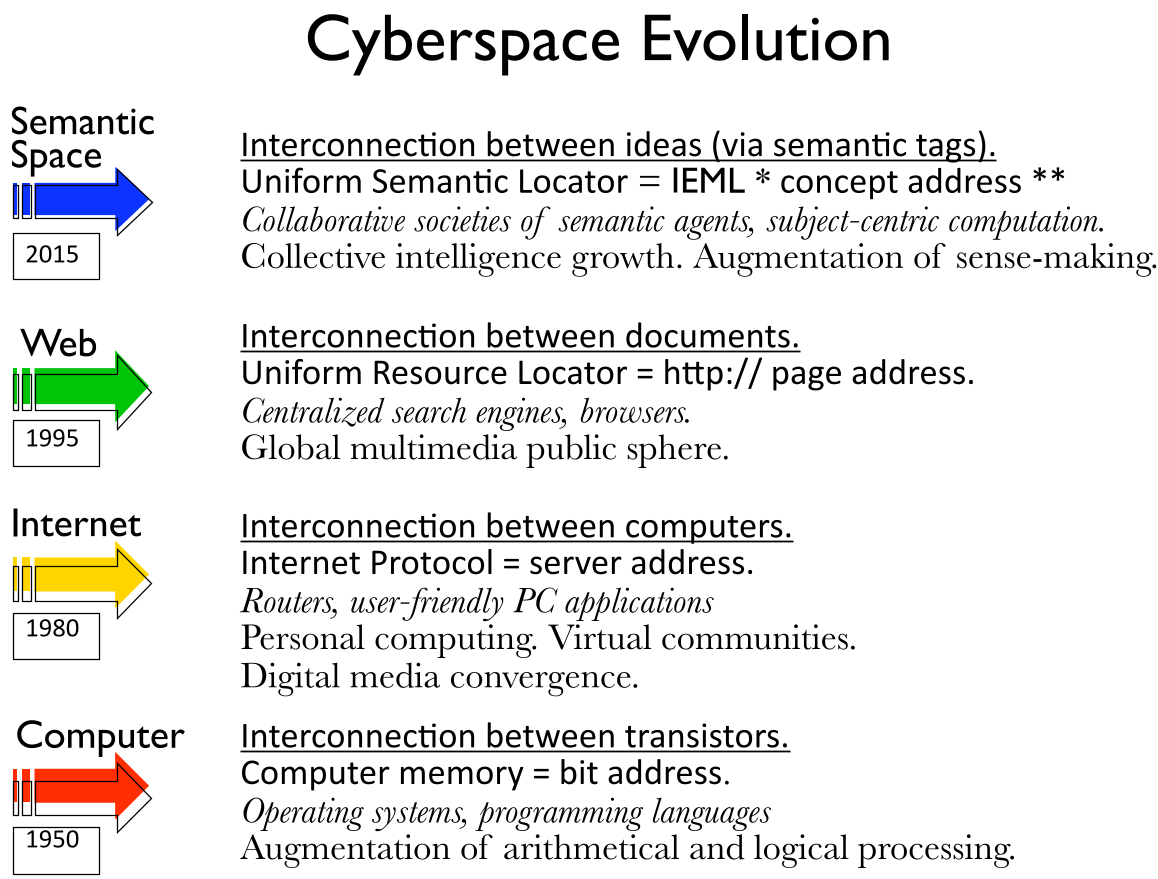 Figure 1: The proposed Four-Layer Architecture of Cyberspace, placing IEML at the pinnacle of semantic computing.
Collective Intelligence as a "Human Capital" Model
Lévy uses IEML to model the "metabolism" of collective intelligence. By applying the Actor-Network Theory, he defines six poles of human capital that exchange resources:
- Know/Documents (S)
- Want/Persons (B)
- Can/Bodies (T)
This allows for the creation of a Technoscience of the Humanities. If every social interaction and piece of knowledge is tagged with IEML, we can generate real-time "maps" of a community's intellectual growth, innovation capacity, and ethical development.
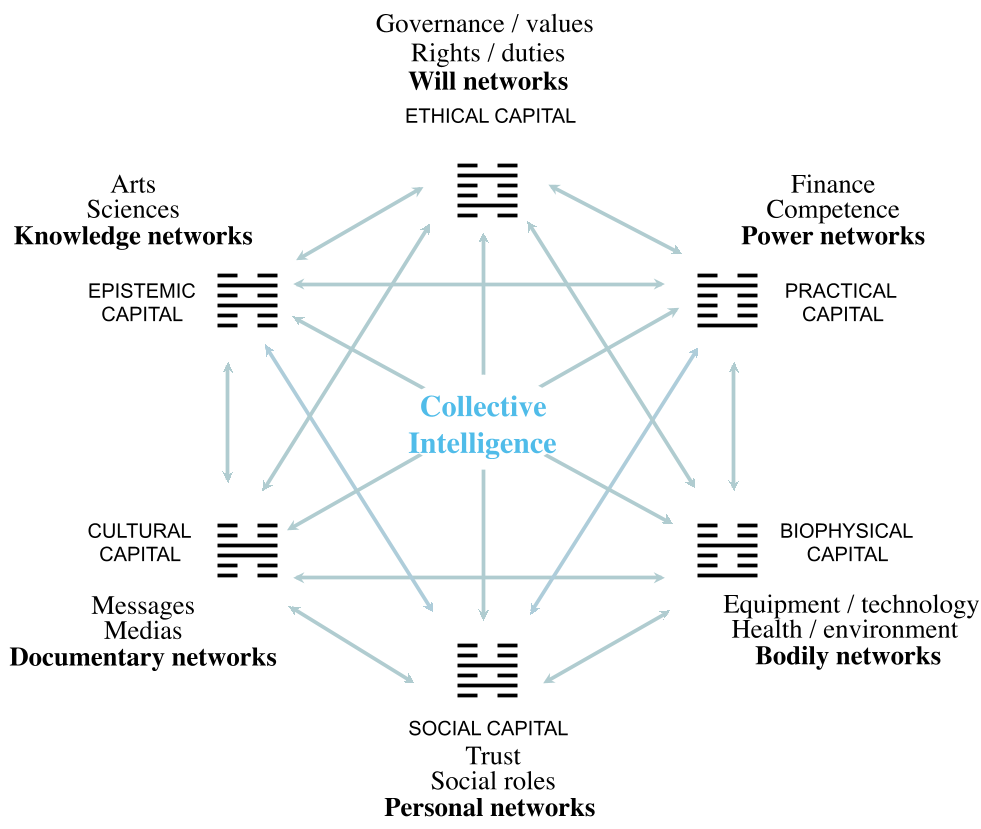 Figure 2: The Six-Fold model of Collective Intelligence, mapped via IEML primitives (E, U, A, S, B, T).
Critical Analysis: A Scientific Revolution in the Humanities?
The ambition of IEML is staggering. It seeks to do for "Meaning" what the Enlightenment did for "Space and Time"—standardize it so it can be explored scientifically.
The SOTA Perspective: Compared to the "Web of Data" (RDF/OWL), IEML is far more ambitious. While OWL focuses on logical relationships between symbols, IEML focuses on the internal structure of the symbols themselves. It is "Subject-Centric" rather than "Object-Oriented."
Limitations:
- Adoption Curve: For IEML to work, it requires widespread translation/mapping effort.
- Complexity: The rigorous syntax of IEML is a high barrier to entry for casual users compared to simple "hashtagging."
Conclusion: Reflections in the Cyber-Mirror
The ultimate goal of the IEML program is Self-Reference. When a community can see its own collective intelligence reflected through a unified semantic mirror, it can consciously direct its evolution. Lévy argues that this "reflexive leap" is the next necessary step in human development—a transition from a species that "happens" to have intelligence to a species that "manages" its collective mind.
Takeaway: IEML provides the "Grammatical Revolution" needed to turn the chaos of the Web into a structured, computable, and self-aware global memory.