
Beyond the Empty Matrix: Solving the New Item Problem in Social Event Recommendation
Toward the New Item Problem: Context-Enhanced Event Recommendation in Event-Based Social Networks
The paper introduces a "Context-Enhanced" event recommendation framework designed for Event-Based Social Networks (EBSNs) to address the "New Item Problem." It leverages a Learning to Rank (LTR) approach that unifies content similarity, dual-layer social influence (online and offline), and geographical local popularity to recommend upcoming events.
TL;DR
Recommending events is fundamentally harder than recommending movies or products. Why? Because every event is a New Item. By the time you have "rating data," the event is already over. This paper introduces a context-enhanced framework that replaces missing ratings with topic-based pseudo-ratings and integrates online/offline social signals via a Learning to Rank model to predict user attendance for future events.
The "New Item" Paradox
In traditional recommendation systems, we rely on the User-Item matrix. If User A and User B both liked The Matrix, we recommend User A's other favorites to User B. In Event-Based Social Networks (EBSNs) like Meetup or Douban, this logic collapses:
- Zero History: An upcoming event has no participants yet.
- Perishability: Once an event ends, recommending it is useless.
- Spatial Constraints: Unlike digital goods, events require physical presence, making geography a hard filter.
Existing solutions often ignore the Offline Social Network—the bond formed by people who actually meet in person—which is a much stronger predictor of behavior than simple online group membership.
Methodology: The Context-Enhanced Trinity
The authors propose a two-phase architecture: Contextual Feature Extraction followed by Pairwise Learning to Rank.
1. User Preference (The Pseudo-Rating)
Since there are no ratings, the authors use LDA (Latent Dirichlet Allocation) to map users and events into the same topic space. By calculating the Jensen-Shannon Divergence (JSD) between a user’s interest profile and an event’s description, they generate a similarity score. This score acts as a "pseudo-rating," allowing traditional CF-style logic to function.
2. Social Influence: Online meets Offline
The paper makes a critical distinction:
- Online Friends: People in the same digital group.
- Offline Friends: People who have actually attended the same events in the past. The social influence is calculated by weighted averaging the pseudo-ratings of a user's friends, acknowledging that offline ties often carry more "decision-making weight."
3. Local Popularity (Geographical Intelligence)
To help cold-start users (those with no friends or history), the system calculates what is "hot" in their specific city. They estimate local interest using Maximum Likelihood Estimation (MLE) of topics within a geographical region.
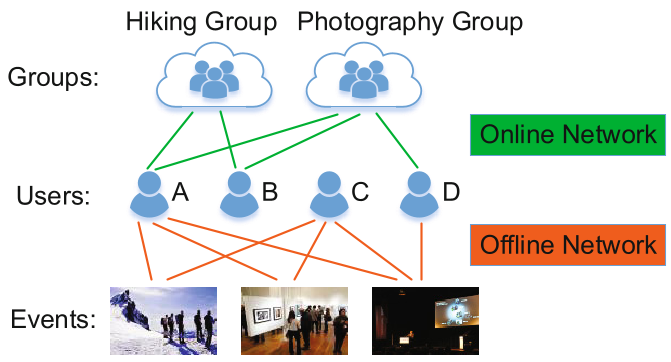 Figure 1: Illustration of the dual social network structure (Online vs. Offline) in EBSNs.
Ranking via SVM
Instead of just predicting a score, the authors treat this as a Ranking Problem. They employ a Ranking SVM with a hinge loss function. This model learns to compare two events and decide which one User is more likely to attend, balancing the loss to ensure "power users" (those with many registrations) don't bias the model against casual users.
Experimental Validation
The model was tested on a real-world dataset crawled from Meetup.com, containing over 100k users and 86k events.
Key Breakthroughs:
- Holistic Advantage: The "Context" method (using all features) outperformed single-feature baselines (Content-only or Social-only) in every metric.
- Sparsity Resilience: Despite the extremely low density of the data, the inclusion of "Local Popularity" significantly bolstered performance for cold-start scenarios.
 Table 1: Performance comparison showing the Context-Enhanced method achieving the highest HitRate, Precision, and Recall.
Critical Insight & Future Outlook
This paper’s true value lies in its treatment of Offline Social Ties as a first-class citizen. While many social recommenders focus on "Follow" or "Like" buttons, this work recognizes that co-attendance is a high-signal behavioral indicator.
Limitations: The model currently assumes a static interest profile. In reality, user interests and the "vibe" of a city shift over time. Future Work: Incorporating temporal awareness (e.g., weekend vs. weekday preferences) and the reputation of the event organizer could further refine the ranking precision.
Takeaway for Engineers: When building for ephemeral markets (events, news, limited-time offers), stop chasing the rating matrix. Build a robust Content-to-Topic bridge and use contextual metadata to simulate the missing feedback loop.