
Elevating Semantic Queries: Smart Coding Support Through Ontology Mappings and ML
Towards Better Query Coding Support Utilizing Ontology Mappings
The paper introduces an enhanced prototype system that facilitates the coding of SPARQLoid queries by integrating vocabulary and endpoint recommendation mechanisms based on ontology mappings. By leveraging machine learning and Word2Vec-based similarity, it assists users in identifying and utilizing heterogeneous Linked Open Data (LOD) sources more efficiently.
TL;DR
Accessing the vast world of Linked Open Data (LOD) usually requires deep knowledge of specific ontologies. This paper presents an upgraded SPARQLoid prototype that simplifies this process. By utilizing ontology mappings, Word2Vec for semantic validation, and Machine Learning for endpoint availability prediction, the system provides a semi-automatic query coding environment that is 3x faster than previous iterations.
The Semantic Barrier: Why SPARQL Coding is Hard
The Linked Open Data cloud contains hundreds of SPARQL endpoints, each often using its own unique vocabulary (ontology). For a user, this creates two major pain points:
- Vocabulary Mismatch: If you don't know the exact IRI for "City" or "Population" used by a specific database, you can't query it.
- Endpoint Volatility: With over 500 endpoints online, many are slow or unavailable. Manually checking which endpoints contain your data and are actually "alive" is a massive waste of time.
Methodology: Bridging the Gap with SPARQLoid
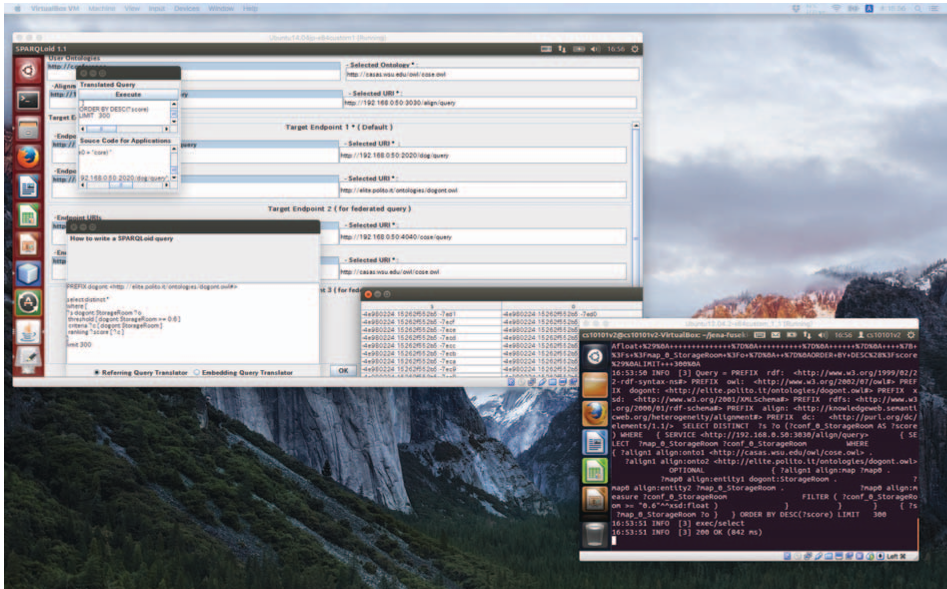
The authors build upon SPARQLoid, a framework that allows users to write queries using "well-known" ontologies. These queries are then translated into standard SPARQL using weighted ontology mappings.
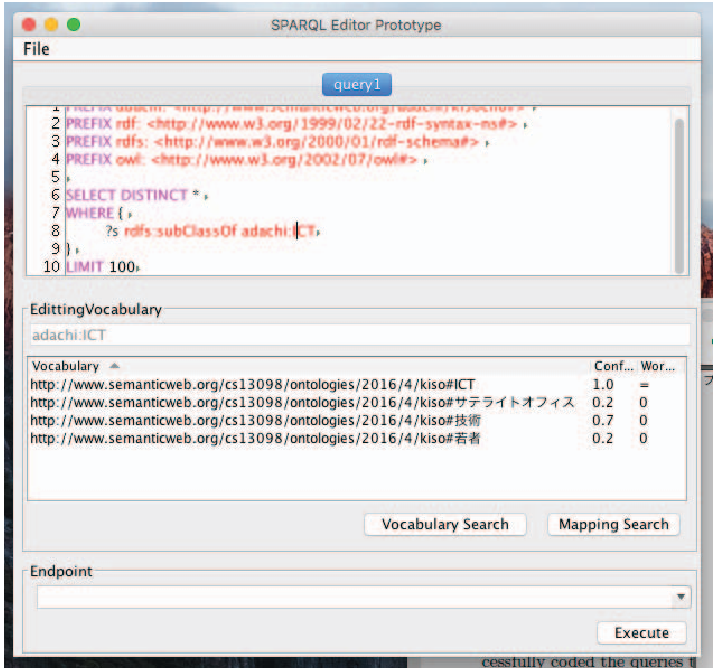
1. Vocabulary Search via Word2Vec
When a user types a keyword, the system searches through existing ontology mappings. To ensure these mappings are actually semantically sound, the authors integrated Word2Vec. By calculating the vector similarity between the user's term and the mapped IRI, the system provides a "sanity check" alongside the mapping's original confidence score.
2. ML-Driven Endpoint Recommendation
The most significant bottleneck in previous systems was evaluating endpoint availability. To solve this, the authors moved from brute-force checking to predictive modeling. By training classifiers (C4.5, NaiveBayes, Boosted Decision Stumps) on performance data from "SPARQL Endpoint Status," the system can predict whether an endpoint is worth investigating.
Experimental Results: Speeding Up Discovery
The integration of Machine Learning led to a dramatic improvement in efficiency:
- Baseline Investigation Time: ~27 minutes.
- ML-Optimized Time: 8.3 minutes.
- Accuracy: The "Boosted Decision Stamp" classifier achieved a precision of 0.855 and an F-measure of 0.885, proving that the system can accurately ignore "dead" or irrelevant endpoints without missing valuable data.
Critical Analysis & Future Outlook
The core contribution here is the transition from a purely "semantic" lookup to a "performance-aware" semantic lookup. By treating endpoint discovery as a classification problem, the authors moved the needle on usability.
Takeaways:
- Hybrid Validation: Combining human-defined weights with unsupervised embeddings (Word2Vec) creates a more robust recommendation system.
- Efficiency Matters: In the Semantic Web, logic and reasoning are often slowed down by network latency; ML is a viable tool for pruning the search space.
Limitations: While the time reduction is significant, 8 minutes is still a long wait for an interactive coding session. Future work involving Online Learning and Multi-armed Bandit algorithms could potentially reduce this to seconds by learning from user interactions in real-time.
Summary of Performance Metrics
| Classifier | Precision | Recall | F-Measure |
|---|---|---|---|
| BoostedDecisionStamp | 0.855 | 0.921 | 0.885 |
| C4.5 | 0.853 | 0.919 | 0.883 |
| NaiveBayes | 0.828 | 0.779 | 0.801 |