
EDISON: Shattering the Cloud Bottleneck for Smart City Environmental Sensing
Towards EDISON: An Edge-Native Approach to Distributed Interpolation of Environmental Data
This paper introduces EDISON, an edge-native framework for distributed interpolation of city-scale environmental data. It leverages AI and horizontally distributed edge servers to transform sparse sensor observations into a dense spatio-temporal grid, achieving performance near that of centralized global models.
TL;DR
Smart cities generate torrents of data that overwhelm centralized cloud systems. EDISON (Edge-native Distributed Interpolation of SenSor Networks) is a novel architecture that moves environmental data modeling from distant data centers to the network's edge. By using overlapping local models and a smart consensus algorithm, it provides high-accuracy weather and environmental mapping with significantly reduced latency and bandwidth requirements.
Positioning the Work
In the landscape of Smart Cities, we have transitioned from "not enough data" to "too much data to move." EDISON sits at the intersection of Edge AI and Geostatistics, moving beyond simple data relaying to performing sophisticated spatial interpolation (Kriging) locally. It represents a shift from cloud-centric "Big Data" to edge-centric "Distributed Intelligence."
Problem & Motivation: The Scalability Wall
Current weather and environmental monitoring systems are mostly built on a Centralized Paradigm. Sensors across a city send raw data to the cloud, which then processes it to fill in the gaps (interpolation).
However, this face three critical failures:
- Transmission Latency: Real-time applications like autonomous driving cannot wait for a cloud round-trip.
- Resource Exhaustion: As we add thousands of mobile sensors (on phones, buses, and drones), the bandwidth cost becomes prohibitive.
- Data Heterogeneity: Combining expensive, high-accuracy stationary stations with "cheap" mobile sensors requires local, agile calibration that clouds struggle to manage at scale.
Methodology: The EDISON Architecture
The core innovation of EDISON lies in how it handles Spatial Distribution without losing Global Context.
1. Spatial Partitioning and Overlapping Locales
Instead of treating the city as one block, EDISON divides it into a dense grid of "Observation Regions." Crucially, these regions are assigned to overlapping Edge Locales.
- Each region is governed by at least two edge servers.
- This overlap is the secret sauce—it allows neighboring servers to compare notes and ensure their models "agree" at the borders.
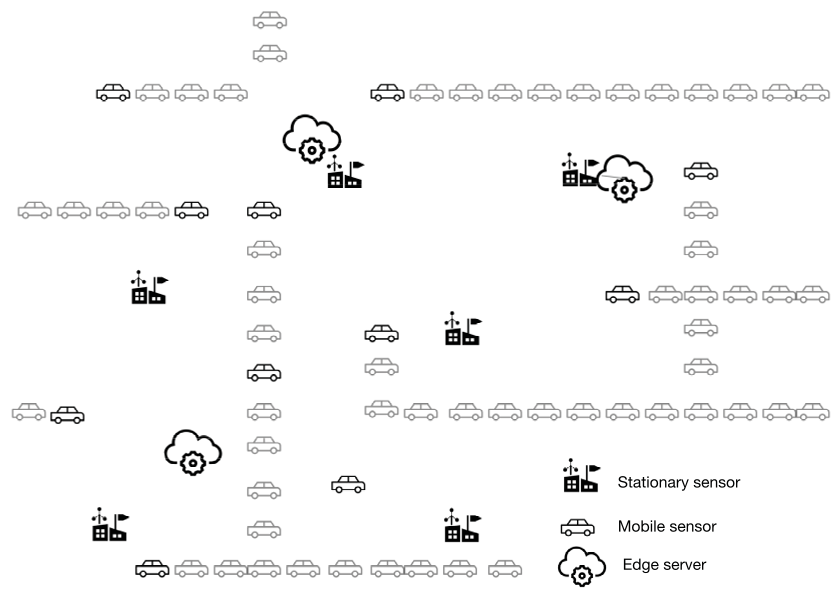 Figure 1: Heterogeneous sensor setup including stationary RWS and mobile vehicle sensors.
2. The Consensus Algorithm
EDISON doesn't just average data; it calibrates models.
- Local Training: Each edge server fits a local variogram (Kriging) using data within its locale.
- Model Exchange: Servers share "sufficient statistics" (not raw data, protecting privacy) with neighbors.
- Calibration: If a neighbor's model is more accurate on shared regions, the local server adjusts its parameters to reach a consensus.
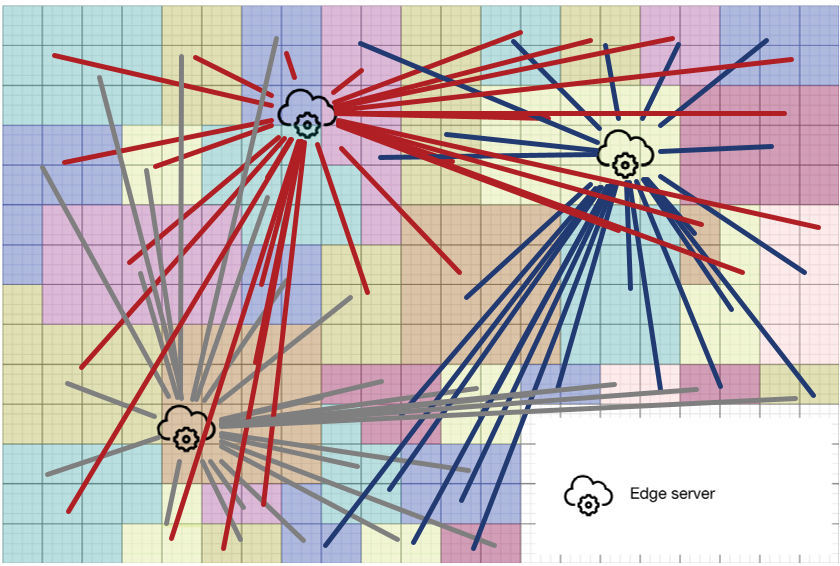 Figure 2: The logic of overlapping edge locales centered by edge servers.
Experiments & Results: Performance at the Edge
The authors simulated a 101x101 grid using Gaussian processes to mimic complex weather patterns (short and long-term covariance).
Quantitative SOTA Comparison
The results prove that decentralization doesn't have to mean a sacrifice in quality:
- Global Model (Cloud): 0.57 RMSE
- EDISON Consensus (Edge): 0.59 RMSE
- Raw Local Models: 0.61 - 0.63 RMSE
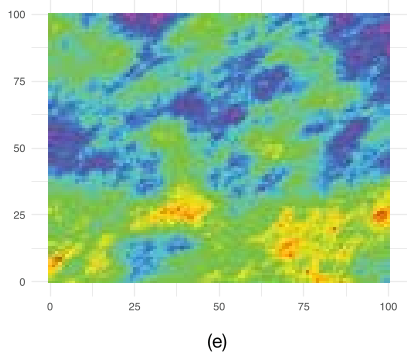 Figure 3: Visual comparison: (c) Consensus vs (d) Global Model vs (e) Ground Truth.
The Consensus Mechanism successfully recovered much of the accuracy lost by local partitioning, bringing the edge-native approach within 3.5% of the performance of an all-knowing global model.
Critical Analysis & Conclusion
Takeaway: EDISON proves that we can achieve "Cloud-level" accuracy using "Edge-level" resources. By focusing on model consensus rather than data aggregation, it provides a blueprint for private, low-latency urban sensing.
Limitations:
- The current study relies on simulated Gaussian data; real-world urban canyons and micro-climates may present more non-linear challenges.
- The computational overhead of frequent model re-calibration on low-power edge hardware remains to be fully explored.
Future Outlook: The integration of Federated Learning and Agent-based Modeling could further refine how these edge servers negotiate, potentially leading to a self-organizing "weather web" that requires zero human intervention.