
CUDRT: Decoding the DNA of AI-Generated Text via Five Core Operations
Towards Reliable Detection of LLM-Generated Texts: A Comprehensive Evaluation Framework with CUDRT
This paper introduces CUDRT, a comprehensive bilingual evaluation framework and large-scale benchmark for detecting LLM-generated texts. It categorizes LLM activities into five core operations—Create, Update, Delete, Rewrite, and Translate—incorporating outputs from state-of-the-art models like GPT-4, Llama3, and Qwen to test detector reliability.
TL;DR
As LLMs become indistinguishable from human writers, standard detection benchmarks have become outdated. CUDRT (Create, Update, Delete, Rewrite, Translate) is a new bilingual framework that moves beyond simple Q&A tasks to evaluate detectors across the full spectrum of AI text manipulation. The study reveals that training on specific AI operations—like text deletion—is the "secret sauce" for building detectors that generalize across different models.
Background: The Moving Target of Detection
Current LLM detectors often operate in a vacuum, trained on static question-answering datasets like HC3. However, in the real world, AI isn't just "creating"; it is polishing drafts (Update), summarizing reports (Delete), and translating news (Translate). CUDRT identifies a critical gap: existing detectors are brittle when faced with tasks they haven't seen during training, especially in non-English contexts.
Methodology: The Five Pillars of CUDRT
The authors argue that the "purity" of human text and the "intent" behind AI generation are key. They curated 480,000 samples across:
- Create: Completing sentences or answering questions.
- Update: Polishing for fluency or expanding on details.
- Delete: Summarizing or refining text for conciseness.
- Rewrite: Style transformation while maintaining meaning.
- Translate: Bilingual English-Chinese conversion.
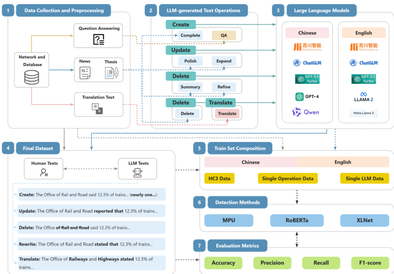
The framework adopts a "Train-then-Test" philosophy. Instead of just running a pre-trained detector, the authors analyzed how training on one specific operation (e.g., Rewrite) allows a model (like RoBERTa or XLNet) to detect text from another operation (e.g., Create).
The Perplexity Insight
Using Perplexity (PPL) as a proxy for "AI-ness," the authors found that LLM-generated text is significantly more "concentrated" and predictable than human text across almost all operations—except translation. In translation, the gap between AI and human PPL narrows, explaining why translation is the hardest operation to detect.
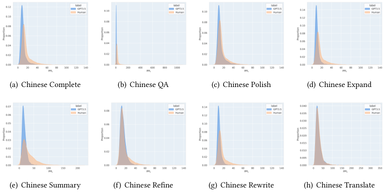
Experimental Analysis: What Makes a Good Detector?
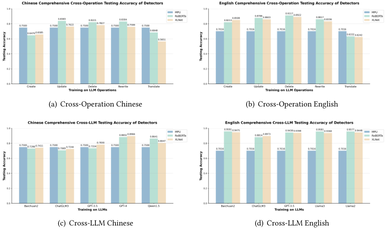
Through extensive cross-operation and cross-model testing, the research unearthed three major insights:
- The "Delete" Advantage: Models trained on "Delete" operations (summaries) showed superior generalization. Why? Because when an LLM deletes or refines text, it leaves behind structural "fingerprints" that are more distinctive than when it simply generates new text from scratch.
- The SOTA Convergence: Detectors trained on high-tier models like GPT-4 and Qwen1.5 were surprisingly better at spotting text from "weaker" models. This suggests that the highest-performing LLMs have the most recognizable structural patterns.
- Language Barriers: Detecting Chinese AI text remains harder than English. The structural nuances of Chinese require more specialized attention-based models to achieve the same F1-scores seen in English benchmarks.
Critical Analysis & Conclusion
While CUDRT provides a massive leap forward in benchmarking, the study admits that "Translate" and "Delete" tasks remain the frontier for detection failure. Short, highly constrained AI outputs still look too much like human writing.
Future Outlook: The next generation of detectors shouldn't be "general-purpose." To be truly reliable, systems must be "Operation-Aware"—identifying whether a text was meant to be a summary or a creative piece before applying a detection score. CUDRT provides the blueprint for this transition, moving detection from a game of chance to a rigorous science.