
Towards Self-Regulating AI: Re-imagining Model Governance in Finance
Towards Self-Regulating AI: Challenges and Opportunities of AI Model Governance in Financial Services
This paper proposes a system-level framework for "Self-Regulating AI" in financial services, focusing on automating model governance and risk management. It introduces a modular architecture designed to provide continuous monitoring, mitigation, and reporting to ensure robustness and regulatory compliance.
TL;DR
As AI models move from experimental toys to the backbone of financial decisions, the legacy governance processes—built for static spreadsheets—are breaking. This paper from researchers at Columbia and JPMorgan Chase outlines a path toward Self-Regulating AI: a system-level framework that integrates continuous monitoring, automated reporting, and real-time risk mitigation into the AI lifecycle.
Current Standing: This is a foundational "outlook" paper that shifts the conversation from manual audit trails to autonomous system-level compliance.
The "Broken" Reality of AI Governance
Traditional financial governance (rooted in the OCC and CRD IV regulations) expects models to have clear conditional dependencies and static assumptions. When applied to modern AI, this creates a "Governance Debt":
- Inertia: Reviews often take 12+ months. By the time a model is approved, the data distribution has already shifted.
- Complexity Wall: Manual, parameter-level reviews are impossible when the number of model parameters grows 10x annually.
- Fragmented Accountability: Complex review committees distribute decision-making power so widely that pinpointing responsibility becomes impossible.
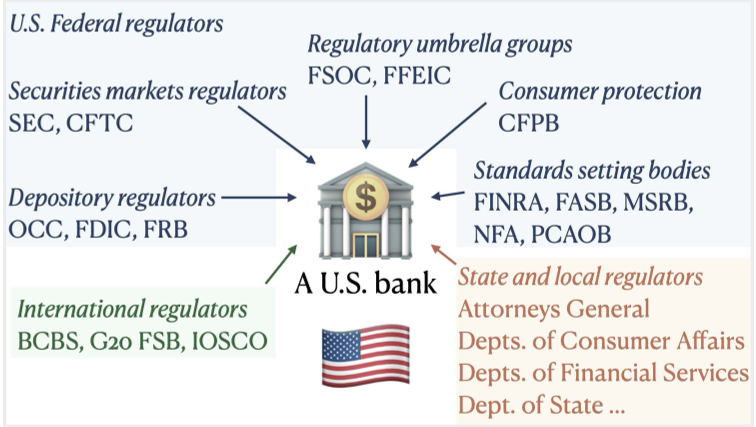 Figure 1: The labyrinth of local, state, federal, and international regulators that financial AI must satisfy.
Methodology: The Self-Regulating Framework
The researchers argue that governance shouldn't be a hurdle at the end of the race; it should be the track itself. They propose a System-Level Framework with three core pillars:
1. Decoupled Regulatory Modules
Instead of baking compliance into the AI model (which makes retraining a nightmare), the framework uses modular blocks for:
- Explainability: Generating adverse action notices in real-time.
- Fairness: Monitoring prediction accuracy deltas across demographic classes.
- Data Quality: Detecting missing or out-of-range "drifting" data before it impacts the score.
2. Continuous Run-Time Mitigation
Most governance today is "Off-line." This framework introduces Run-time Remediation:
- Controller Logic: If a primary AI model shows detectable bias in production, the "Governance Controller" can dynamically switch to a more conservative "shadow model."
- Post-processing: Real-time recalibration of model scores to compensate for detected environment shifts.
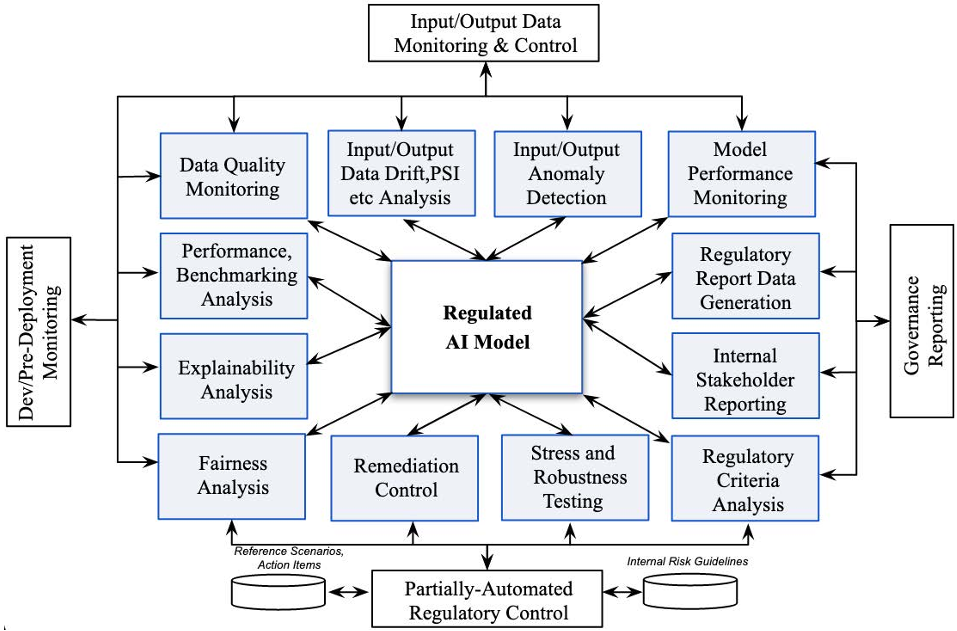 Figure 2: The proposed architecture where monitoring and mitigation wrap around the core AI model.
Critical Results & Industry Implications
The paper identifies that the "manual path" isn't just slow—it's risky. US financial institutions paid $320 billion in regulatory fines between 2008 and 2016 despite rigorous manual checks.
- Empirical Focus: The framework moves governance from "Why did the model pick this parameter?" to "How does the system behave under stress?"
- Agility: Automated reporting (Capability 1) reduces the feedback loop from months to days, allowing models to adapt to black-swan events like the global pandemic without waiting a year for re-approval.
Deep Insight: Is Full Automation Possible?
The authors are pragmatic. They don't advocate for "unsupervised" AI. Instead, they propose a "human-in-the-loop" alerting system where AI handles the data-heavy task of monitoring millions of transactions, and human committees focus on high-level risk appetite and policy configuration.
Future Outlook: We are moving toward a world where AI will govern AI. The data generated by continuous monitoring will eventually feed into "Generative Adversarial" stress tests, where one AI tries to find "compliance loopholes" in another, making the entire financial system more resilient.
Summary Takeaway
The era of "Model-as-a-Table" is over. We are in the era of "AI-as-a-System." Financial firms that fail to automate their governance modules will find themselves either crushed by compliance costs or left behind by more agile, self-regulating competitors.