
Dynamic Mobile Crowdsourcing: Optimizing the Human-Sensor Loop for Electricity Load Forecasting
SPECIAL SECTION ON TOWARDS SERVICE-CENTRIC INTERNET OF THINGS (IOT): FROM MODELING TO PRACTICE
This paper introduces a Dynamic Mobile Crowdsourcing (MC) selection method specifically designed for real-time electricity load forecasting. The core approach utilizes a time-aware worker ability model and a dynamic selection algorithm that manages the unpredictable arrival and departure of both tasks and workers, achieving performance close to offline optimal benchmarks.
TL;DR
Electricity load forecasting is shifting from centralized models to decentralized, crowdsourced data collection. However, the "dynamic" nature of human participation (workers arriving and leaving at will) creates a massive scheduling challenge. This paper proposes a dynamic selection method using Time-Aware Ability Thresholds and Task Priority to ensure that the most capable users are recruited for the right tasks at the right time.
Background: Why Static Models Fail in Smart Grids
Electricity load forecasting is the backbone of grid stability. While mobile devices provide a rich sensor network for collecting consumption data, current Crowdsourcing (MC) platforms often fail because they treat tasks and workers as a fixed pool. In a real-world scenario, a worker might only be available for a 15-minute window, and a forecasting task must be completed before a specific power-dispatch deadline. Static models cannot handle these "Dynamic Arrivals," leading to missed deadlines and poor data quality.
The Core Innovation: Time-Aware Ability Model
The authors define "Worker Ability" () not just as a static skill set, but as a multi-dimensional fitness function.
1. The Ability Matrix
The system maps tasks to workers using a keyword-space matrix, calculating familiarity with specific task categories (e.g., "photo collection" or "sensor reading").
2. Dynamic Adjustments
Crucially, the raw ability score is adjusted by three environmental factors:
- Distance: Proximity to the data collection point.
- Time: Using a truncated exponential function to favor workers who provide results early.
- Reputation: A history-based reliability score.
3. The Dynamic Threshold Mechanism
Instead of simply picking the "best available" worker (Greedy Strategy), the platform maintains a dynamic threshold () for each task.
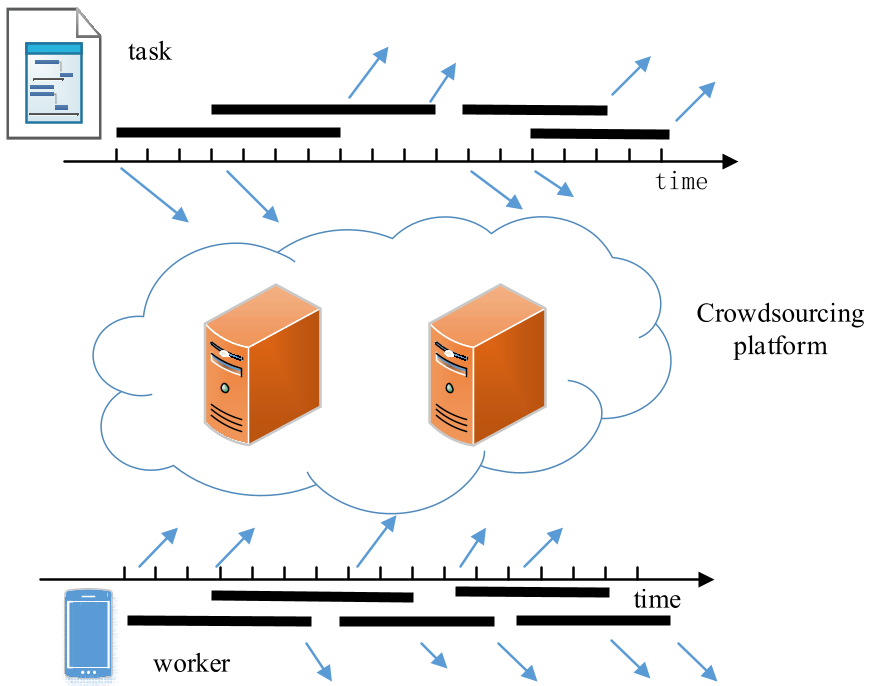 Figure 1: Workers and tasks join and leave the system at different time slots, necessitating a fluid selection strategy.
If a worker's ability exceeds the threshold, they are recruited. This threshold isn't static; it decreases as the task deadline approaches (to ensure completion) and increases after a successful recruitment (to aim higher for the remaining slots).
Methodology: Avoiding "Task Hunger" through Priority
A common problem in dynamic systems is that high-ability workers are all "gobbled up" by popular tasks, leaving niche tasks unfulfilled—a state known as "hunger." The authors solve this by introducing Task Priority (): Where:
- : Number of workers still needed.
- : Remaining time for the task.
By weighting worker selection with this priority, the system ensures that urgent tasks or tasks with large quotas get the resources they need before their window of opportunity closes.
Experimental Results
The researchers compared their Dynamic method against a Greedy approach and an Offline benchmark (the "perfect" scenario where all arrival times are known in advance).
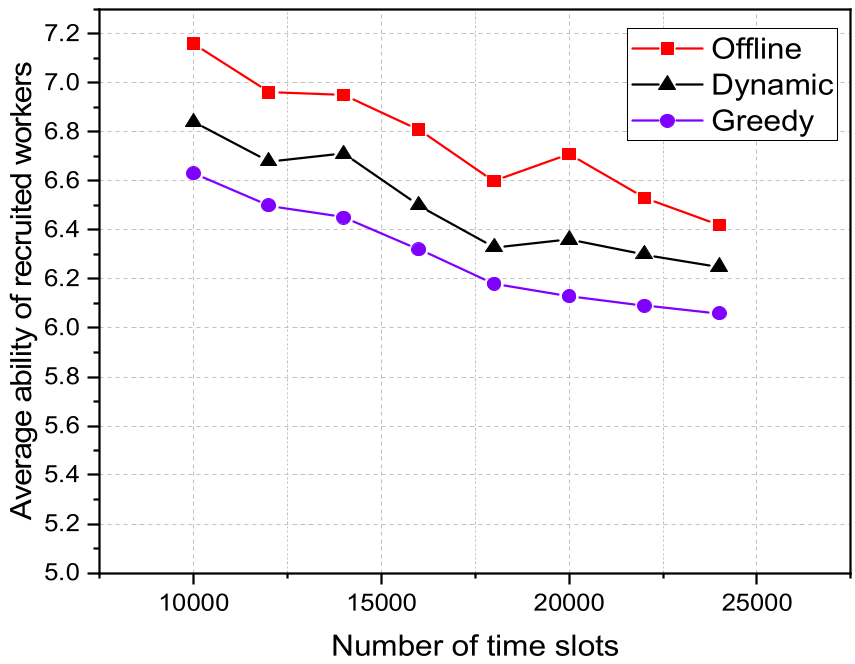 Figure 2: Performance metrics across varying worker populations.
Key Findings:
- Average Ability: The Dynamic method consistently recruited higher-quality workers compared to the Greedy approach, showing that "waiting" for a better worker based on threshold logic pays off.
- Completion Rate: As the number of tasks increases (and resources become scarce), the Dynamic method maintains a significantly higher completion rate, proving the effectiveness of the priority mechanism.
Critical Insight & Future Outlook
The brilliance of this work lies in its acceptance of uncertainty. By using a threshold that "decays" over time, the algorithm mimics human intuition—holding out for high quality but eventually settling for "good enough" as the deadline nears.
Limitations: The authors admit that Privacy Preservation is a missing piece. Collecting energy data involves sensitive user habits. Future iterations must integrate Differential Privacy or Federated Learning to protect workers while maintaining the utility of the data.
Conclusion: This research provides a robust blueprint for managing the "Gig Economy" of sensor data, turning a chaotic flow of mobile users into a reliable stream of intelligence for the smart grid of tomorrow.