
From Static Mashups to Social Things: The STN Model for a Ubiquitous Web
Towards a Social and Ubiquitous Web: A Model for Socio-technical Networks
Towards a Social and Ubiquitous Web introduces a formal model for Socio-Technical Networks (STNs) to integrate physical devices (WoT) as first-class social citizens. The method leverages a Semantic Web overlay—implemented via the STN Ontology—to enable autonomous discovery and interaction among people and "things" across heterogeneous platforms like Twitter and Facebook.
TL;DR
The Web of Things (WoT) is expanding at a rate that makes manual integration impossible. This paper proposes a Socio-Technical Network (STN) model that applies social networking metaphors to things. By treating devices as "smart agents" within a semantic overlay, we can move beyond static, fragile "wiring" to a dynamic, autonomous ecosystem where things friend, follow, and discover each other just like humans.
The Scalability Wall: Why Your Smart Home is Still "Dumb"
Metcalfe’s Law tells us that network value grows with the square of its nodes. However, as we add billions of IoT devices, the "affinity" (value per connection) often drops because the cost of integration becomes overwhelming. Currently, we rely on:
- Manual Mashups: Developers "wire" devices together (e.g., IFTTT), which is labor-intensive and doesn't scale.
- Static Interfaces: Once a connection is made, it can't adapt if the environment changes.
- Walled Gardens: Facebook and Twitter aren't built for a toaster to talk to a vacuum cleaner autonomously.
The authors argue that the only way to manage this complexity is to grant "things" social agency.
Methodology: The Socio-Technical Overlay
The core of the paper is a formal mathematical definition of an STN. It isn't just a graph; it's a dynamic system.
The Formal Model
An STN (s) is defined as:
- (Socio-Technical Graph): The state of the network at time t, containing agents (people/things) and artifacts.
- : Valid actions like
createConnectionToorsendMessage. - : Policies (privacy, rate limits) that regulate these actions.
- (Ontology): The shared vocabulary that gives everything meaning.
Architecture Layers
- Agency Layer: Distinguishes between "Agents" (autonomous/social) and "Artifacts" (passive resources).
- Social Layer: Where the "connectedTo" relationships live.
- Normative Layer: The "rules of the road" (e.g., a smart car must interpret local driving regulations).
(Note: Refer to Figure 1 in the paper for the STN Browser interface and structural flow)
Validation: Bridging ThingsNet, Twitter, and Facebook
How do you prove a model meant for "everything" works? The authors built three distinct implementations:
- ThingsNet: A "thing-friendly" social platform using WebID and Turtle (RDF). It allows things to register and interact without human intervention.
- Twitter Wrapper: Leveraging Twitter's open identity (anyone/anything can be a user) to map "Following" to STN operations.
- Facebook Wrapper: Despite Facebook's human-centric restrictions, they demonstrated how things could use the platform as an information source (Artifact).
The STN Browser
They developed a software client that is "API-agnostic." It doesn't know how Twitter's API works internally; it simply reads the STN Semantic Description, understands that a follow operation requires a screen_name via an HTTP POST, and executes it.
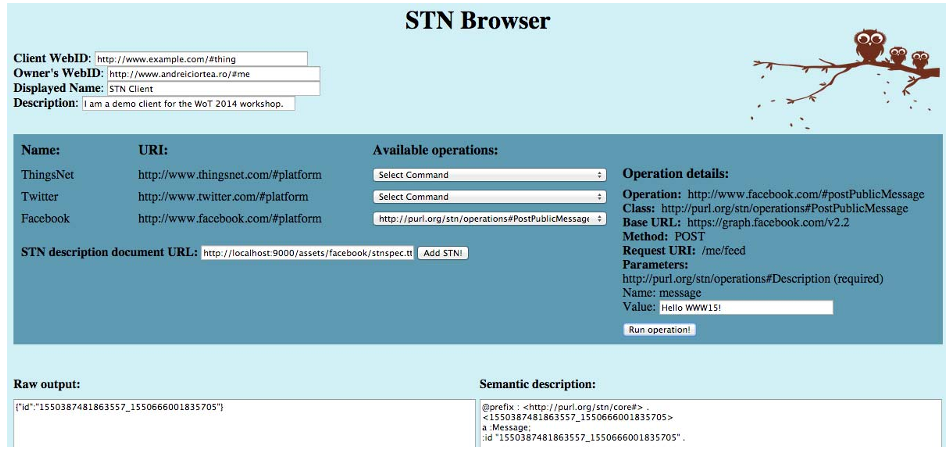 Fig 1. The STN Browser demonstrating a uniform interface for posting to Facebook using the semantic model.
Critical Insight: Autonomous Governance
The real power of this model isn't just connectivity; it's Autonomy & Regulation. By separating the Normative Layer from the Agency Layer, we can change the rules (e.g., privacy settings) without reprogramming the device. This provides a "social control" mechanism for the IoT, using trust and reputation to manage how things interact.
Conclusion & Future Outlook
The STN model provides the "glue" for a Social Web of Things. While the current implementation has limitations—such as the rich complexity of Facebook profiles being hard to map to a simple ontology—the objective of an interoperable backbone is achieved.
Future Work: The next leap is the "Normative Layer"—how do we make legal and social norms fully machine-readable so that a robot can "understand" a privacy policy before it decides to share data?
Key Takeaways
- Interoperability is achieved through semantic descriptions, not just standardized APIs.
- Social Agency allows the Web of Things to scale by delegating discovery and wiring to the devices themselves.
- Semantic Web + IoT is a necessary marriage for a sustainable ubiquitous web.