
Towards a Society of Peers: Evolution of Semantic P2P Networks
Towards a society of peers: Expert and interest groups in peer-to-peer systems
This paper introduces a social-inspired P2P architecture that organizes nodes into "Expert" and "Interest" groups to enhance information retrieval. By adaptively learning peer expertise (stored content) and interests (queried topics), the system builds a semantic overlay on top of unstructured networks using dynamic routing indices.
TL;DR
This research moves P2P systems away from "blind" message flooding toward a socially-aware architecture. By treating peers as individuals with specific Expertise (what they know/store) and Interests (what they seek), the system adaptively restructures its connections to ensure queries find the right "communities" in the fewest hops possible.
Problem & Motivation: The Chaos of Unstructured Networks
In early P2P systems, finding a file was like shouting in a crowd and hoping the right person heard you. The overhead was massive, and the "noise" (redundant messages) made the system unscalable. While "Routing Indices" were introduced to give peers a better "sense of direction," they were often static or failed to capture the organic way users behave.
The authors argue that a P2P network is essentially a social network of digital entities. If we can observe how a peer behaves—what it stores and what it asks for—we can cluster similar peers together. This creates a "Small-World" effect where nodes with similar knowledge are just one hop away.
Methodology: The Architecture of Communities
The core of the proposal is a dynamic Routing Index that acts as a specialized address book. The system defines two primary types of overlays:
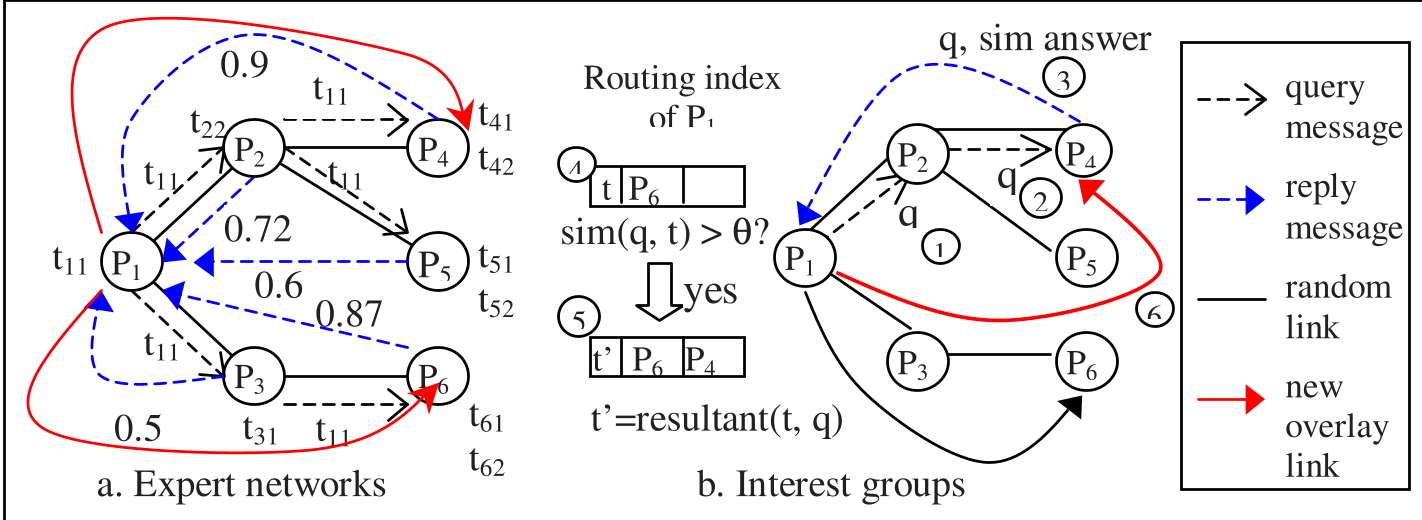
1. Expert Networks (Content-Centric)
Peers summarize their local documents into Feature Vectors (centroids). When a peer joins, it broadcasts these vectors. Neighbors calculate the similarity between their own content and the newcomer. If they are an "Expert" match, they establish a preferential link.
2. Interest Groups (Query-Centric)
Interests are fleeting. This architecture tracks the topics of queries a peer issues over time. If Peer A consistently gets successful answers from Peer B, a "shortcut" is created. This reflects human social behavior: we remember who answered our niche questions last time.
3. Propagation Strategies
To keep the network updated, the authors tested four strategies. The Dual Propagation strategy proved most effective, where expertise information is exchanged both backward (to the sender) and forward (to the destinations) during every query transaction.
Experiments & Results: Focused Searching
The authors simulated 4,000 nodes using the PeerSim framework. The results confirm a fundamental trade-off in P2P design:
- Traffic Reduction: Increasing the number of expert neighbors significantly reduces the total number of messages (see Fig 2). The search becomes a "sniper shot" rather than a "shotgun blast."
- The Reachability Paradox: Figure 3 reveals that too much grouping can sometimes lower total answered queries if the query is unrelated to the peer's group. This highlights the need for a Hybrid Approach that maintains some random links for exploration.
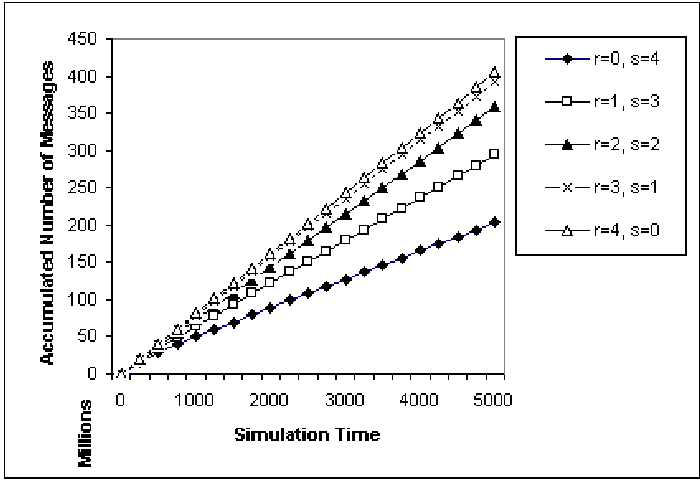 Fig 2. As we use more expert links (S) instead of random ones, the message counts drop drastically.
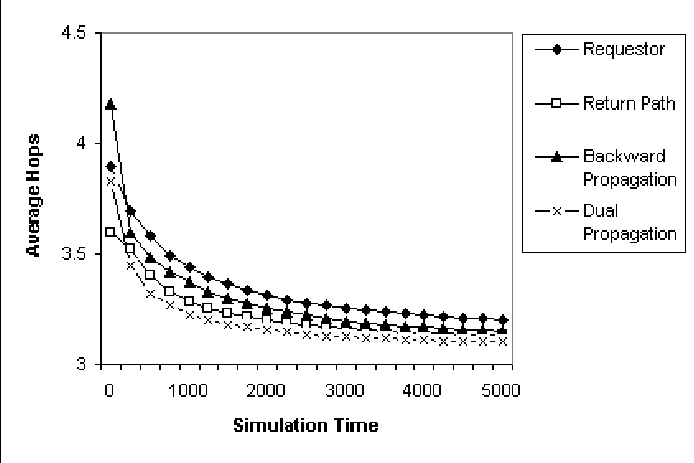 Fig 8. Increasing the Time-To-Live (TTL) for advertising during the joining phase dramatically reduces the hops needed to find an answer later.
Critical Analysis & Conclusion
The "Society of Peers" concept provides a robust framework for decentralized systems. Its strength lies in its Inductive Bias: the assumption that both content and interests are naturally clustered, not uniformly distributed.
Takeaway: This work demonstrates that decentralized systems don't need a global map to be efficient. By localizing "who knows what," the network can evolve into a highly efficient semantic structure.
Limitations: The paper assumes keywords can be easily mapped to vectors. In modern contexts, we would likely replace these simple vectors with LLM Embeddings to capture even deeper semantic relationships. Future research could investigate how these social metaphors hold up in adversarial environments where "experts" might be malicious.