
Beyond Efficiency: Decoding the CM-U Theory of Cultural Usability
Towards a Theory of Cultural Usability: A Comparison of ADA and CM-U Theory
This paper introduces the Cultural Model of Usability (CM-U) theory, a framework that treats usability as a distributed cognition process across individual, tool, and situational models. It challenges the "culture-blind" traditions of HCI by comparing CM-U with Artifact Development Analysis (ADA) theory to explain cross-cultural variations in user behavior and evaluation.
TL;DR
Is "easy to use" a universal concept? Probably not. This paper introduces the Cultural Model of Usability (CM-U) theory, arguing that usability is a product of distributed cognition across users, tools, and evaluation contexts. By comparing it with the Artifact Development Analysis (ADA) theory, the research reveals that Western users view usability through the lens of performance, while Eastern users often prioritize aesthetic and emotional value.
The "Culture-Blind" Fallacy in HCI
For decades, the Human-Computer Interaction (HCI) field operated under a "moderate universalism" or outright "culture-blindness." It was assumed that if a button worked in London, it should work the same way in Beijing, provided the language was translated.
The author, Torkil Clemmensen, argues that this ignores the Cultural Models—the "folk theories" of how the world works. For instance, Westerners (influenced by Aristotelian logic) tend to focus on discrete objects, while Easterners (influenced by Confucian thought) focus on the context and the relationships between objects. These cognitive styles fundamentally change how a user "sees" an interface.
Methodology: The Three Pillars of CM-U
The CM-U theory moves away from seeing culture as a "variable" and instead views it as a distributed system. It suggests that usability happens when three distinct models align:
- Individual Cultural Models: The user's internal goals, actions, and emotions.
- Artifact Cultural Models: The "theories" and affordances built into the tool by the designer.
- Situational Models: The specific context of use or evaluation (e.g., a formal usability lab vs. home use).
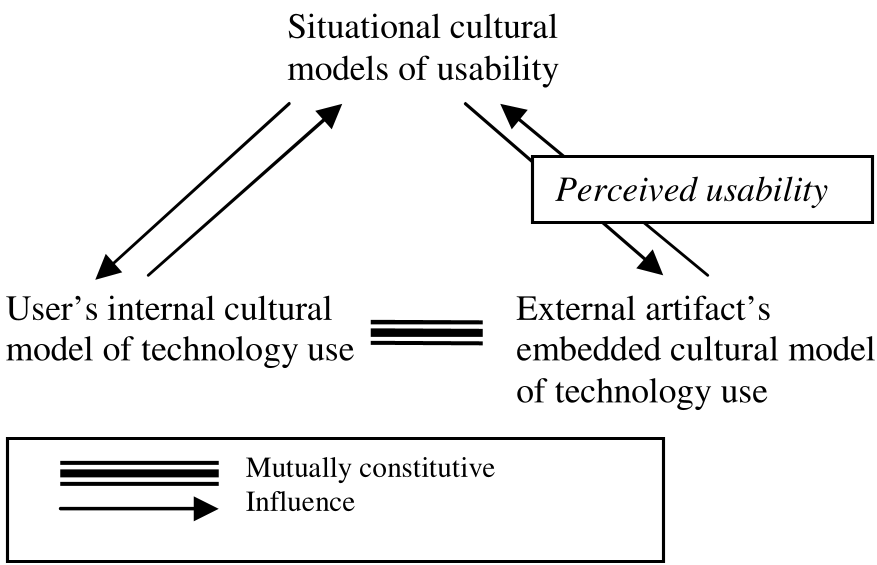 Figure 1: The mutual constitution of internal and artifact cultural models, mediated by the evaluation situation.
Head-to-Head: CM-U vs. ADA Theory
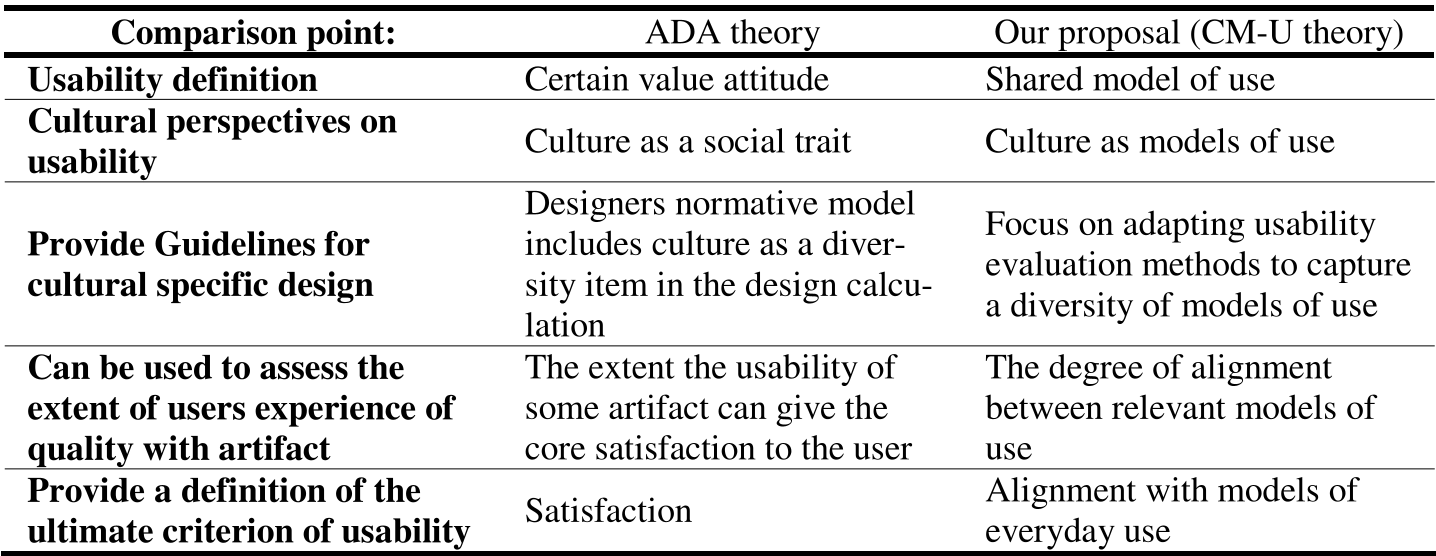
The paper performs a critical comparison between the proposed CM-U Theory and the ADA Theory (Artifact Development Analysis).
- ADA Theory views usability as a "Value Attitude." It categorizes user needs into Functional, Aesthetic, Sensibility, and Ethical values. Its ultimate criterion is Satisfaction.
- CM-U Theory views usability as a "Shared Model of Use." It focuses on the alignment between the user's mental model and the tool's built-in logic. Its ultimate criterion is Alignment with everyday use.
Comparison Table Summary
| Feature | ADA Theory | CM-U Theory |
|---|---|---|
| Usability Def. | Value Attitude | Shared Model of Use |
| Perspective | Culture as a Social Trait | Culture as Models of Use |
| Ultimate Goal | User Satisfaction | Alignment of Models |
Key Insight: Cultural Biases in Evaluation
One of the most striking findings is that our evaluation methods are not neutral. The "Think-Aloud" protocol, a staple of Western usability testing, encourages users to focus on "foreground objects" (the interface elements). This aligns perfectly with Western cognitive styles but may feel unnatural or produce skewed data when used with holistic thinkers.
- Danish/Western Users: Prioritize effectiveness, efficiency, and lack of frustration. Their "folk theory" of usability is performance-centric.
- Chinese/Eastern Users: Show higher concern for visual appearance, fun, and satisfaction. Their "folk theory" is more holistic and emotion-centric.
Critical Analysis & Takeaways
The research concludes that there is no "one true theory" of cultural usability. Instead:
- CM-U is better for cross-cultural comparisons where task performance is the primary focus.
- ADA is preferable when the goal is to understand emotional and aesthetic preferences.
The Great Limitation: Most HCI practitioners are using Western-developed theories to evaluate global products. This "Theoretical Bias" means we might be identifying "problems" that aren't actually problems for the target culture, while missing deep cognitive misalignments.
Future Outlook: Designers should move beyond simple "localization" (translating text) to "culturalization"—adapting the very logic and evaluation methods of the software to fit the cultural models of the target audience.