
Tower of Babel: Gamifying the Construction of Sentiment Lexicons for Resource-Scarce Languages
Tower of babel: a crowdsourcing game building sentiment lexicons for resource-scarce languages
This paper introduces Tower of Babel (ToB), a language-independent Crowdsourcing Game (or Game with a Purpose, GWAP) designed to construct sentiment lexicons for resource-scarce languages. By transforming the arduous task of manual word labeling into a Tetris-like collaborative game, ToB achieves high-quality sentiment classification for languages like Korean while significantly reducing time costs and improving user engagement.
TL;DR
While the English-speaking world enjoys a wealth of sentiment analysis tools, many "resource-scarce" languages lack the foundational lexicons to perform basic emotion mining. This paper presents Tower of Babel (ToB), a collaborative, Tetris-like game that turns the tedious task of labeling words into an engaging social experience. The study proves that we can build accurate linguistic resources faster and with more enjoyment than traditional manual annotation.
The Problem: The "English Slant" in AI Data
Sentiment analysis—classifying text as positive, negative, or neutral—is a cornerstone of modern social media monitoring and stock market prediction. However, there is a massive imbalance: while over 60% of Twitter content is non-English, sentiment lexicons are overwhelmingly English-centric.
Acquiring these lexicons for other languages usually involves:
- Manual Annotation: Accurate but painfully slow and expensive.
- Machine Translation: Fast but misses cultural nuances and loses subjective meaning.
- Bootstrapping: Requires existing ontological resources (like WordNet) which many languages don't have.
The authors' insight was simple: if people spend 3 billion hours a week playing games, why not channel that energy into solving the linguistic data scarcity problem?
Methodology: Tetris with a Purpose
The core of Tower of Babel is the integration of "labor" into "play." The researchers used the Black Box theory (Input-Process-Output) to deconstruct labeling and re-engineer it into a gaming loop.
1. Game Mechanics: Collaborative Placement
ToB adapts the familiar mechanics of Tetris. Instead of geometric shapes, players receive word-blocks. At the bottom of the screen are three stacks: Positive, Neutral, and Negative.
- The Challenge: You must move and drop the word into the correct sentiment stack before it hits the bottom.
- Social Motivation: Players are matched in pairs. You only score "Hits" and earn points if your partner places the same word in the same stack.
2. Quality Control: Output Agreement
This is not just for fun; it's a validation strategy. By requiring two independent players to agree on a sentiment, the system filters out noise and low-effort entries without needing a "Gold Standard" expert list.
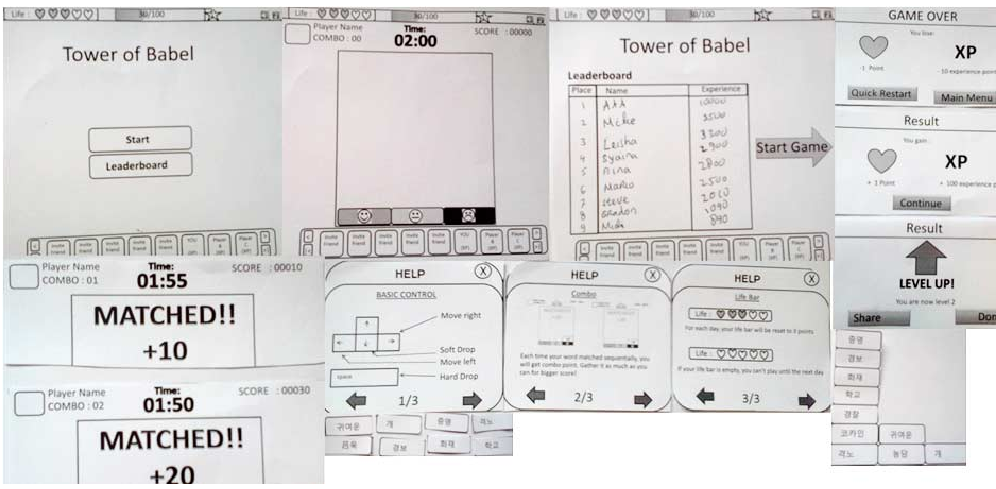 Figure 1: Early-stage paper prototyping used to refine the user interface and synchronization logic.
Experiments & Results: Fast, Accurate, and Fun
The authors tested ToB against a conventional web survey (manual condition) with 135 participants.
- Accuracy: There was no statistically significant drop in accuracy. ToB achieved a precision of 0.80, matching the manual method's 0.81.
- Efficiency: This is where ToB shines. The game was significantly faster, reducing the average time to complete the set from 242 seconds to 175 seconds.
- Consistency: ToB showed a trend towards higher inter-judge agreement (Krippendorff’s α), likely because the game environment forces players to make quick, intuitive judgments.
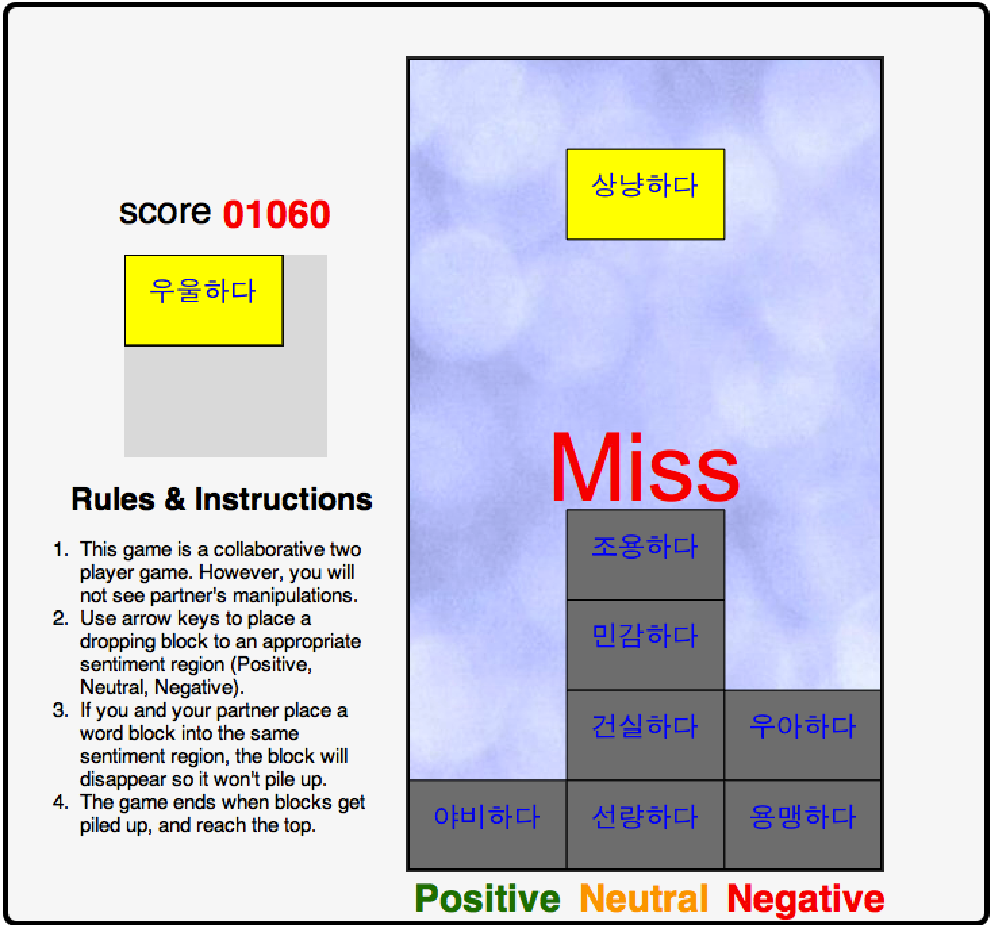 Figure 2: The actual gameplay interface, showing falling word-blocks and the sentiment stacks.
Critical Insights: Beyond the Game Loop
The success of ToB suggests that Inductive Bias in game design can act as a natural filter for data quality. However, the study also highlights a key limitation: Context.
Participants noted that some words are "ambiguous" or change sentiment depending on the sentence. While ToB is excellent for building base lexicons, future iterations would need to gamify contextual labeling (e.g., showing a word within a tweet) to handle advanced linguistic nuances like sarcasm.
Conclusion
The Tower of Babel project demonstrates that the barrier to building high-quality AI resources for non-English languages isn't just a lack of funding—it's a lack of engagement. By leveraging the Social and Achievement motivations of players, we can crowdsource the "hidden labor" of NLP in a way that is accurate, productive, and, most importantly, enjoyable.
Takeaway for the Industry: For startups or researchers working on niche languages (Thai, Vietnamese, Swahili, etc.), gamification might be the most cost-effective path to SOTA performance in sentiment analysis.