
Politics, Safety, and Slurs: Mapping the Landscape of Russian Online Toxicity
Share of Toxic Comments among Different Topics: The Case of Russian Social Networks
The paper presents a large-scale analysis of toxic comments across different topics on the Russian social network Pikabu. By fine-tuning RuBERT-based models and proposing a well-being dimension-based topic classification, the study achieves a SOTA F1-score of 0.8385 and identifies politics as the most toxic category.
TL;DR
With online vitriol increasingly spilling over into physical violence and mental health crises, understanding where this toxicity breeds is crucial. This study analyzes over 19 million comments from Pikabu (the Russian equivalent of Reddit) to quantify toxicity across different topics. By fine-tuning RuBERT models, the researchers found that while toxicity remains stable over time, it clusters heavily around specific themes—primarily politics, which is twice as toxic as everyday topics like health or jobs.
Background & Motivation: Moving Beyond Topic-Agnostic Models
Most existing toxic comment classifiers focus on what was said (the rhetorical device) rather than the context of the discussion. However, human behavior suggests that some environments are naturally more prone to aggression.
Prior work in the Russian segment (Runet) has been fragmented, often focusing on sentiment (positive/negative) rather than toxicity (insults/harassment). The authors aimed to bridge this gap by creating a robust classifier and a structured framework to categorize high-level topics based on global "well-being" dimensions.
Methodology: The "Objective Well-being" Framework
To categorize the vast amount of data, the authors adopted six dimensions used by the UN and OECD for measuring well-being:
- Politics
- Safety
- Socioeconomic Development
- Job Opportunities
- Environment
- Health
For the classification engine, the authors compared various adaptations of RuBERT.
The Model Architecture
The researchers found that Transfer Learning was more effective than Data Enrichment. Simply adding more toxic data from different sources (like VK or YouTube) actually decreased performance, likely due to differences in community norms and linguistic styles between social platforms.
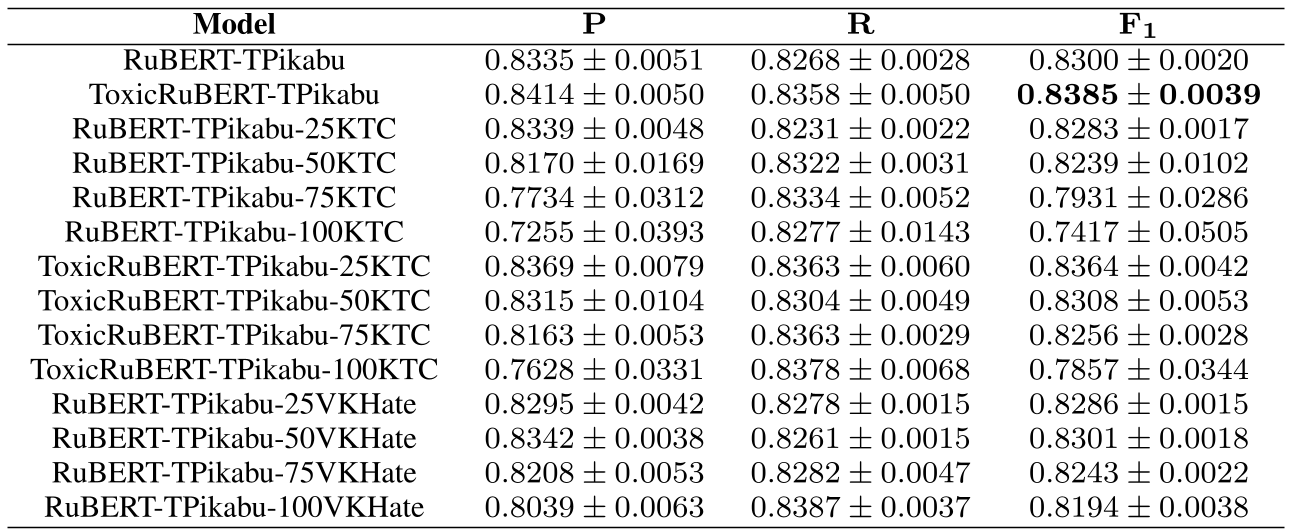 Table 1: Classification results. ToxicRuBERT-TPikabu achieved the best balance of precision and recall.
Key Results: Where the Vitriol Lives
The application of the model to 70,000 posts revealed a clear hierarchy of toxicity:
- Politics (27.7%): The undisputed leader. High polarization in political discourse acts as a magnet for toxic behavior.
- Safety (23.8%) & Socioeconomic (18.5%): These topics rank significantly higher than others, likely due to the inherent stress associated with security and financial stability.
- The Baseline (15-16%): Topics like Health, Environment, and Jobs showed the lowest, most consistent levels of toxicity.
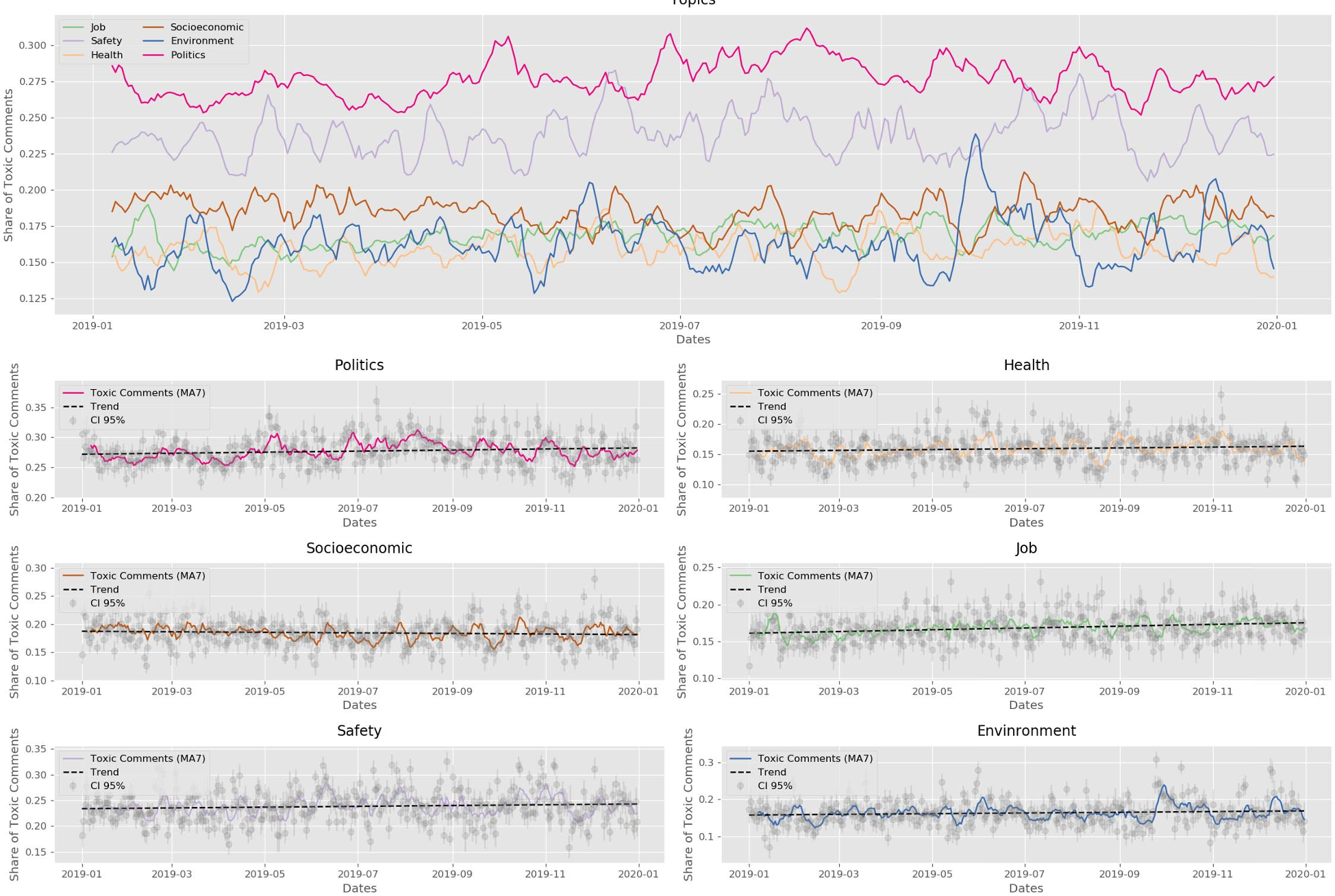 Fig 1: Daily fluctuations in toxicity share. Politics consistently remains at the top of the chart.
One of the most striking findings is the stability of toxicity norms. While toxicity varies day-to-day (responding to news events), the monthly average is remarkably steady. This implies that communities have "ingrained" levels of acceptable aggression that don't easily change.
Critical Insight: The Value of Community-Specific Models
A major takeaway for NLP practitioners is the failure of data enrichment in this study. The fact that adding VK (Vkontakte) data to a Pikabu-trained model reduced the F1-score highlights the importance of Domain Adaptation. Every social network has its own "sociolect"—a unique blend of slang, irony, and formal speech that general-purpose toxicity detectors fail to capture accurately.
Summary & Future Outlook
This work provides a critical benchmark for the Russian NLP community by open-sourcing the ToxicRuBERT-TPikabu model. The results suggest a pragmatic approach for platform moderators: instead of spreading resources thin, aggressive moderation should be prioritized for political and safety-related tags, where the risk of mental health impact and escalation is highest.
Future research may look at "Sub-topics" (e.g., specific political figures vs. general policy) to see if toxicity is driven by users or by the inherent nature of specific debates.