
Toxic Language vs. Forum Health: Quantifying the Decline of Online Communities
The Impact of Toxic Language on the Health of Reddit Communities
The paper investigates the correlation between online toxic language and community health using 2009 Reddit data. It utilizes a 52-dimensional feature vector approach to quantify weekly toxicity and user engagement, demonstrating a significant negative correlation between toxic behavior and community growth.
TL;DR
Does toxic language actually kill an online community, or is it just part of the "internet culture"? This study analyzes 180 subreddits from 2009 to find a definitive answer. By tracking toxic language and user engagement over 52 weeks, the researchers found a staggering negative correlation of up to -0.9 between toxicity and community health. The takeaway is clear: while some communities are "naturally" more aggressive, sudden spikes in toxicity are the primary drivers of community death.
Problem & Motivation: Beyond Detection
Most research in the field of online safety focuses on how to detect a toxic comment. However, we often ignore the consequences of that toxicity on the ecosystem. Community managers frequently ask: "At what point does language become so toxic that users leave?"
The authors argue that "Health" is a quantifiable metric of user engagement. When toxicity rises, the psychological cost to individuals is high, but the revenue cost to businesses—due to lower engagement and churn—is equally devastating. This study aims to map the "toxicity tolerance" of different subreddits based on their size and topic.
Methodology: The Toxicity-Health Vector
To move beyond anecdotal evidence, the researchers created a high-dimensional analysis of Reddit:
- Toxicity Labels: Utilizing the Community Sift system, comments were graded from Level 1 (Safe) to Level 7 (High-risk threats). Levels 6 and 7 were officially classified as "Toxic."
- Health Score: This wasn't just about the number of posts. High post volume can sometimes indicate a "flame war" rather than a healthy community. To correct for this, the authors combined total posts with unique author counts, applying a sigmoid function to create a standardized health index [0, 1].
- The 52-Week Snapshot: Every subreddit was mapped into two 52-dimensional vectors (one for health, one for toxicity), using moving averages to filter out temporary noise and focus on long-term trends.
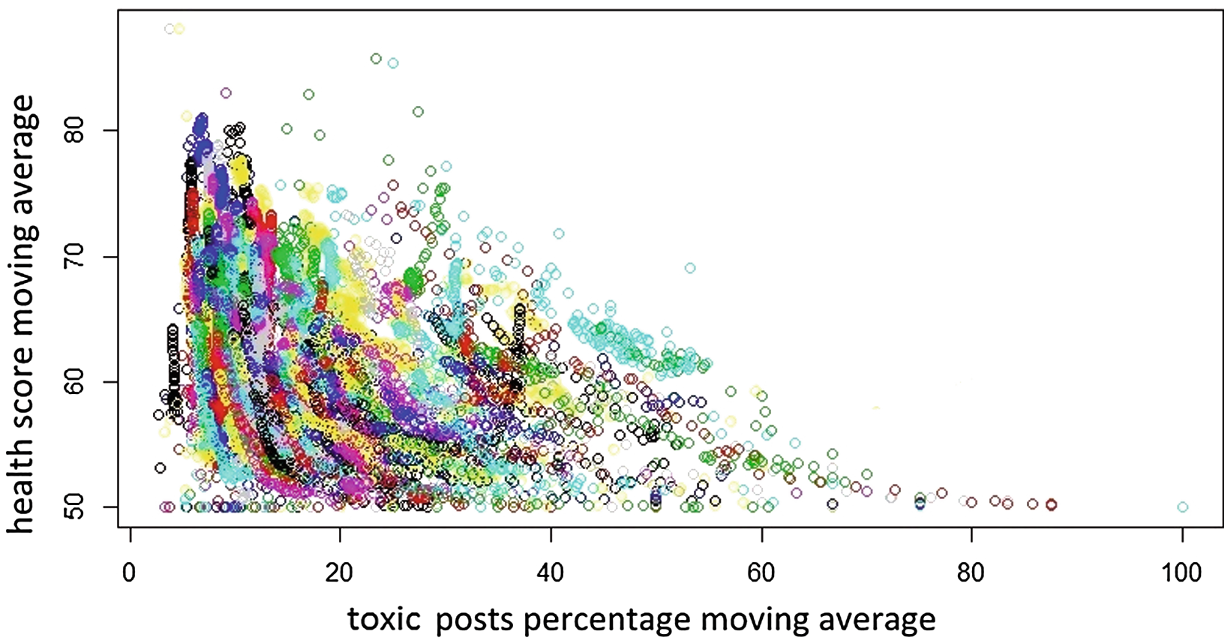 Figure 1: The distribution shows that as toxicity increases, health values move toward the lower end of the Y-axis.
Key Insights: Does Size Matter?
The results revealed a fascinating dynamic between the size of a community and its resilience:
- The Negative Correlation: 50% of the studied subreddits showed a correlation coefficient of -0.8 or higher. High toxicity and high health essentially never coexist in a stable state.
- Topic Baselines: Different topics have different "stable" levels of toxicity. Users in a gaming subreddit might expect more aggressive language than users in a book club. The study found that as long as this toxicity remains stable, the community can still grow.
- The Growth Trigger: When toxicity declines, health almost always grows, particularly in smaller communities. Conversely, even a small 10% increase in toxicity can stall the growth of a small subreddit.
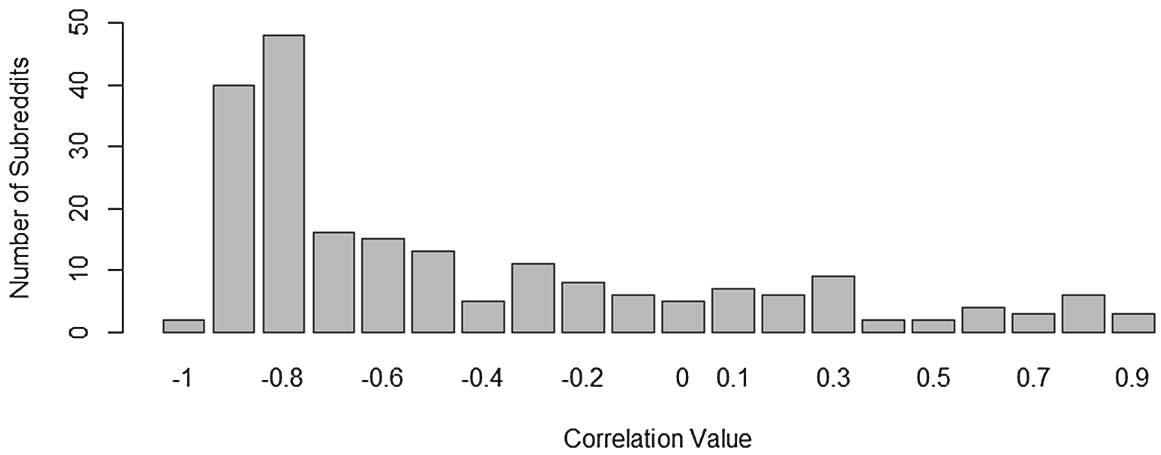 Figure 2: This histogram confirms the hypothesis, showing a high frequency of subreddits clustered at the far left (highly negative correlation).
Critical Analysis & Conclusion
Takeaway
The study proves that toxicity isn't just a "social issue"—it is an existential threat to the sustainability of digital products. For platforms like Reddit, "community health" is directly proportional to their ability to regulate extreme language (risk levels 6 and 7).
Limitations
- Historical Data: Using data from 2009 may not capture modern "trolling" and "brigading" tactics, which are more sophisticated than the n-gram-based detection used here.
- Context Scarcity: While the Community Sift tool is robust, distinguishing between "toxic words" used colloquially vs. as targeted abuse remains a challenge in automated systems.
Future Outlook
Future research should investigate the tipping point: is there a specific numerical threshold where a community enters a "death spiral"? Understanding these limits would allow for proactive moderation interventions before a community reaches the point of no return.