
Decoding Online Hostility: A Comparative Analysis of Toxicity in Political YouTube Discourse
Identifying Toxicity Within YouTube Video Comment
This study investigates online toxicity within YouTube comment sections by comparing pro-NATO and anti-NATO channels. Using the Google Perspective API for automated scoring and Latent Dirichlet Allocation (LDA) for topic modeling, the researchers quantified five types of toxic behavior (threats, insults, hate, sexually explicit, and identity-based attacks) across thousands of user comments.
TL;DR
Online Social Networks (OSNs) have evolved from safe havens into digital battlegrounds. This paper explores the "toxicity gap" between pro- and anti-NATO YouTube channels. By leveraging Google’s Perspective API and LDA Topic Modeling, the study reveals that anti-NATO narratives are significantly more prone to vitriolic engagement, while pro-NATO discussions, though containing defensive threats, maintain a higher frequency of positive alignment.
Academic Positioning: This work bridges Social Network Analysis (SNA) and automated content moderation, moving beyond simple sentiment analysis to categorize specific toxic behaviors like identity attacks and profanity in a geopolitical context.
Problem & Motivation: The Anonymous Shield
Harassment is no longer a fringe issue; 73% of adult internet users have witnessed online harassment. The authors argue that toxicity is fundamentally different from negative sentiment—it is "rude, disrespectful language" designed to make users abandon a discussion.
The challenge lies in scale and nuance. How do you monitor millions of comments where "threats" might be subtle innuendos rather than explicit violence? The researchers chose the NATO debate as a case study due to the extreme ideological leanings of the respective audiences, providing a perfect "natural experiment" for toxicity profiling.
Methodology: From API Scores to Topic Manifolds
The research team utilized a two-pronged approach to quantify hate:
- Perspective API: A multi-headed CNN-based model that assigns probability scores (0-1) to comments across five attributes: Threats, Insults, Hate Speech, Sexually Explicit, and Identity-based Attacks.
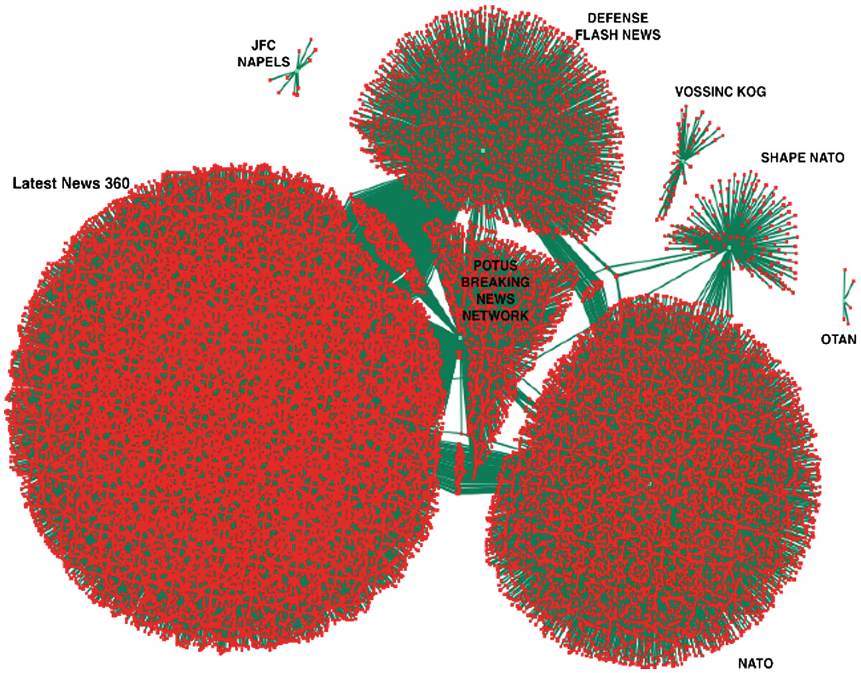
- Semantic Clustering: They used Latent Dirichlet Allocation (LDA) to extract latent themes from thousands of comments, then projected these high-dimensional topics into a 2D space using t-SNE for visualization.
 Algorithm 1: The logical flow for classifying comments into toxic categories based on score thresholds.
The "Toxicity Gap": Experimental Results
The findings were stark. The anti-NATO dataset, which was significantly larger (reflecting higher engagement or bot activity), was a "breeding ground" for aggression.
- Pro-NATO Snapshot: 35% Non-toxic. Topics focused on "Alliance," "United," and "Respect."
- Anti-NATO Snapshot: Only 13% Non-toxic. Topics were riddled with "Fake News," "Shit," and "Fuck."
Intriguingly, "Threats" was the highest toxic category for pro-NATO channels (37%), but manual inspection revealed these were often geopolitical posturing (e.g., "NATO will crush Russia") rather than personal harassment.
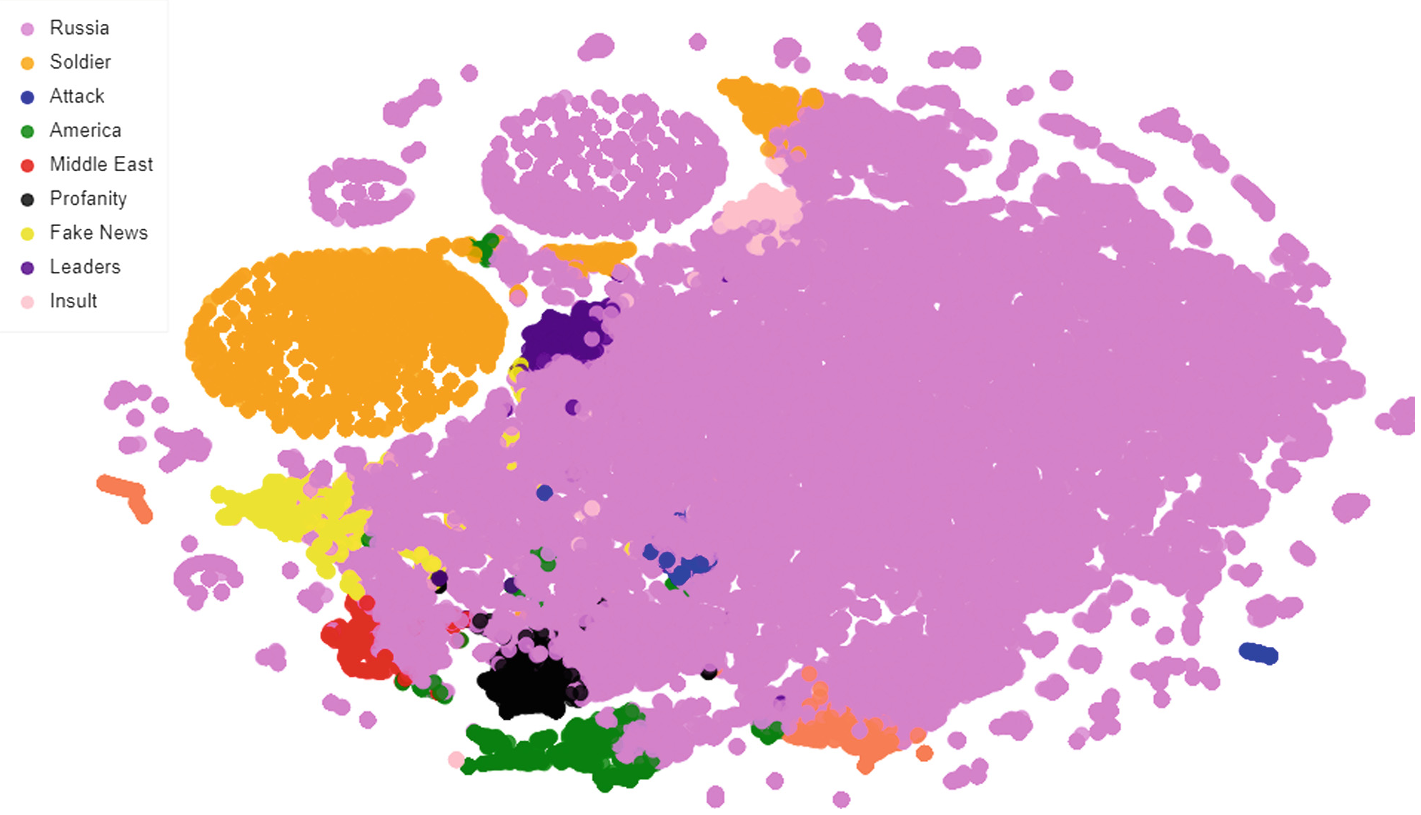 Figure: t-SNE visualization mapping the clusters of toxic vs. non-toxic topics in anti-NATO discourse.
Critical Insight & Limitations
The study highlights a critical Inductive Bias in digital discourse: anti-establishment narratives (in this case, anti-NATO) seem to attract or generate a higher density of profanity and identity-based attacks.
Limitations to Consider:
- Data Skew: The anti-NATO dataset was 5.6x larger than the pro-NATO set. This suggests that "angry" content generates more engagement, but it also means the anti-NATO analysis is statistically more robust than the pro-NATO side.
- Adversarial Weakness: While Perspective API is SOTA, the authors acknowledge that similar tools are vulnerable to simple adversarial bypasses (e.g., typos or coded language).
Conclusion: Toward Cognitive Security
By identifying specific toxic behaviors according to narrative shifts, this research provides a roadmap for Cognitive Security. It suggests that moderators shouldn't just look for "bad words" but should monitor "narrative health." Future work should focus on causal inference—does the video content cause the toxicity, or do toxic users simply gravitate toward specific political narratives?
Takeaway for the Industry: Automated moderation must move toward "Contextual Awareness." A threat against a nation-state and a threat against an individual user require different moderation interventions.