
TRACE: Solving the "Credit Assignment" Trap in Long-Horizon Agents
TRACE: Turn-level Reward Assignment via Credit Estimation for Long-Horizon Agents TRACE: TURN-LEVEL REWARD ASSIGNMENT VIA CREDIT ESTIMATION FOR LONG-HORIZON AGENTS
TRACE (Turn-level Reward Assignment via Credit Estimation) is a dense credit-assignment framework for training long-horizon agents using Reinforcement Learning. It uses a frozen reference model to score tool-call transitions based on gold-answer log-probabilities, achieving SOTA results on benchmarks like BrowseComp-Plus (Qwen3-4B: 7.2 to 35.6; 30B: 8.4 to 42.6).
TL;DR
Current LLM agents often struggle to learn from Reinforcement Learning because rewards are too "sparse"—a single "Correct/Incorrect" at the end of 50 tool calls doesn't tell the model which search query was the winner. TRACE (Turn-level Reward Assignment via Credit Estimation) introduces a breakthrough: using a frozen reference model to calculate dense, turn-by-turn rewards based on how much "closer" each action brings the agent to the gold answer. It transforms base models into deep-research experts without a single line of human-labeled process data.
The Motivation: Why Outcome Rewards Fail Agents
In single-turn tasks like math, outcome-based RL (like DeepSeek's GRPO) works wonders. But for agents, a trajectory is a marathon.
- The Dilution Problem: If an agent makes 10 brilliant moves but fails on the 11th, outcome-only RL punishes all 10 brilliant moves.
- The Redundancy Problem: If an agent succeeds but wastes 5 turns on redundant searches, RL rewards those wasteful turns, leading to "bloated" and inefficient agents.
The authors realized that the gold answer (available during training) is a lighthouse. If a tool call (like browser.open) makes that gold answer more "predictable" to a language model, that move deserves credit.
Methodology: The Logic of Log-Ratio TD
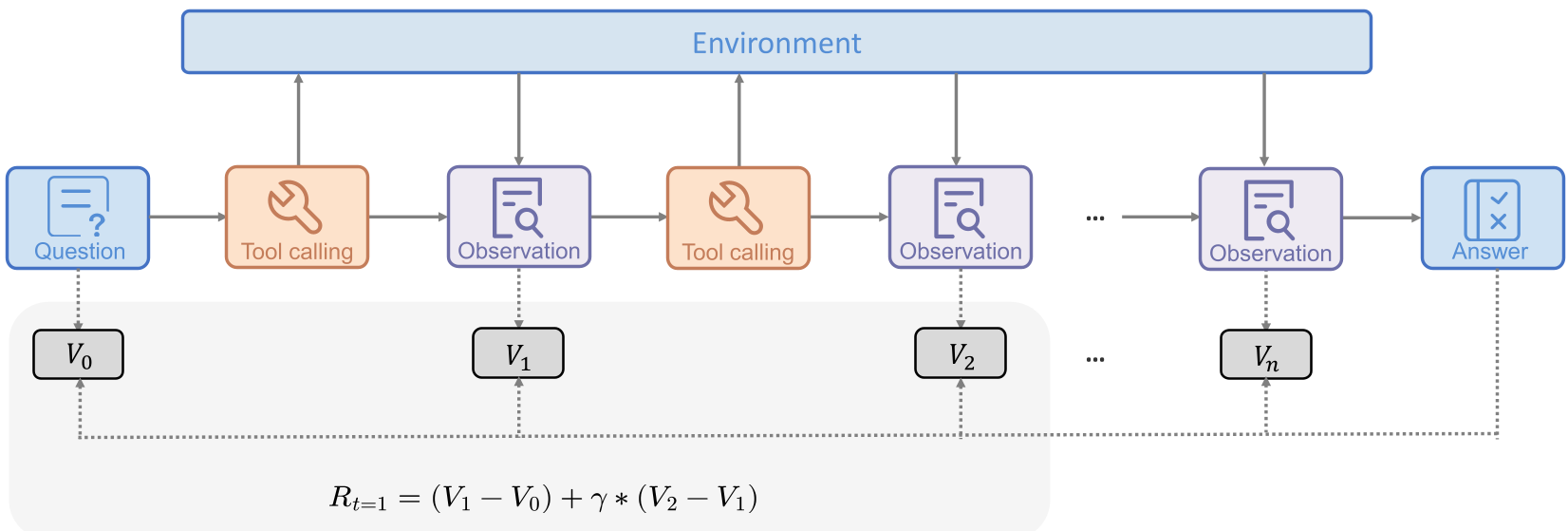
TRACE segments a rollout at every tool-call boundary. It then asks a frozen version of the model: "Given this new piece of info, how likely is the gold answer now?"
1. State Value via Gold-Answer Probability
The core innovation is the log-ratio state value. Instead of looking at absolute probability increases (which are volatile), TRACE looks at the relative closure of the gap to the answer.
2. The Telescoping Property
Because of the mathematical formulation (log-ratio), the rewards "telescope." This means the sum of all turn-level rewards is mathematically tied to the final state. If an agent performs a redundant search that adds no new info, the TD change is zero. If it deletes a useful piece of info from its context, the reward is negative.
Experimental Results: SOTA Performance
TRACE was tested on complex, multi-hop search tasks where the agent must chain multiple documents to find an answer.
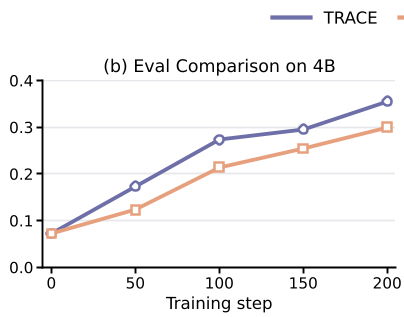
- Massive Accuracy Jumps: On BrowseComp-Plus, TRACE boosted a 4B model from 7.2% to 35.6%.
- Faster Convergence: As shown in the learning curves below, TRACE (blue line) starts learning significantly earlier and plateaus much higher than standard GRPO.
- Cross-Language Transfer: Techniques learned on English closed-web data transferred to Chinese open-web tasks (xbench-DeepSearch), proving TRACE teaches interaction logic, not just data memorization.
Deep Insight: Turning "Found Info" into Advantage
The qualitative analysis in the paper provides a "smoking gun" for why this works. In successful runs, TRACE assigns massive positive credit (+6.39) to the specific browser.search that surfaces the discriminative fact, while assigning near-zero credit to subsequent redundant checks. Conversely, it heavily penalizes "hallucinated" search results that lead the agent astray, even if the rest of the trajectory was perfect.
Conclusion & Future Outlook
The beauty of TRACE is its simplicity: it requires no additional critic training and no human labels. It purely leverages the inherent knowledge of the base model to supervise its own agentic behavior.
Limitations: Currently, TRACE relies on having a short, verifiable "gold answer." For open-ended tasks like "write a report," we still need to find a way to define a stable "state value." However, for deep-research and fact-finding agents, TRACE provides the blueprint for the next generation of efficient, high-reasoning LLMs.