
Trace2TAP: Bridging the Gap Between Behavior Traces and Human Intent in IoT Automation
Trace2TAP: Synthesizing Trigger-Action Programs from Traces of Behavior
This paper introduces Trace2TAP, a novel hybrid system that synthesizes Trigger-Action Programs (TAP) from behavior traces (sensor logs and manual actions). By leveraging symbolic reasoning and SAT-solving, it achieves state-of-the-art performance in generating human-intelligible automation rules that align with user intent across complex IoT environments.
TL;DR
Trace2TAP is a breakthrough framework that automatically turns your daily interactions with smart devices into "If-This-Then-That" rules. Unlike traditional "black-box" AI that simply predicts your next move, Trace2TAP uses symbolic reasoning to offer a menu of transparent, editable rules. It handles messy, out-of-order sensor data and allows users to choose the automation that actually matches their intent, not just their past habits.
The Motivation: Why Rules are Hard and AI is Opaque
The "Smart Home" dream usually follows two paths:
- The Programmer Path: You manually write rules (TAP). This is fine for "If I arrive, turn on the light," but fails when you have 20 sensors and complex overlapping conditions.
- The ML Path: A model learns your behavior and predicts actions. The problem? It’s often a "black box." If the AI turns off the lights while you're still reading, you can't "edit" the model-you're just stuck with it.
The authors of Trace2TAP identified a critical "intent gap": our past actions (the "Trace") aren't always what we want to happen. We might forget to turn off the kettle, or we might turn off the light before closing the door because of the switch location. Trace2TAP solves this by using the trace as a suggestion rather than a strict law.
Methodology: From Traces to Symbolic Logic
Trace2TAP’s magic lies in its synthesis pipeline, which moves away from pure statistical prediction toward program synthesis.
1. Variable Selection (Signal Processing)
Before diving into heavy math, the system identifies which sensors actually matter.
- Trigger Variables: Uses cross-correlation to find sensors that change right before an action.
- Condition Variables: Uses Conditional Entropy to find sensors that maintain a steady state (e.g., "Is the sun currently up?") when an action occurs.
2. The SAT-Solver Engine
This is the core technical contribution. Instead of testing every possible rule (which would take forever), Trace2TAP defines a Symbolic Rule Template. It formulates the problem as a constraint: "Find a rule where the trigger happened, the conditions were met, and the action occurred at least 30% of the time in the trace."
It then hands this to the Z3 SMT Solver, which "solves" the logic puzzle to find all valid rules instantly.
 Table 1: The Symbolic Rule Template used to represent the search space for triggers and conditions.
Making AI Intelligible: Clustering & Ranking
Exhaustive synthesis produces too many rules. To prevent "choice paralysis," Trace2TAP groups rules into Usage Contexts using the K-modes algorithm.
- If Rule A and Rule B both automate the same 10 manual light-clicks, they belong to the same cluster.
- Within each cluster, rules are ranked by a linear score weighing true positives, precision, recall, and simplicity (shorter rules are usually better).
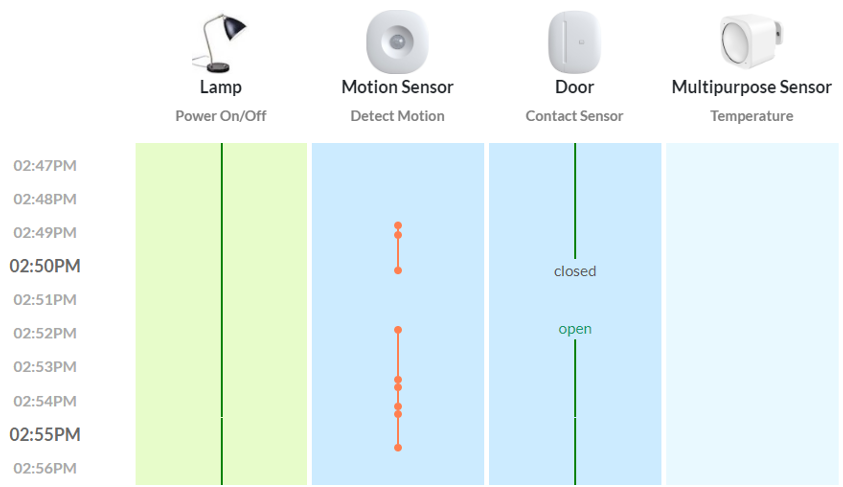 The Trace2TAP UI: Transforming complex behavioral data into a human-readable list of options.
Experimental Results: Humans are the Final Arbitrator
In a multi-month field study, the results were telling:
- Efficiency: The median rank of selected rules was 2nd. The clustering system halved the amount of time users spent looking for the right rule.
- Intent > Precision: Participants often chose rules that had lower "precision" on paper because they matched their mental model (e.g., "I often forget to do this, so I want the rule to be aggressive").
- Handling "Mis-orders": Over 50% of the selected rules were triggered by events that technically appeared after the manual action in the trace (like closing the door after turning off the light). Trace2TAP’s symbolic approach was able to "see through" this temporal noise.
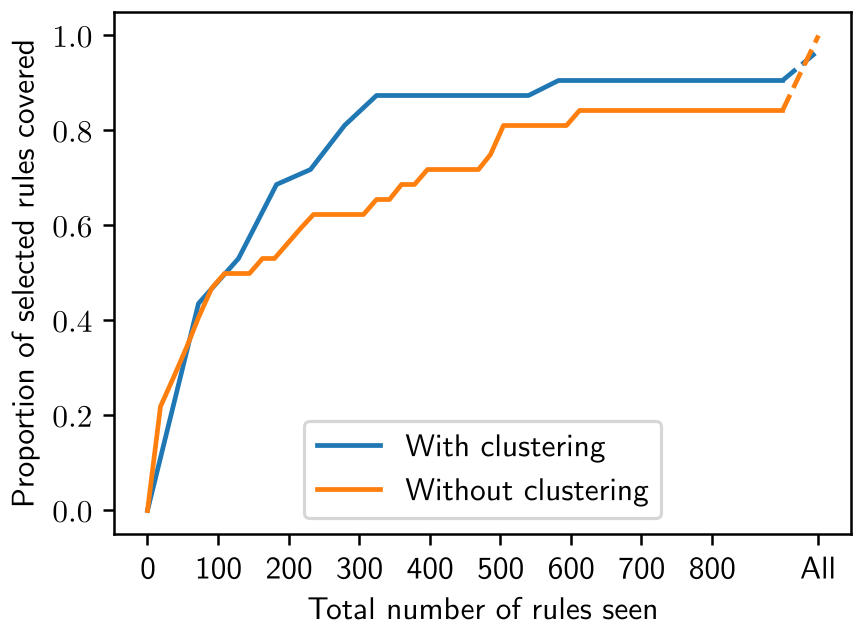 Figure: The impact of clustering on rule discovery—clustering significantly reduces the number of candidate rules a user must examine to find their desired automation.
Final Insight: The Human-in-the-loop is Non-negotiable
The real takeaway of Trace2TAP is its philosophical stance on AI: Causality vs. Correlation. Sensors might find a high correlation between "Room Temperature" and "Light On" (because the bulb generates heat), but a human knows temperature shouldn't trigger the light.
By combining the rigor of SAT-solving with a human-centric visualization, Trace2TAP ensures that we aren't just automating our habits—we are automating our intentions. This work paves the way for smarter, more debuggable, and ultimately more helpful IoT environments.