
Traceable CP-ABE: Securing Social Networks with Multi-Authority and Fine-Grained Revocation
Traceable and Complete Fine-Grained Revocable Multi-authority Attribute-Based Encryption Scheme in Social Network
The paper proposes a traceable and multi-authority Ciphertext-Policy Attribute-Based Encryption (CP-ABE) scheme tailored for social networks. It integrates a fine-grained revocation mechanism and malicious user tracing to ensure secure distributed access control while achieving SOTA security in the standard model.
TL;DR
In the era of cloud-assisted social networks, data confidentiality and access control are paramount. This paper introduces a Traceable and Complete Fine-Grained Revocable Multi-Authority ABE (Attribute-Based Encryption) scheme. It solves three critical issues: the single point of failure in authority centers, the difficulty of revoking specific user attributes, and the "anonymous" abuse of private keys by malicious users.
Background & Motivation: Beyond Centralized Access
As social networks grow in complexity, relying on a single Central Authority (CA) to manage all attributes becomes a bottleneck and a security risk. If the CA is compromised, the entire system collapses. Furthermore, if a user decides to leak their private key to a third party, traditional ABE schemes often have no way of identifying the source of the leak or revoking just that specific user’s access without re-encrypting everything.
The authors identify that Distributed Access Control paired with Traceability is the only way to ensure accountability in large-scale data sharing.
Methodology: The Core Architecture
The proposed scheme is built on eight foundational algorithms: GlobalInit, CASetup, AASetup, Encrypt, CAKeyGen, AAKeyGen, Decrypt, and Trace.
1. Multi-Authority Decentralization
Instead of one authority, the system uses multiple Certificate Authorities () and Attribute Authorities (). This ensures that even if one node fails, the system persists.
2. Fine-Grained Revocation and Identity Binding
The key innovation lies in how the ciphertext and keys are constructed. Each user's identity () is mathematically embedded into their private key during the AAKeyGen process:
When data is encrypted, the sender can define a Revoke List within the access structure. The ciphertext includes specific components (, ) that account for both the authorized users () and the revoked users ().
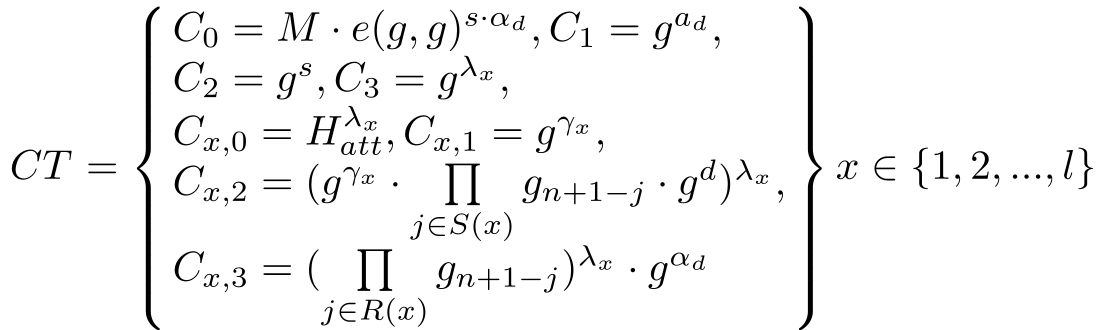 Figure 1: The mathematical construction of the ciphertext incorporating revocation logic.
Security Analysis: The Standard Model
The authors provide a rigorous proof using the Dual System Encryption approach. They define "semi-functional" keys and ciphertexts—mathematical constructs used only in the proof to show that an adversary cannot distinguish between a real message and a random string, even if they have access to some secret keys.
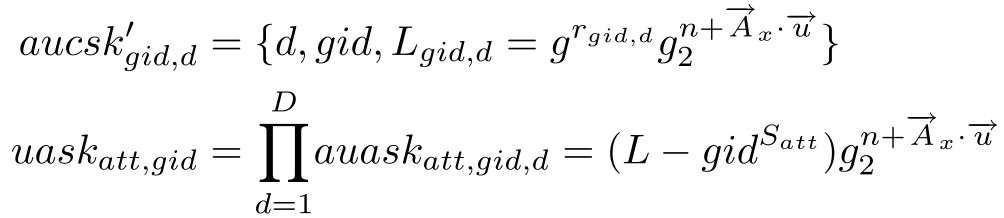 Figure 2: Definitions of semi-functional secret keys used for security proofs.
Key Security Guarantees:
- Collusion Resistance: Malicious users cannot combine their attributes to decrypt data they aren't authorized to see.
- Traceability: If a "pirate decoder" is found, the authority can run the
Tracealgorithm to extract the unique embedded in the underlying keys.
Critical Insight & Conclusion
By moving away from threshold-based access to LSSS-based policies, this scheme offers the flexibility needed for social media permissions (e.g., "Allow friends of friends EXCEPT those in the 'Work' group").
Takeaway: The integration of traceability directly into the multi-authority generation phase is a significant step forward. However, the computational cost of managing multiple revocation lists within the ciphertext ( and ) may scale with the number of revoked users. Future research should look into optimizing the ciphertext size to remain constant regardless of the size of the revocation list.
Limitations
- Efficiency: The bilinear pairings and group operations in the
Decryptphase are computationally intensive for mobile devices. - Dynamic Updates: While revocation is "fine-grained," the paper does not deeply explore the overhead of updating the public parameters when attributes themselves change globally.