
TRACEMIN-Fiedler: Scaling Spectral Graph Theory to Millions of Nodes
TRACEMIN-Fiedler: A Parallel Algorithm for Computing the Fiedler Vector
This paper introduces TRACEMIN-Fiedler, a novel parallel algorithm for computing the Fiedler vector (the second smallest eigenvector of a graph Laplacian). By leveraging the Trace Minimization (TRACEMIN) framework and a Preconditioned Conjugate Gradient (PCG) solver, it achieves significantly higher scalability and speed compared to the sequential multilevel state-of-the-art solver, MC73_FIEDLER.
TL;DR
The Fiedler vector is the "Swiss Army Knife" of graph theory, essential for everything from matrix reordering to web searches. However, computing it for massive graphs has traditionally been a slow, sequential process. TRACEMIN-Fiedler changes the game by introducing a parallel trace minimization algorithm that is up to 641 times faster than standard HSL routines, handling matrices with millions of entries with ease.
Background: The Connectivity of Everything
In spectral graph theory, the second smallest eigenvalue () represents the "algebraic connectivity" of a graph. Its corresponding eigenvector, the Fiedler vector, provides a low-dimensional embedding that reveals the structural clusters of a network.
Despite its utility, the standard approach (used in HSL's MC73_FIEDLER) involves a multilevel scheme: coarsening the graph, solving a tiny version, and refining the result. While effective for small systems, this approach struggles with modern datasets due to the inherent sequential nature of the refinement process and the potential for ill-conditioned linear systems.
The Core Insight: Trace Minimization
Instead of following the traditional "Shift-and-Invert" path, which requires solving potentially indefinite systems, the authors utilize the Trace Minimization (TRACEMIN) framework.
The mathematical intuition is elegant: The eigenvectors corresponding to the smallest eigenvalues of a symmetric matrix are the vectors that minimize the trace of subject to .
Key Algorithmic Innovations:
- Saddle-Point Resolution: Each iteration solves a saddle-point system to update the eigenvector approximation.
- Deflation Strategy: Since the smallest eigenvalue of a Laplacian is always 0 (corresponding to a constant vector), the algorithm explicitly deflates this component to ensure the PCG solver focuses purely on the Fiedler vector.
- Parallel Efficiency: The authors use block-row partitioning and MPI communication. By applying the Laplacian to a set of vectors simultaneously, they transform memory-bound operations into computationally dense ones.
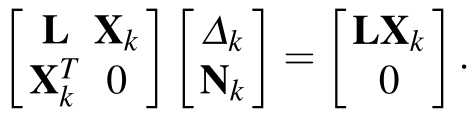 Figure 1: The saddle-point problem at the heart of the TRACEMIN iteration.
Battle-Tested Performance
The researchers tested TRACEMIN-Fiedler against four massive matrices from the University of Florida Sparse Matrix Collection.
1. Accuracy Supremacy
TRACEMIN-Fiedler isn't just fast; it's precise. In the kktPower test case, it achieved a relative residual of 3.1 x 10^-24, far surpassing the 10^-8 range typically seen in multilevel solvers.
2. Parallel Speedup
The comparison with the industry-standard HSL MC73_FIEDLER (running on a single core) highlights the power of parallelism:
- Rajat31 (4.7M nodes): Speedup of 227x on 32 cores.
- kktPower (2.1M nodes): Speedup of 641x on 32 cores.
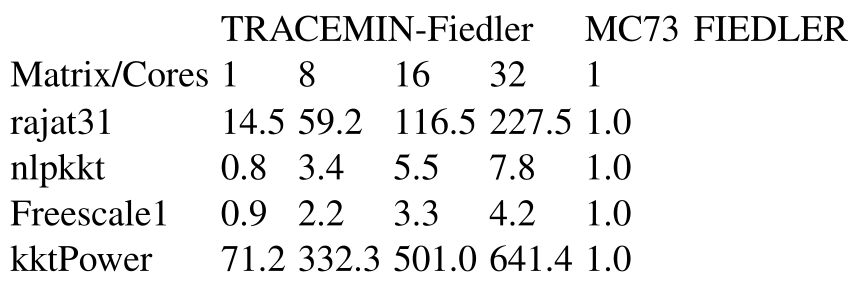 Table 1: Dramatic speed improvements over the sequential baseline.
Critical Analysis: Why it Works
The success of TRACEMIN-Fiedler over multilevel RQI comes down to Numerical Conditioning. In RQI, as the eigenvalue estimate approaches the true , the system becomes nearly singular, making it difficult for iterative solvers to converge without high-quality preconditioning.
TRACEMIN, by contrast, operates directly on . Because the Laplacian is symmetric positive semi-definite (SPSD), a simple diagonal (Jacobi) preconditioner remains highly effective and trivially parallelizable.
Summary & Future Outlook
TRACEMIN-Fiedler proves that for large-scale graph analysis, moving away from complex multilevel heuristics toward robust iterative trace minimization is the key to unlocking parallel performance. While the current implementation focuses on the Fiedler vector, the framework is naturally extensible to computing the first eigenvectors, paving the way for multi-way graph partitioning and more sophisticated data mining tasks.
For practitioners in machine learning and big data, this method provides a scalable blueprint for spectral analysis on high-performance computing clusters.