
TRACEMIN-Fiedler: Scaling Spectral Graph Analysis to the Parallel Era
TRACEMIN-Fiedler: A Parallel Algorithm for Computing the Fiedler Vector
This paper introduces TRACEMIN-Fiedler, a novel parallel algorithm designed to compute the Fiedler vector (the eigenvector of the second smallest eigenvalue) of large-scale graph Laplacians. By leveraging the Trace Minimization (TRACEMIN) framework and a Preconditioned Conjugate Gradient (PCG) solver, the method achieves significant parallel speedups and maintains high numerical precision compared to existing multilevel solvers.
TL;DR
The Fiedler vector is the "Swiss Army knife" of graph theory, essential for everything from matrix reordering to data mining. However, computing it for massive datasets has traditionally been a sequential bottleneck. This paper introduces TRACEMIN-Fiedler, a parallel algorithm that utilizes Trace Minimization to compute this vector with extreme precision and speeds up the process by up to 641x on a 32-core cluster compared to industry-standard HSL routines.
The Problem: When Multilevel Schemes Hit the Sequential Ceiling
The second smallest eigenvalue of a graph's Laplacian, known as the algebraic connectivity, and its corresponding Fiedler vector, are critical for partitioning and reordering sparse matrices.
The current golden standard, HSL's MC73_FIEDLER, uses a multilevel approach: it coarsens the graph, solves the problem on a tiny version, and then "prolongates" the solution back up. While clever, this approach is predominantly sequential. Furthermore, it uses Rayleigh Quotient Iteration (RQI), which leads to indefinite linear systems that are notoriously difficult to solve and precondition in a parallel environment.
Methodology: The Power of Trace Minimization
The authors pivot away from the RQI/Multilevel paradigm toward Trace Minimization (TRACEMIN). The core intuition is to transform the eigenvector problem into a constrained minimization problem:
Key Technical Insights:
- Symmetry and Stability: Unlike RQI, which results in shifted matrices that can be indefinite, TRACEMIN works directly with the Laplacian , which is symmetric positive semi-definite. This allows the use of the Conjugate Gradient (CG) method.
- Addressing the Zero Eigenvector: A Laplacian always has a zero eigenvalue corresponding to a constant vector. The authors use a tiny diagonal perturbation () in the first iteration to ensure the solver doesn't fail, followed by a deflation step to lock onto the second-smallest eigenvalue.
- Parallel Efficiency: The matrix-vector multiplication—the most expensive part—is performed on a set of vectors simultaneously, maximizing cache locality and reducing MPI communication overhead.
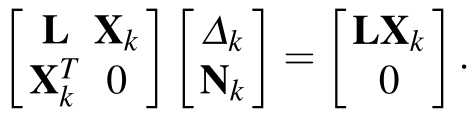 Figure 1: The core saddle-point problem solved in each TRACEMIN iteration.
Performance: Crushing the Baseline
The authors tested their algorithm on four massive matrices from the UF Sparse Matrix Collection, with orders up to 4.6 million.
High Precision
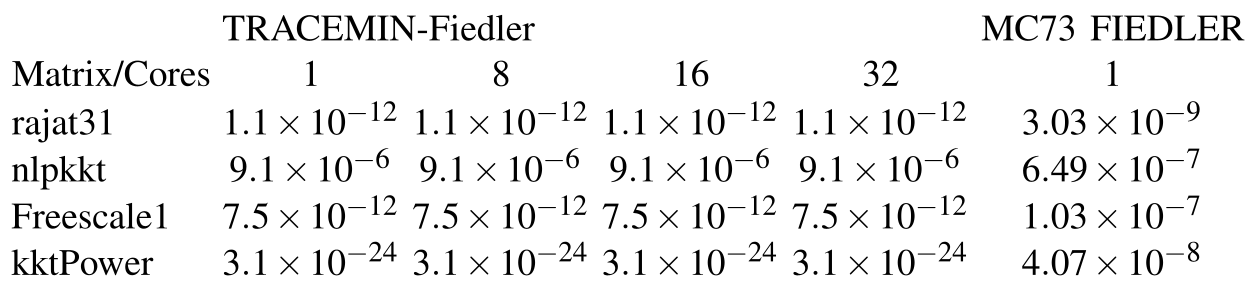
As shown in the table below, TRACEMIN-Fiedler consistently achieved lower relative residuals than the multilevel scheme. In the kktPower matrix, the precision reached a staggering .
Massive Speedups
While for some matrices the 1-core performance was comparable to HSL, the parallel scalability is where TRACEMIN-Fiedler shines. By distributed block rows across 32 processors, the algorithm achieved speedup factors of:
- 227x for
rajat31 - 641x for
kktPower
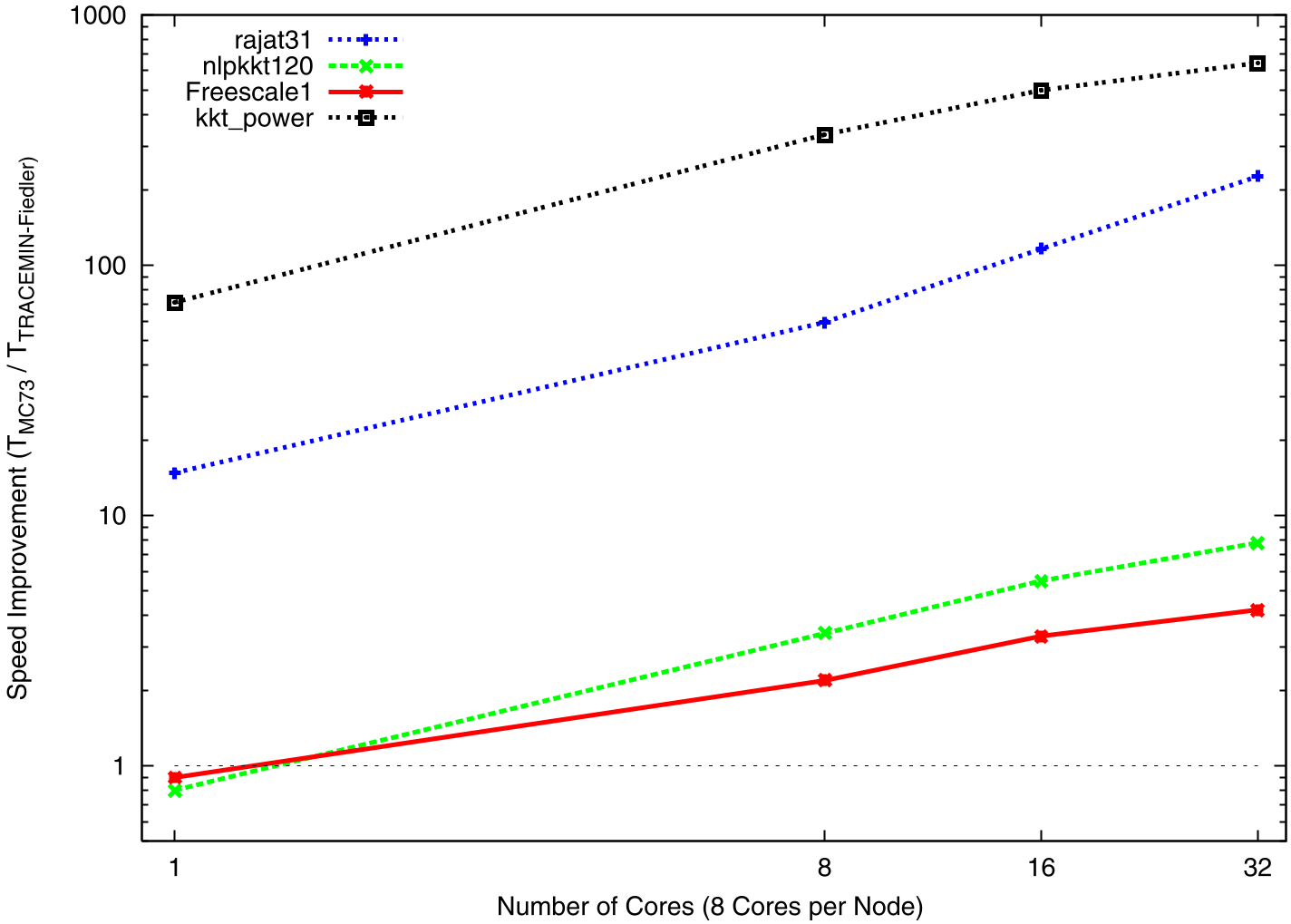 Figure 2: Speedup comparison—TRACEMIN-Fiedler demonstrates near-linear scaling potential while HSL remains static.
Critical Insight & Conclusion
The true value of this work lies in its robustness. By ensuring the linear systems remain positive semi-definite (unlike RQI), the authors could use a simple but highly scalable diagonal preconditioner.
Takeaway: If you are dealing with graph partitioning or spectral clustering on modern clusters, the TRACEMIN-Fiedler approach offers a blueprint for high-performance spectral analysis. It proves that direct parallel trace minimization can outperform complex multilevel heuristics in both speed and numerical accuracy.
Limitations: The scalability is highly dependent on the matrix sparsity pattern. Matrices with irregular non-zero distributions will see higher communication costs during the MPI AllReduce operations.