
TRACER: Bridging the Gap Between Accuracy and Interpretability in High-Stakes AI
TRACER: A Framework for Facilitating Accurate and Interpretable Analytics for High Stakes Applications
TRACER is an interpretable analytics framework designed for high-stakes applications like healthcare and finance. It introduces the TITV (Time-Invariant Time-Variant) model, which achieves SOTA predictive accuracy while providing granular feature-level explanations.
In high-stakes domains like healthcare and finance, a model's prediction is only as good as the trust it inspires. Reporting a "26% mortality risk" to a doctor without explaining why is often useless—and potentially dangerous. While Deep Learning (specifically RNNs) has pushed the boundaries of predictive accuracy, it has done so by sacrificing the transparency inherent in simpler models like Logistic Regression.
Published at SIGMOD '20, TRACER (Accurate and inTerpRetAble Clinical dEcision suppoRt) introduces a novel framework that refuses to compromise, delivering State-of-the-Art (SOTA) performance alongside deep, clinician-validated interpretability.
The Core Insight: Invariance vs. Variance
The researchers identified a critical gap in how current AI models "explain" themselves. Most models treat feature importance as a static value or a purely time-dependent one. However, human experts (like doctors) perceive features in two ways:
- Time-Invariant Importance: Some indicators (e.g., Blood Urea Nitrogen for kidney function) are fundamentally important across the entire duration of a patient's stay.
- Time-Variant Importance: Other indicators only become critical during specific windows (e.g., a sudden spike in C-Reactive Protein indicating an acute infection).
TRACER captures both through its specialized TITV (Time-Invariant Time-Variant) model.
Methodology: The TITV Model Architecture
The TITV model splits the cognitive load of importance-weighting into two distinct subnetworks:
1. The FiLM-based Time-Invariant Module
This module uses Feature-wise Linear Modulation (FiLM) to apply an affine transformation to the input data. By processing the entire time series through a Bidirectional RNN (BIRNN), it generates scaling () and shifting () parameters. The vector acts as the global importance of each feature, shared across all time windows.
2. The Attention-based Time-Variant Module
Simultaneously, a self-attention mechanism operates on the hidden states of an adapted BIRNN. This module calculates , representing the fine-grained, localized importance of features at specific moments in time.
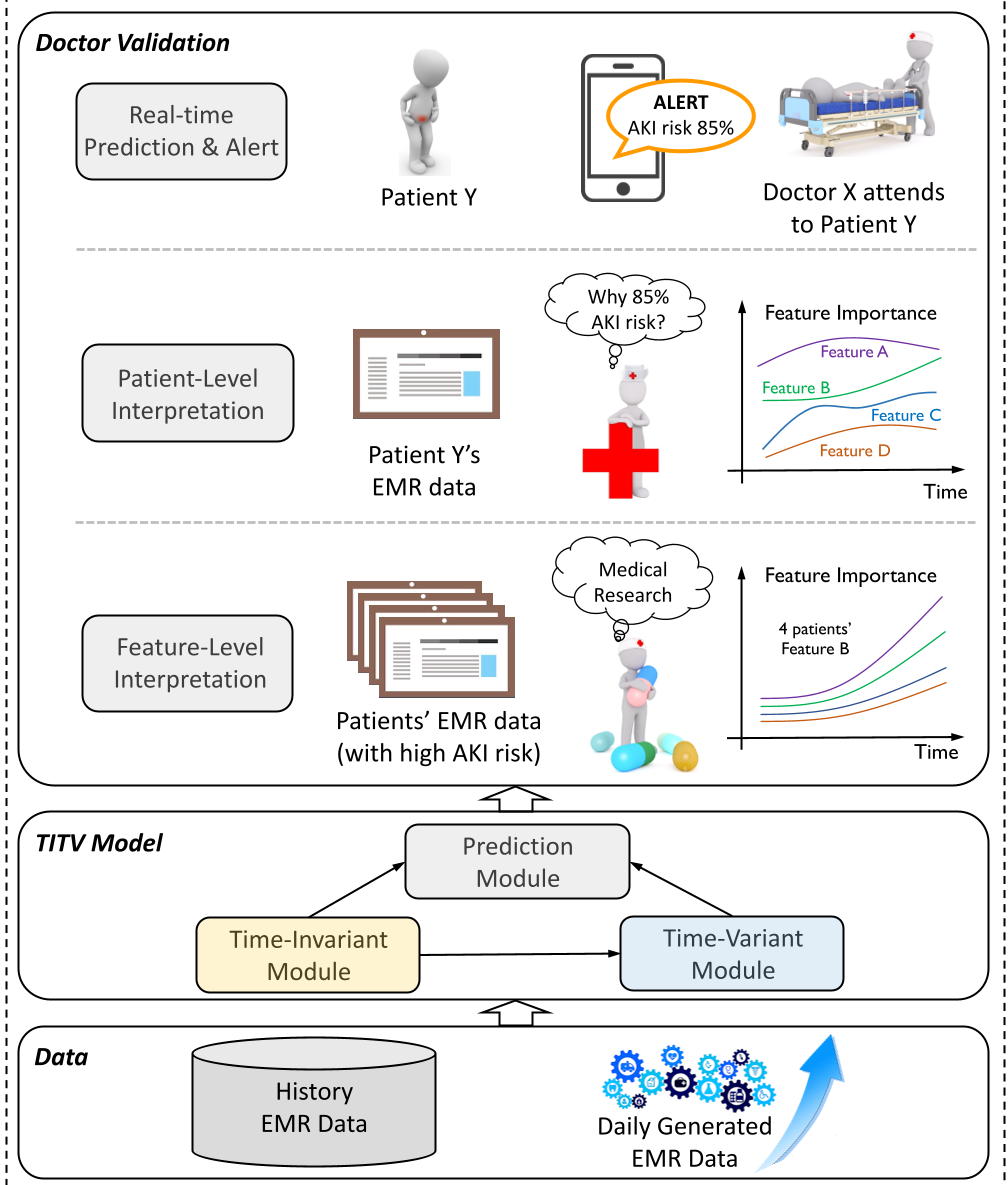
3. The Fusion
The model sums these components () to create an overall importance weight, which is then used to generate the final prediction. This ensures that the model's "attention" is guided by both long-term medical knowledge and short-term clinical alerts.
Clinical and Financial Validation
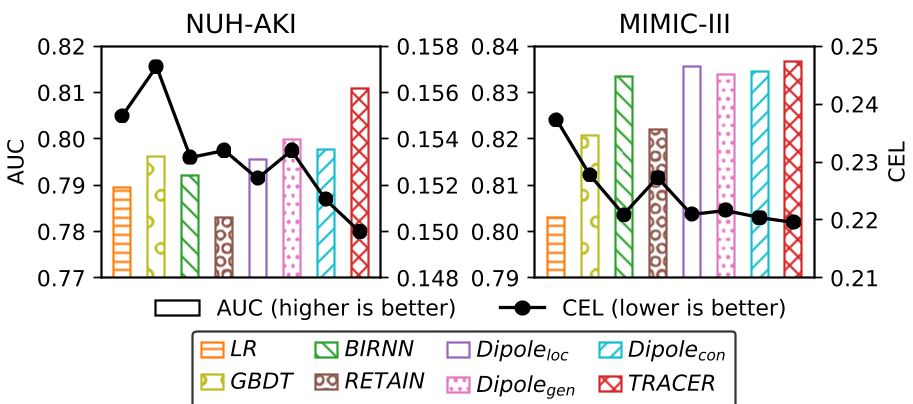
The paper evaluates TRACER on two massive medical datasets (NUH-AKI and MIMIC-III) and a financial dataset (NASDAQ-100).
Performance Benchmarks
TRACER consistently outperformed traditional models (LR, GBDT) and SOTA interpretable models (RETAIN, Dipole). The ablation studies proved that removing either the Invariant or Variant module led to a significant drop in AUC, proving that both temporal layers are necessary for optimal performance.
Feature-Level Insights
What makes TRACER truly stand out is its ability to generate "Importance-Time" trajectories. In the AKI (Acute Kidney Injury) task, doctors observed that TRACER correctly identified Urea as having a rising importance as the prediction time approached, whereas HbA1c (a diabetes marker) remained stable but low in importance for kidney-specific outcomes. This alignment with "medical common sense" is what allows practitioners to trust the model.
Deep Insight: Why This Matters
The technical brilliance of TRACER lies in its Inductive Bias. By forcing the model to separate invariant and variant traits, the authors have mirrored the way human experts reason. In a financial context, this allowed the model to identify that stocks like Amazon (AMZN) have high, fluctuating importance on the NASDAQ-100 index, while bottom-tier stocks show consistently negligible influence—information vital for portfolio risk management.
Conclusion
TRACER is more than just a more accurate RNN. It is a framework for Explainable AI (XAI) that provides the "why" behind the "what." By integrating with systems like GEMINI, TRACER moves AI out of the research lab and into the hospital ward, where its insights can help save lives through early, interpretable alerts.
Limitations: While powerful, the model currently relies on pre-structured EMR data. Future versions could benefit from integrating unstructured doctor notes directly into the TITV architecture to capture the subjective context of clinical care.