
Traces of Time through Space: How Complex Canvases Solve the "Presentation Bottleneck"
Traces of Time through Space: Advantages of Creating Complex Canvases in Collaborative Meetings
The paper investigates the impact of collaborative meeting modalities on content sharing and meeting effectiveness by comparing SAGE2 (large display collaborative software), conventional projectors, and Zoom video-conferencing. It introduces the concept of "Complex Canvases" and "Parallel Content Contribution," demonstrating how persistence of spatial content enhances cognitive memory and group participation.
TL;DR
In a world oscillating between "Zoom fatigue" and the return to the office, this paper argues that the secret to effective meetings isn't better video quality—it’s spatial permanence. By comparing SAGE2 (a large-display collaborative system) with projectors and Zoom, researchers found that "Parallel Content Contribution" allows ideas to be queued in space rather than lost in time, transforming meetings from sequential lectures into collective sense-making sessions.
The Presentation Bottleneck: Why Meeting Software Fails
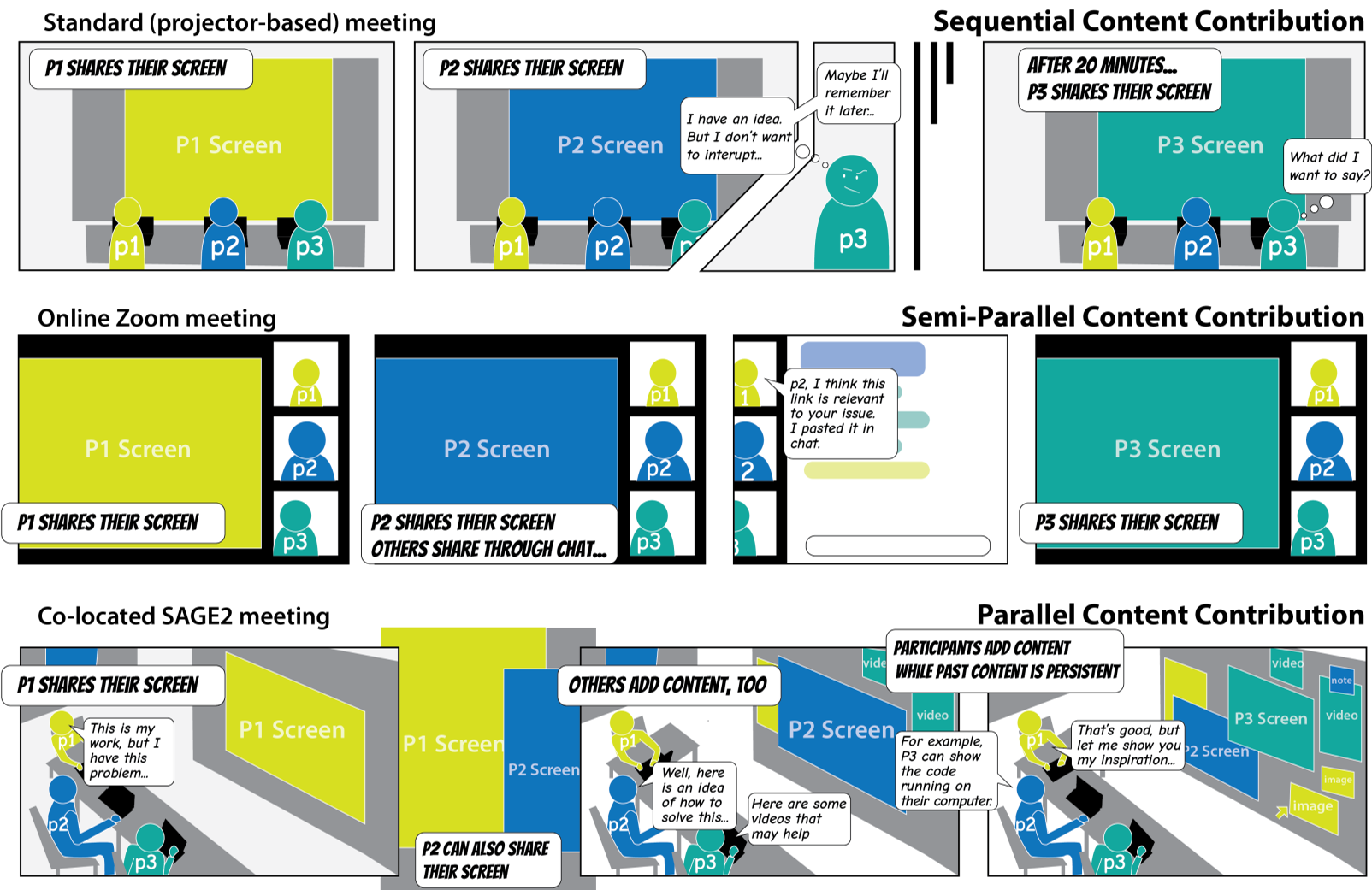
Prior to the pandemic, the "Conventional Projector based Meeting" (CPM) was the gold standard. However, it suffers from a fundamental flaw: Sequentiality. Only one person can hold the HDMI cable; only one screen can be shown.
The authors identify that this creates a "technical intervention load." If a listener has a related idea, they must either interrupt verbally or wait until the end, by which time the idea is often forgotten. Zoom (ZM) improves this slightly with "Semi-Parallel" features like chat and annotations, but it still lacks the immersive spatial memory of a shared physical environment.
Methodology: Comparing Three Worlds
The study observed the research lab across three distinct phases:
- SEM (SAGE Environment Meeting): Using large, wall-sized displays (Makani and Pele) where anyone could drag-and-drop content at any time.
- CPM (Conventional Projector): Traditional HDMI-cable-based screen mirroring.
- ZM (Zoom Meeting): Fully distributed remote work.
The Visualization of Flow
Core Insight: Parallelism and Complex Canvases
The most significant contribution of this work is the distinction between Sequential, Semi-Parallel, and Parallel sharing.
In a SAGE2 environment, "Parallel Content Contribution" occurs. While one person presents their main results, another might pull up a 3D model, a relevant news clip, or a budget spreadsheet on a different part of the wall. This creates a Complex Canvas—a mural of the meeting's progression.
Key Advantages of these Canvases:
- Queuing of Ideas: Content placed on the periphery acts as a visual "reminder" for the group to address a point later without interrupting the current speaker.
- Direct Referents: Everyone has agency. If a participant misses a detail on slide 3, they can independently open that PDF and scroll back without asking the presenter to stop.
- Information Continuity: Unlike a Zoom screen share that disappears when "Stop Sharing" is clicked, SAGE2 content persists. This allows for "Information Clustering," where related ideas are physically grouped together, aiding spatial memory.
Evidence from the Field
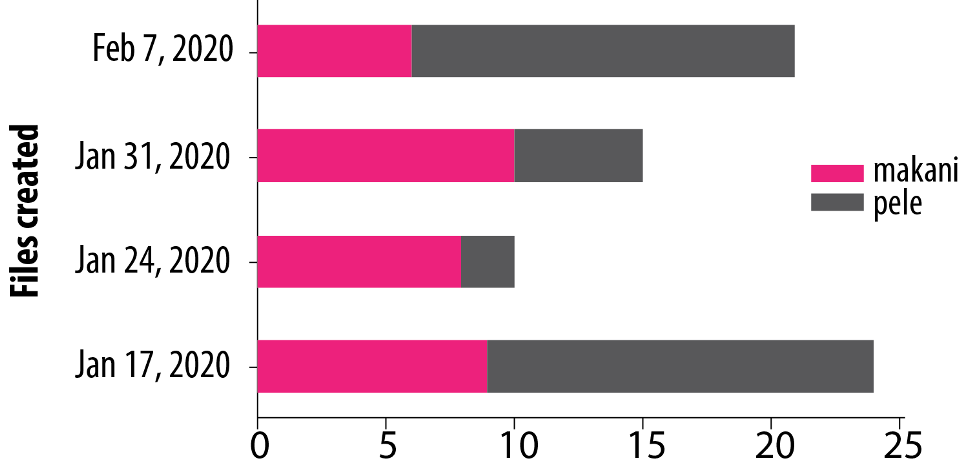 Figure 2: The logs show that in SAGE2 meetings, participants aren't just watching; they are actively populating the space with auxiliary information (7-15 files per meeting), a behavior nearly impossible in traditional projector setups.
Results & Survey Feedback
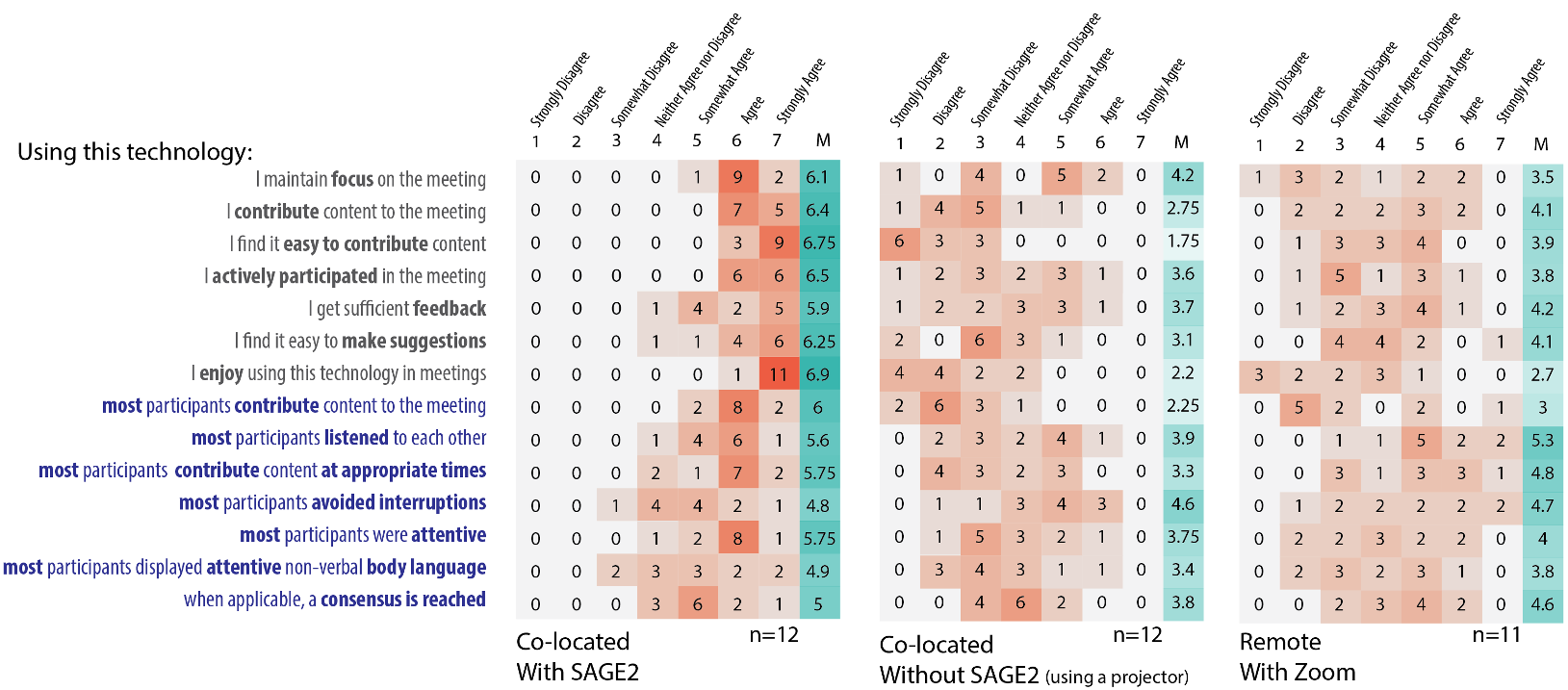
The attitudinal survey results were striking. Participants felt more focused and felt that "consensus was reached" more effectively in the SAGE2 modality.
- CPM (Projector): Scored lowest. Participants felt prone to distraction and noted that technical issues (dongles, cables) frequently derailed the flow.
- ZM (Zoom): Viewed as an "intermediary" step. The parallel chat was seen as a useful "log," but multitasking during meetings decreased overall attentiveness.
Critical Analysis & The Future of Hybrid Work
The researchers admit a limitation: their subjects were SAGE2 experts. However, the design implications are universal. If we want to solve "Zoom fatigue," we shouldn't just look at faces; we should look at shared space.
Future Work Directions:
- AI Mediation: Could an AI automatically cluster related notes on the wall?
- Hybrid Equality: How do we ensure a remote worker on a 13-inch laptop feels as "present" as someone standing in front of a 16-foot display wall?
- Infinite Canvases: Moving beyond physical screen boundaries to resizable virtual spaces that inform users of new content via "animated cues."
Conclusion
The "Traces of Time through Space" reminds us that human collaboration is naturally non-linear. By enabling parallel contributions and persistent visuals, SAGE2-style environments provide the "External Memory" necessary for high-stakes, data-intensive teamwork. As we design the next generation of hybrid tools, the focus must shift from streaming video to constructing canvases.