
TRACES: Bridging Global Themes and Temporal Nuance in Twitter Storytelling
TRACES: Generating Twitter stories via shared subspace and temporal smoothness
This paper introduces TRACES, a novel Twitter story generation framework that employs a multi-task clustering algorithm called STMTC. By integrating shared subspace learning with temporal smoothness constraints, TRACES successfully identifies coherent event threads from massive, unstructured social media streams, achieving SOTA performance in clustering accuracy and story quality.
Executive Summary
TL;DR: TRACES is an unsupervised framework designed to turn the chaotic "firehose" of Twitter data into structured, readable stories. It moves beyond simple keyword clustering by using a Multi-Task Clustering (STMTC) approach that simultaneously identifies common global topics and ensures that event transitions make sense over time.
Positioning: This work represents a sophisticated evolution in the field of Timeline and Storyline Construction. While previous SOTA methods treated time steps in isolation or focused solely on keyword bursts, TRACES treats each time window as a related task, positioning itself as a leader in coherent narrative generation for unstructured social media data.
The Core Challenge: Noise, Heterogeneity, and Discontinuity
Extracting stories from Twitter is notoriously difficult. Unlike news articles, tweets are:
- Fragmented: High noise and short context make single-tweet analysis unreliable.
- Evolving: Topics shift rapidly, making it hard to link a "bombing" event today with an "arrest" event three days later.
The authors identify a critical gap: existing methods either focus on global themes (losing the specific evolution of events) or local transitions (losing the bigger picture). TRACES addresses this by asking: Can we find a mathematical representation that captures both?
Methodology: The STMTC Engine
The heart of TRACES is the Shared Subspace and Temporal Smoothness Multi-Task Clustering (STMTC) algorithm. Instead of clustering each day's tweets separately, it solves a joint optimization problem.
1. The Shared Subspace (Global Consistency)
The model learns an orthogonal projection matrix () that maps features into a lower-dimensional shared subspace. This ensures that if a story is about the "Paris Attacks," terms like "Paris," "Security," and "Attack" remain centrally relevant across all time tasks.
2. Temporal Smoothness (Local Continuity)
A story isn't just a collection of related facts; it's a sequence. STMTC introduces a penalty term for variance between consecutive tasks (). This forces the clusters in Time to be logically related to clusters in Time , analogous to "smooth" video frames.
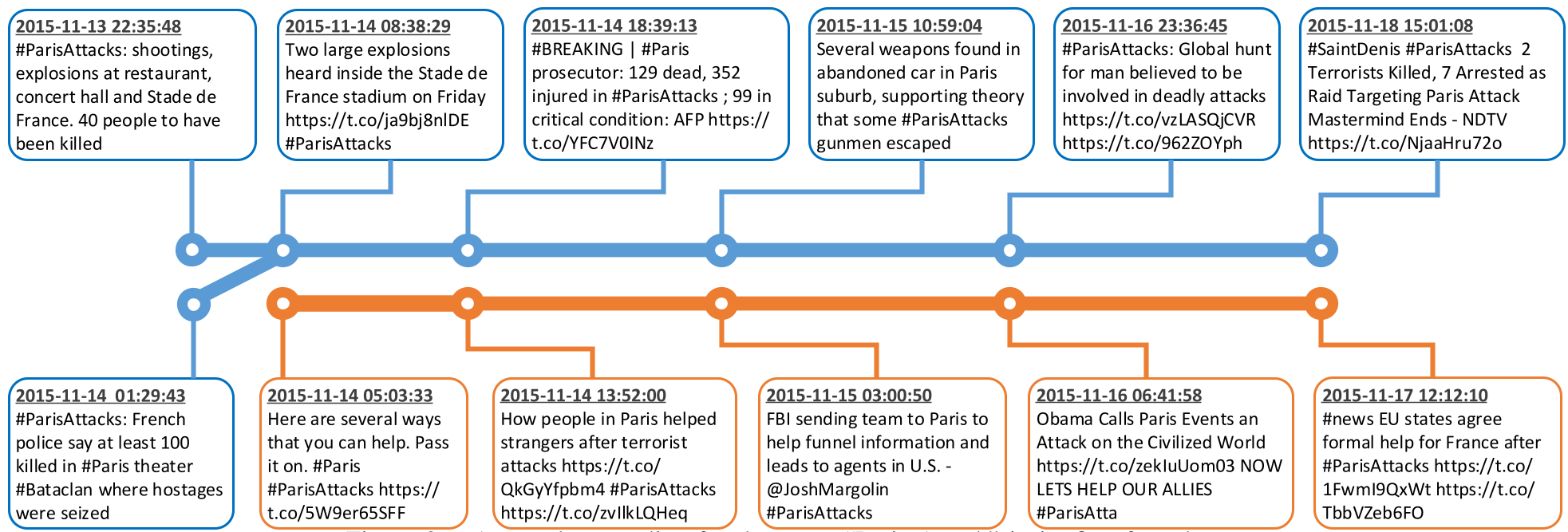 Figure 1: Conceptual visualization of stories maintaining shared features while transitioning smoothly.
Experiments: Proving the Gains
The researchers tested TRACES against high-performance baselines like BigClam and LSSMTC using real-world data from Latin American civil unrest and the 2015 Paris Attacks.
Performance Benchmarks
In the LATAM dataset, STMTC dominated the metrics:
- Accuracy: Achieved up to 91.8% in specific tasks, significantly higher than K-Means and standard NMF approaches.
- Coherence: The NMI (Normalized Mutual Information) scores were consistently higher, indicating that the clusters formed by STMTC align much more closely with human-labeled ground truth.
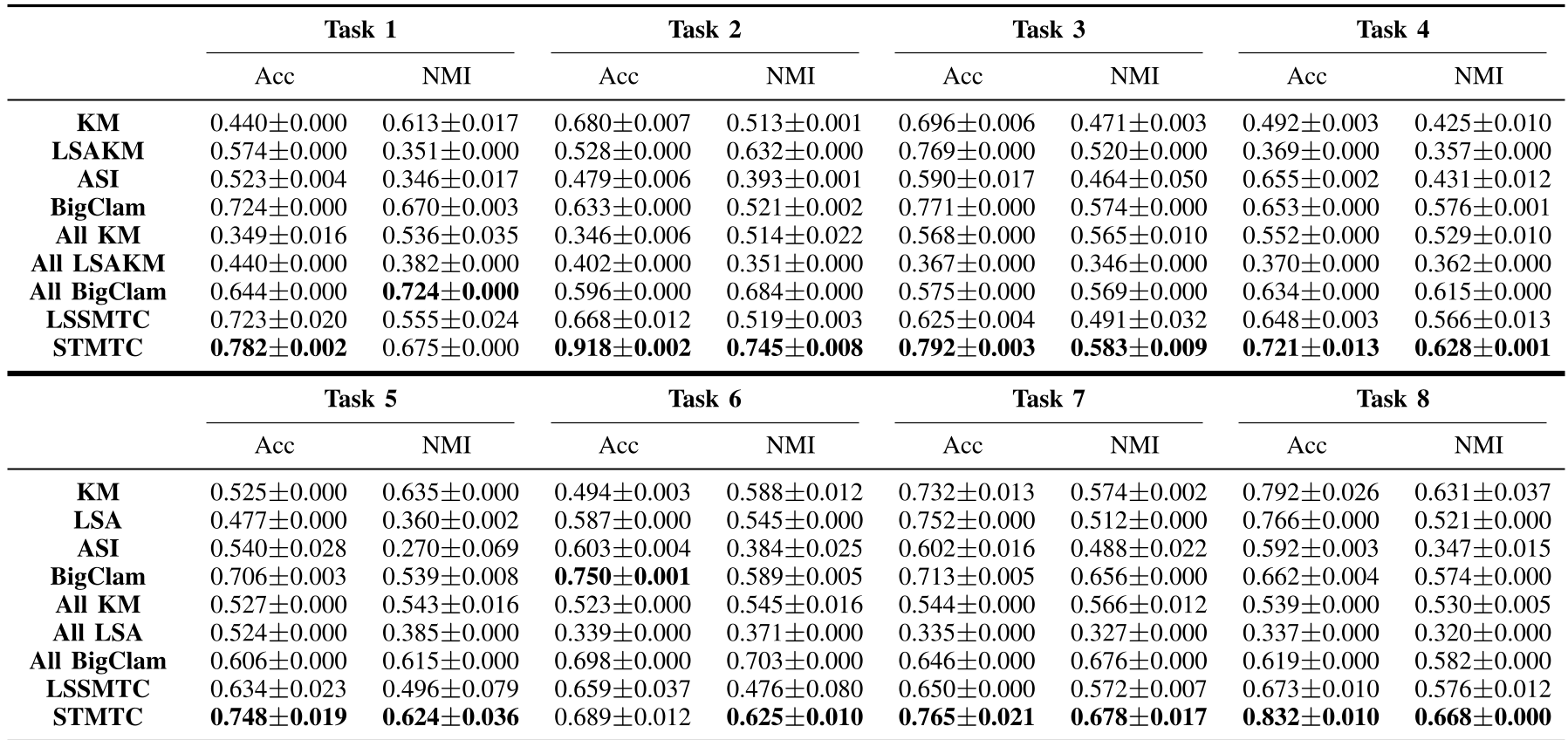 Table 1: Quantitative results showing STMTC outperforming single-task and basic multi-task clustering methods (Average Accuracy +11-18%).
Case Study: The Paris Attacks
A qualitative look at the Paris Attack dataset shows TRACES's ability to branch narratives. It successfully separated the "Security/Police Action" thread (tracking arrests and weapons) from the "Victim Support" thread (tracking international aid and helplines), while maintaining the "Paris Attack" context as a shared anchor.
Critical Insight & Future Outlook
Takeaway: The success of TRACES proves that for episodic social media data, multi-task learning is not an option—it is a necessity. By treating different time periods as related tasks, we overcome the sparsity of individual tweets.
Limitations & Future Work: While TRACES is powerful, it currently relies on pre-defined query expansion. Integrating deep contextual embeddings (like BERT or GPT-based embeddings, which were emergent after this paper's era) could further enhance the "Shared Subspace" by capturing semantic nuances beyond simple TF-IDF or Semi-NMF relationships. Additionally, extending this to cross-platform storytelling (Twitter + News + YouTube) remains a promising frontier.
Source Context: This analysis is based on the paper "TRACES: Generating Twitter Stories via Shared Subspace and Temporal Smoothness" by Zhang et al.