
Tracing Digital Thyroid Culture: How Hashtags Empower Patient Agency
Tracing digital thyroid culture: building communities of support
This research investigates the role of social media in health communication, specifically tracing how the hashtag #hypothyroidism functions on Twitter. By applying Actor-Network Theory (ANT) and Activity Theory, the study maps the digital culture of patient agency and the construction of support communities.
TL;DR
This research explores the digital ecosystem of hypothyroidism on Twitter, demonstrating how the simple hashtag #hypothyroidism serves as a core infrastructure for patient agency. By mapping human and non-human interactions, Elizabeth Keller argues that social media provides the immediacy required to transform isolated patient experiences into a global community of support and advocacy.
Background: Beyond the Clinic
Hypothyroidism is a chronic condition affecting millions, often characterized by debilitating symptoms like "brain fog," extreme fatigue, and depression. While clinical management is standard, the daily "lived experience" often falls through the cracks of professional medical discourse. This study positions Twitter not just as a tool, but as a generative space where digital culture and health communication intersect to fill these gaps.
Problem & Motivation: The Silencing of the Patient
In 2012, health communication faced a significant hurdle: the lack of accessible, real-time support networks that bypassed the traditional doctor-patient hierarchy. The author noticed that while patients were desperate for information on managing symptoms (medication, diet, coping mechanisms), official medical structures were often slow or inaccessible.
The insight driving this work is that the "hashtag" is more than a metadata tag; it is an actor in a network that organizes content, creates visibility, and facilitates a form of "distributed intelligence" among patients who may never meet in person.
Methodology: Mapping the Network
To understand how this community thrives, Keller deployed three sophisticated theoretical lenses:
- Actor-Network Theory (ANT): To identify both human (patients, doctors) and non-human (hashtags, medications, the "butterfly" symbol) participants.
- Articulation Theory: To understand how these disparate elements are linked together to create meaning.
- Activity Theory: To examine the "tensions" and the process by which a single tweet is transformed into collective knowledge.
The Actor Landscape
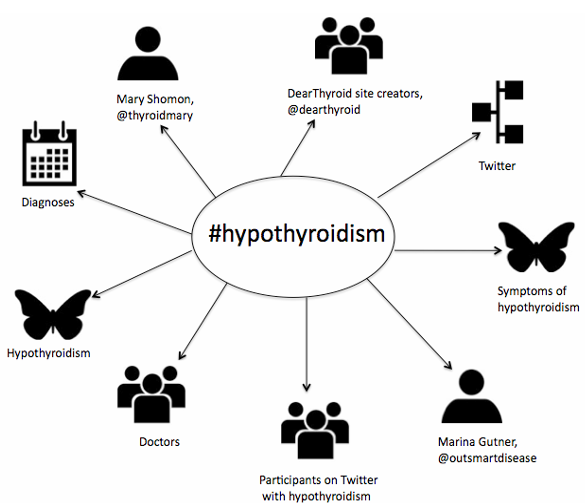 Figure 1: The researcher uses visual symbols like the butterfly (associated with the thyroid) to connect digital actors to the physical community.
Key Results: Where the Strength Lies
The most striking finding of the mapping process was the strength of ties within the network.
- Patient Dominance: Patients themselves are the most active and "bold" actors in the network. They provide the labor that keeps the hashtag relevant.
- Medical Disconnect: Interestingly, doctors and formal diagnosis institutions exhibited the weakest ties to the hashtag activities. This suggests that the #hypothyroidism space is a patient-led "shadow" healthcare system.
- Knowledge Transformation: Activity Theory mapping (Figure 3) showed that actions like "retweeting" or "replying" are critical interventions that move a tweet from personal expression to shared resource.
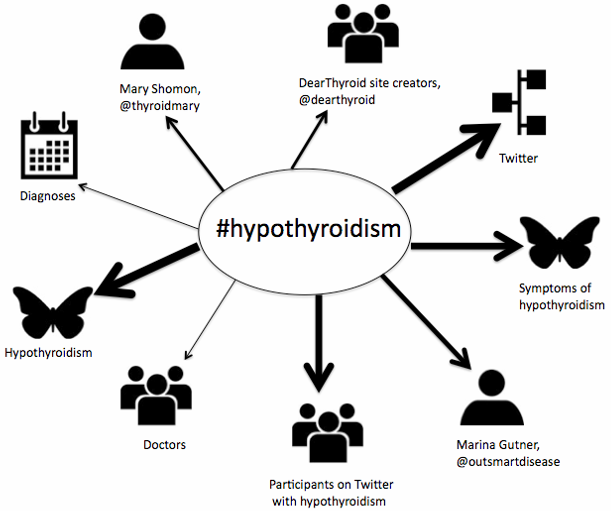 Figure 2: Note the thickness of lines connecting participants compared to the thin lines connecting doctors—highlighting the patient-centric nature of the digital culture.
Critical Insight & Conclusion
Takeaway
The #hypothyroidism hashtag is a primary example of Information Design as Advocacy. By creating an "ambient findability," patients are no longer passive recipients of care; they are active builders of a digital culture that supports mental and physical well-being.
Limitations & Future Work
The study, conducted in 2012, focused on a 140-character environment. In today's landscape of Long-form posts, Threads, and algorithmic feeds, the "immediacy" may be heightened, but the signal-to-noise ratio has also increased.
Future research should investigate how these organic patient networks deal with the rise of "medical misinformation" and whether the disconnect between patients and doctors on these platforms has narrowed or widened over the last decade.