
Tracing the Digital Pulse: A Methodology for Decoding Political Opinion Cascades
Tracing Opinion-Formation on Political Issues on the Internet: A Model and Methodology for Qualitative Analysis and Results
This paper introduces a systematic methodology and a multi-stage model for tracing and analyzing opinion formation on political issues across the blogosphere. By combining quantitative link analysis with qualitative axial coding ("theorizations"), the authors demonstrate how political sentiments cascade through linked social information using the BP oil spill as a primary case study.
TL;DR
This research bridges the gap between massive social data and qualitative insight. It presents a robust framework for identifying how political opinions form, harden, and spread through the internet, moving from an "Initial" state of public apathy to a "Percolated" state of global consensus or polarization.
Background Positioning
In the landscape of digital sociology, this work occupies the crucial middle ground between Big Data analytics and Grounded Theory. It acknowledges that while the blogosphere is a "snapshot of crowd thinking," it is often ignored by policymakers due to its noisy, unstructured nature. The authors provide a roadmap to turn these "soapboxes" into a systematic source of policy feedback.
The Problem: The Noise of the Blogosphere
Traditional political analysis often relies on polls or mainstream media, which are slow and top-down. However, digital communications—specifically blogs—suffer from several issues:
- Adoption Reluctance: Most people ignore political issues until a "signal" becomes loud enough.
- Preaching to the Choir: Blogs often foster echo chambers rather than mutual dialogue.
- Analytic Gap: High-volume data is easy to collect (Quantitative) but difficult to interpret for true logic (Qualitative).
Methodology: The Three-State Model and Axial Coding
The core of the paper is a transition model that explains how an event moves through a network:
- Initial State: Low activity; adoption reluctance is high.
- Alert State: A major event (the signal) triggers "Influentials" and initiates positive externalities (the bandwagon effect).
- Percolated State: The opinion becomes self-sustaining, reinforcing the views of early adopters and disproving the inactive majority.
The Architecture of Opinion
The authors don't just count links; they decode the "Why" using a six-facet coding system:
- Conditions: Situation & Problem
- Actions: Goal & Reasoning
- Consequences: Outcome & Viewpoint
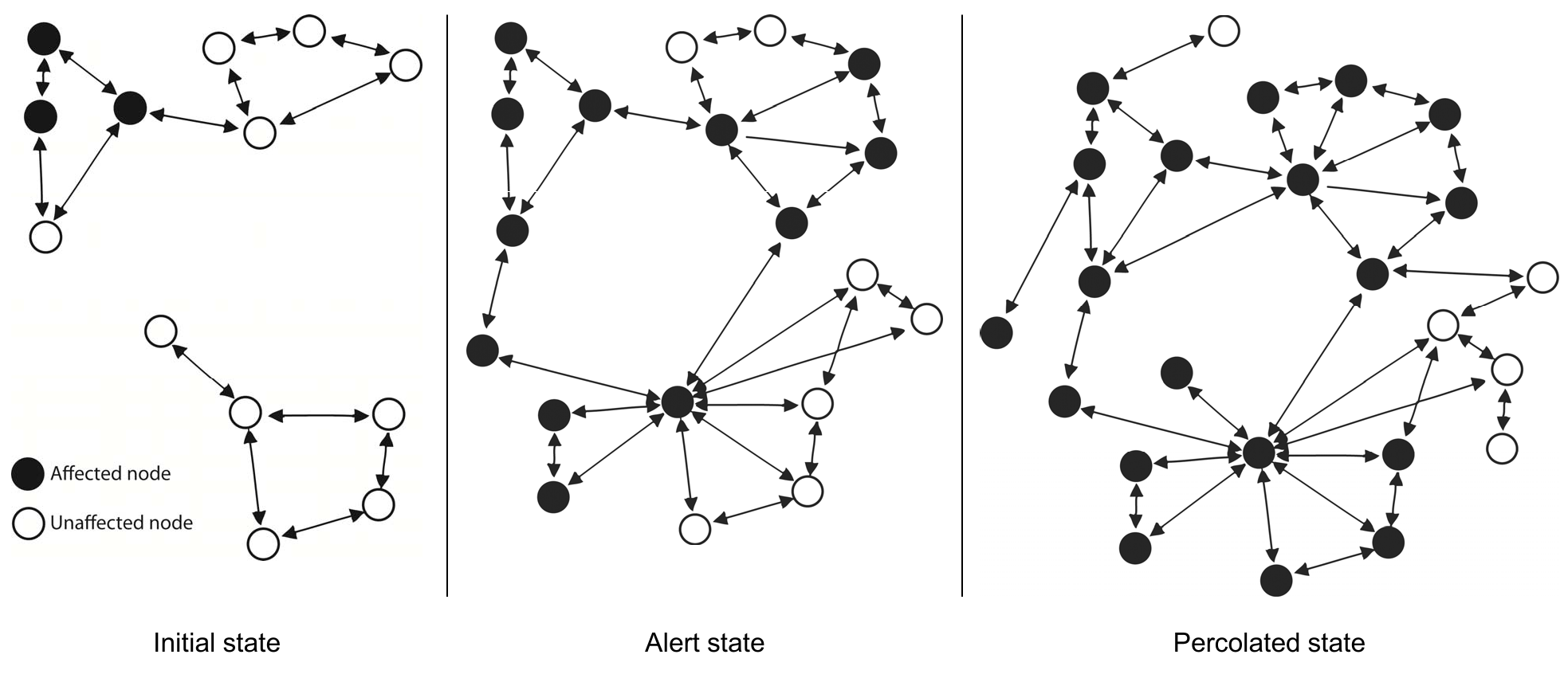
Figure 1: The model shows the diffusion of a new opinion (filled nodes) through dyadic linking behavior.
Case Study: The BP Oil Spill
To validate this, the researchers tracked the "Deepwater Horizon" disaster. By identifying the top 1% of political blogs (the "Focal Blogs"), they were able to see a clear shift.
| # | Focal Blog | Authority Index Indicator |
|---|---|---|
| 1 | Hot Air | High-frequency political commentary |
| 2 | CNN Political Ticker | Secondary triangulation source |
| ... | ... | ... |

Table 1: The study identifies "Influentials" who act as nodes for opinion diffusion.
Through Axial Coding, the research moved from raw text to a "Summary Representation." For example, a blog post complaining about economic damage wasn't just a "negative post"—it was theorized as "Government Inaction due to Disaster Costs."

Table 2: Transforming raw text into logical theorizations for macro-level analysis.
Critical Analysis & Conclusion
Takeaway
The paper effectively demonstrates that the internet is not just a chaotic collection of voices, but a structured network where opinions "percolate" according to predictable socio-physical laws. By using Theorizations, researchers can move beyond sentiment analysis (Is this happy or sad?) to logic analysis (What is the perceived failure and desired goal?).
Limitations
The model's reliance on binary decisions (approve/disapprove) is its biggest weakness. Modern political discourse is often more nuanced than a simple toggle. Additionally, the labor-intensive nature of manual "human coding" for qualitative facets remains a bottleneck that modern LLMs (Large Language Models) might now solve.
Future Outlook
The marriage of Social Network Analysis (SNA) and Qualitative Coding is the future of digital political science. As we move away from blogs toward short-form video and algorithmic feeds, adapting this model to account for "algorithmic bias" rather than "human linking" will be the next great research frontier.