
Tracking the Pulse of Networks: A Scalable Framework for Dynamic Community Evolution
Tracking the Evolution of Communities in Dynamic Social Networks
This paper introduces a heuristic threshold-based framework for tracking community evolution in large-scale dynamic social networks. By matching "step communities" across successive time intervals using the Jaccard coefficient, the method identifies key evolutionary events such as birth, death, merging, and splitting. The framework achieved high scalability, processing a network with 1 million nodes in approximately 85 seconds.
TL;DR
Social networks are living organisms, yet we often analyze them as static "post-mortem" snapshots. This paper presents a high-performance framework for tracking how communities form, merge, split, and dissolve over time. By shifting from static aggregation to a step-by-step matching strategy, the authors enable the analysis of networks with millions of nodes—such as mobile operator data—revealing the complex life cycles of human interaction.
Background & Motivation: Why Static Analysis Fails
In social network analysis (SNA), community detection is essential for understanding group behavior, such as customer churn in telecommunications or academic collaboration trends. However, most algorithms treat graphs as static.
The authors argue that static analysis leads to temporal ablation:
- Loss of Detail: Short-lived but significant groups disappear.
- Contradictory Information: Aggregating edges from different time periods creates "background noise" that confuses modularity-based algorithms.
- Scalability Bottleneck: Methods like Clique Percolation are conceptually strong but computationally expensive for the "Big Data" scale of modern telecoms.
The Core Mechanism: The Community Life-Cycle Model
The paper defines a dynamic community as a timeline of "Step Communities" (observations at specific timestamps). To manage these timelines, the authors define a set of critical evolutionary events:
- Birth & Death: Appearance of new groups or disappearance of old ones after steps.
- Merging & Splitting: When two previous groups join or one group divides into distinct entities.
- Expansion & Contraction: Significant changes in membership size (>10%).
- Intermittency: Recognizing that a group might "go dark" for one interval and return later.
The Matching Strategy
Instead of re-clustering the entire history, the method uses a Heuristic Threshold-based approach. For each new time step , it calculates the Jaccard similarity between current findings and the "fronts" (the latest known states) of existing dynamic communities:
If , the community continues. If multiple "fronts" match one new step community, a Merge is recorded.
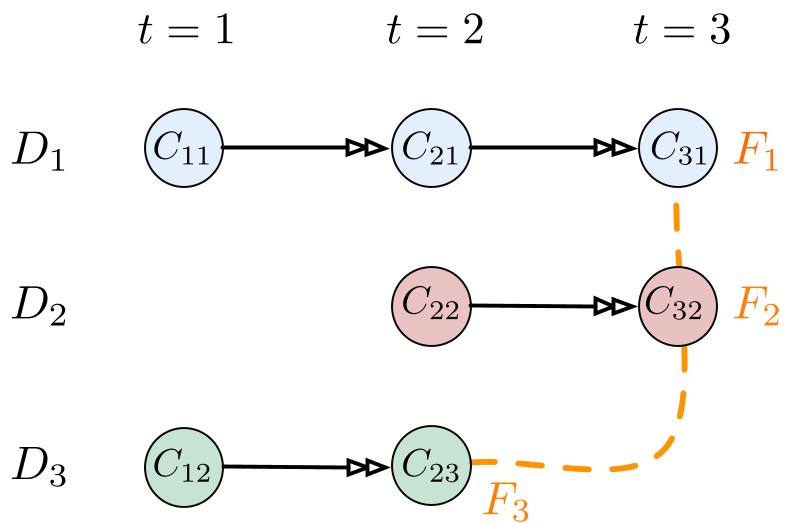 Fig 1: A conceptual view of Birth, Death, and Continuation events across three time steps.
Experimental Results: Accuracy and Speed
The authors validated their work using synthetic benchmarks with "ground truth" events.
1. Robustness to Volatility
The experiments showed that as networks become more volatile (more members switching groups), the Static Aggregation approach (combining all edges) fails miserably, with NMI accuracy dropping sharply. In contrast, the dynamic matching strategy remains stable.
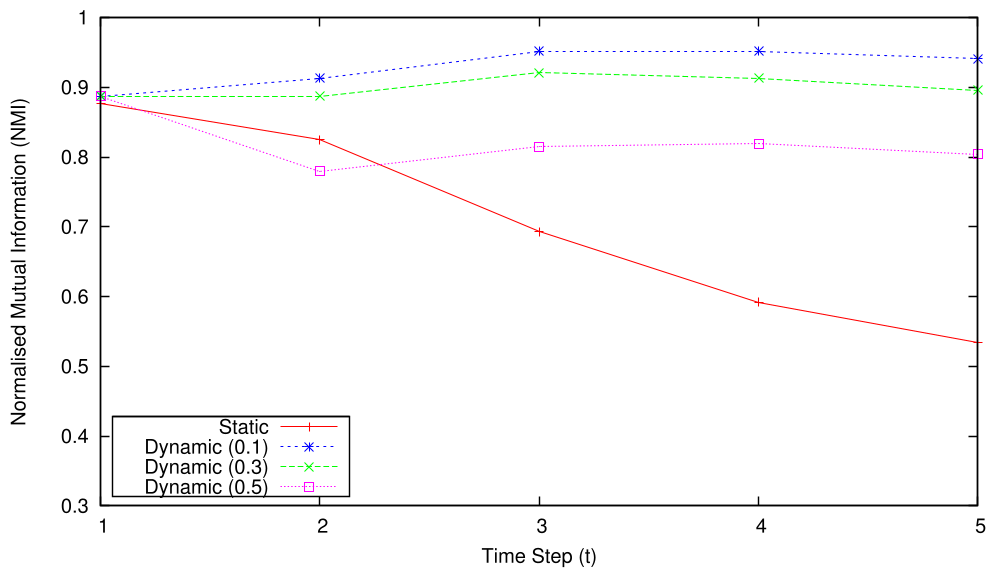 Fig 2: Comparison of NMI accuracy across different event types (Intermittent, Expansion, Birth/Death).
2. Massive Scalability
This is the method's "killer feature." By optimizing set intersections (using node-community maps rather than naive pair comparisons), the algorithm scales linearly.
- 100k nodes: ~2 seconds.
- 1 Million nodes: ~85 seconds. This level of efficiency allowed the team to process 8 weeks of mobile call data (4 million users) in roughly 19 minutes.
Deep Insight: Success in Mobile Operator Networks
When applied to real-world mobile data, the framework identified 82,000 "intermittent" communities. This reveals a profound truth about human social patterns: we often interact in bursts. A group might be active for two weeks, silent for two, and then return. Static methods would likely miss these groups or treat them as unrelated noise.
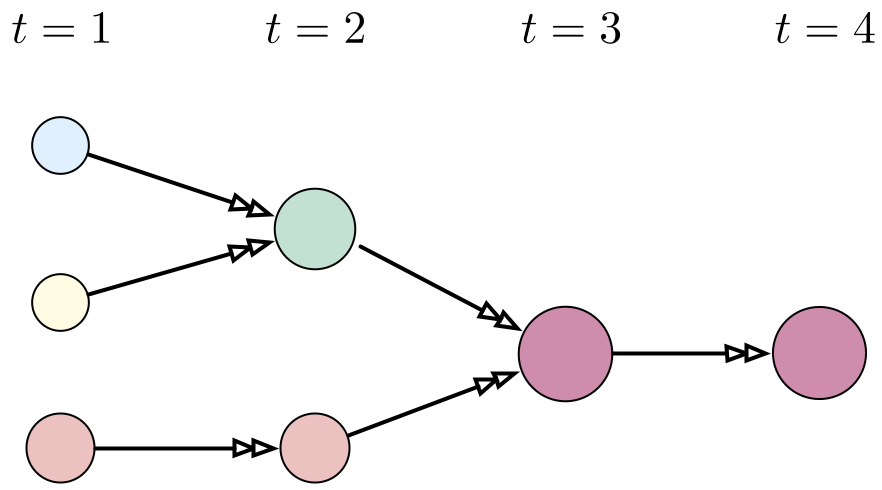 Fig 3: A complex merge event detected in a real mobile subscriber network over 8 weeks.
Conclusion & Future Outlook
Greene et al. have successfully bridged the gap between theoretical community evolution and practical "Big Data" requirements. The framework's independence from the underlying static clustering algorithm (like the Blondel/Louvain method used here) makes it an "evergreen" tool—as static algorithms improve, this tracking framework only gets better.
Future Work: The authors suggest using the insights from one time step's community "fronts" to seed the discovery process for the next step, potentially further increasing speed and stability in extremely high-frequency dynamic graphs.