
Unified Social Video: Breaking the Silos with Cross-Domain Tracking
A Tracking Model for Enhancing Social Video Integration and Sharing
The paper introduces a novel Tracking Model for social video services designed to break through the localized boundaries of autonomous websites. By utilizing a context-tracker and a service center architecture, it integrates "virtual media" across different domains, enabling a global view of User-Generated Content (UGC) and logical relationships.
TL;DR
Social video interaction is currently fragmented across isolated platforms like YouTube, Blogs, and BBS. This paper proposes a Tracking Model that uses video wrapping and a three-layer architectural approach to unify these "islands" of content. By tracking videos at the global level, it creates a "Virtual Media" layer where comments, ratings, and social links are aggregated regardless of which site the video is actually hosted on.
Background & Motivation: The Boundary Problem
In the current Web 2.0 era, User-Generated Content (UGC) is king. However, when a video is shared (or duplicated) from one site to another, its "social life" is severed. A comment on a Blog post doesn't show up on the original YouTube source.
The authors identify three critical gaps:
- Atomic Isolation: Videos are treated as static objects without spatial or temporal logical links.
- Integration Failure: There is no mechanism to track a video's propagation across different domains.
- Loss of Knowledge: Valuable interactions (enrichments) on duplicates are lost to the original publisher and other viewers.
Methodology: Wrapping and Virtualization
The core innovation lies in treating video not as a file, but as a wrapped service.
1. Video Wrapping
Before a video is uploaded, it is "wrapped" with a Service Center address and control codes (using SMIL). This allows the system to identify the video uniquely via content hashing.
2. The Tracking & Integration Module
Instead of relying on a slow, centralized web crawler, the system uses a client-side tracker embedded in the media player. It reports:
- Manipulation: How users interact with the fragment.
- Social Net: Connection between Users, Media, and UGC.
- MediaLink Net: Logical relationships between different videos.
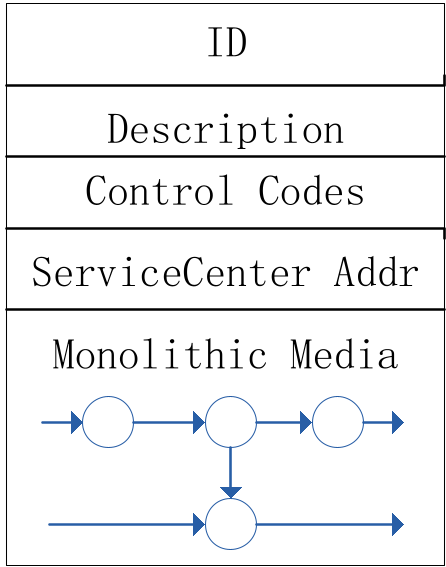
3. The Three-Plane Sharing Model
To handle the complexity of distributed duplicates, the authors propose three layers:
- Instance Plane: Real digital files on specific servers (e.g., a YouKu MP4).
- Virtual Data Plane: An abstract representation of the "Content" itself, aggregating data from all instances.
- Service Plane: The logic layer that presents the aggregated social knowledge to the user.
Experimental Insights: Expanding the "Share Zone"
The paper evaluates the system via a "Share Zone" analysis. Traditional systems operate in Zone 1 (single user, single site) or Zone 2 (multiple users, single site). This model pushes the boundary to Zone 3, encompassing all duplicates across the entire web.
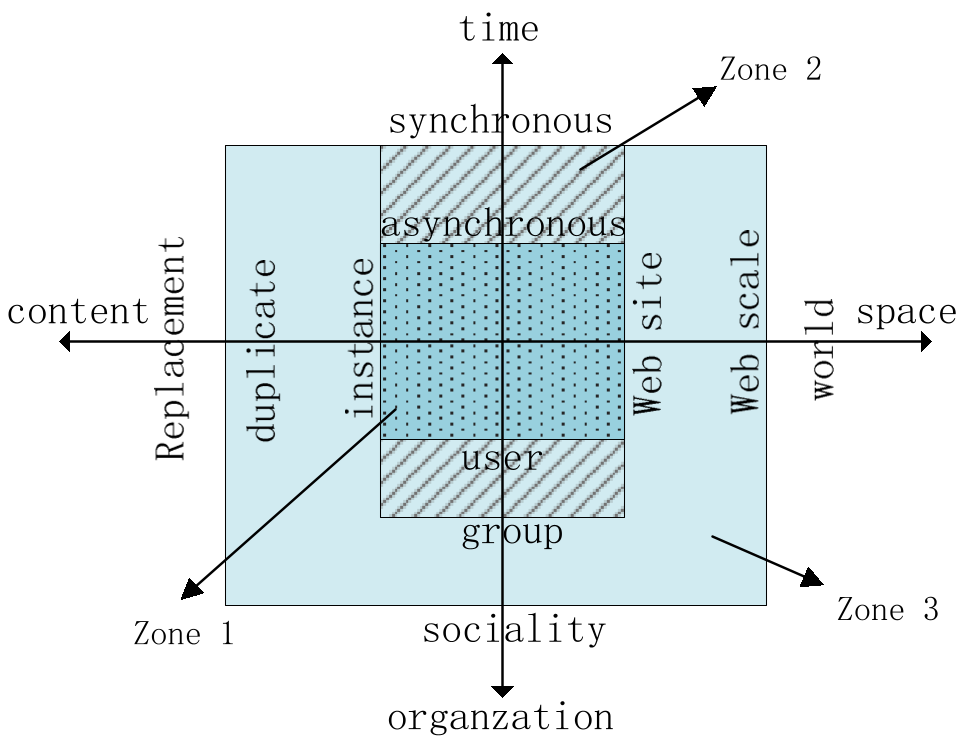
Qualitative Comparison Highlights:
- Cross-Domain Capability: Unlike YouTube or YouKu, which are closed ecosystems, this model tracks across domains.
- Richness of Data: While crawlers capture titles/descriptions, this model captures User Behavior and Business Logic in real-time.
| Feature | Web Crawler | Video Service System | Tracking Model |
|---|---|---|---|
| Business Logic | No | Yes | Yes |
| User Behavior | No | No | Yes |
| Cross-Domain | Yes | No | Yes |
Critical Analysis & Conclusion
Key Takeaways
The "Tracking Model" effectively turns the web into a giant, integrated database for social video. By using a client-reporting mechanism, it avoids the scalability issues of traditional deep-web crawling.
Limitations
- Player Dependency: The system requires a specialized player (Ambulant) or middleware, which might hinder universal adoption in standard browsers.
- Security & Privacy: Tracking "User Behavior" across domains raises significant privacy concerns that would need robust encryption and consent frameworks in a modern context.
Future Work
The authors suggest that future iterations will focus on alleviating the influence of vicious users (spam/attacks) and mining the tracked data to discover deeper "service logics" for personalized recommendations.
In an era of fragmenting social platforms, this research provides a vital blueprint for how we might eventually re-unify our digital experiences around the content itself, rather than the platform it sits on.