
Simulating the Pulse of Healthcare: Intelligent RFID Tracking and Trajectory Prediction
Tracking People and Equipment Simulation inside Healthcare Units
This paper presents an intelligent simulation and prediction system for tracking patients, staff, and medical equipment within healthcare units using RFID technology. It introduces the SK-Means clustering algorithm to discover movement patterns and achieves real-time trajectory estimation to optimize sensor deployment and energy efficiency.
TL;DR
In the high-stakes environment of a hospital, losing a piece of equipment or a patient isn't just an inconvenience—it's a critical failure. This paper introduces a sophisticated simulator that uses the SK-Means clustering algorithm to predict where people and assets are headed. By modeling hospital floors as complex networks of corridors and "gravitational" rooms, the system achieves over 60% prediction accuracy, proving that we can save energy by deactivating sensors that aren't in the object's path.
Background & Motivation: The Invisible Costs of Hospital Management
Hospitals lose millions of dollars annually to misplaced or stolen equipment. While RFID (Radio-Frequency Identification) is a standard solution for tracking, existing systems are often "dumb"—they simply report location without foresight. This leads to two major issues:
- Operational Inefficiency: Real-time tracking is reactive, not proactive.
- Energy Waste: In a dense sensor network, keeping every node active 24/7 drains power.
The authors' insight is rooted in the repetitive nature of human movement. By treating trajectory data as a mining problem, they can predict the next "cell" an object will occupy, creating opportunities for energy-efficient sensor management.
Methodology: SK-Means and the Physics of Movement
The core of the system is the SK-Means algorithm, a variation of K-Means clustering specifically tuned for movement patterns.
1. The Architecture
The system is built on a Java-MySql-Weka stack. It analyzes the "movement size" (average length of paths) to determine the number of clusters required for prediction.
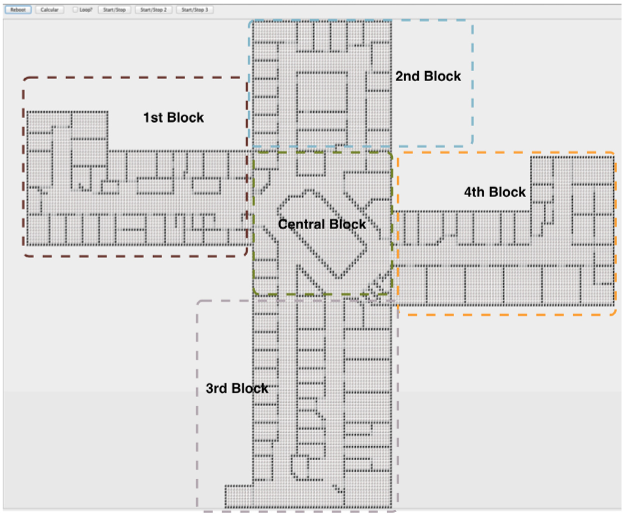 Fig 1: The Graphical User Interface (GUI) showing the hospital floor and entity tracking.
2. Corridor vs. Room Logic
Predicting movement in a hallway is different from predicting movement in a surgical ward. The authors use a dual-logic approach:
- Corridors: Objects are given "preferential directions" (x-dir, y-dir) to simulate intentional transit.
- Rooms: Since specific paths inside a room matter less than the fact that the object is in the room, the authors use gravitational forces. A random point is generated, and the object is either "attracted" to it or "repulsed," creating a realistic, unpredictable shuffle.
Experiments: More Sensors Aren't Always Better
The investigators tested four scenarios to see how sensor placement affects prediction accuracy.
| Scenario | Sensor Count | Average Precision |
|---|---|---|
| 1st (Elevators Only) | 4 | 56.4% |
| 2nd (Every Door) | 124 | 60.8% |
| 3rd (Corridors Only) | 10 | 60.1% |
| 4th (Actual Hospital) | 10 | 62.5% |
Key Insight from Results
The most striking finding is the comparison between Scenario 2 and Scenario 3. Placing 124 sensors at every room door provides nearly the same accuracy as placing just 10 sensors in the corridors. This suggests that the topology of the hospital is more important than the density of the sensors.
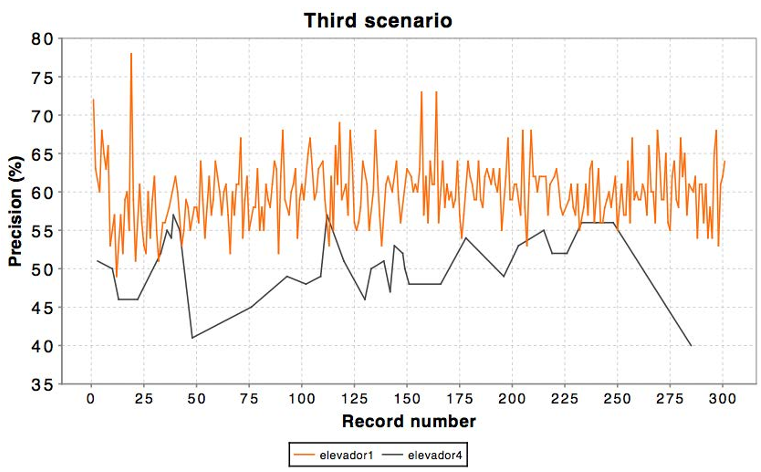 Fig 2: Convergence of the prediction algorithm over time. The red line indicates "usual" trajectories, showing rapid learning.
Critical Analysis & Future Outlook
Conclusion
The paper successfully demonstrates that trajectory prediction is not just a theoretical exercise but a practical tool for infrastructure optimization. By using SK-Means, the system identifies the "Critical Points" of a floor plan, allowing hospitals to deploy fewer, more effective sensors.
Limitations & Future Work
While the 62.5% accuracy is a solid baseline for a clustering approach, modern Deep Learning techniques (like Graph Neural Networks) could likely push this higher by modeling the hospital floor as a topological graph. Furthermore, the paper identifies a manual bottleneck: inputting hospital floor plans into the system. Future iterations aim to use Computer Vision to automatically ingest architectural blueprints.
The Takeaway
For healthcare IT managers, this research suggests a move away from "brute-force" sensor deployment. Instead, a simulation-first approach can identify where sensors are actually needed, potentially saving thousands in installation and maintenance costs.