
FlyTracker: Decoding Social Networks of Drosophila via High-Speed Vision
Tracking for Quantifying Social Network of Drosophila Melanogaster
The paper introduces FlyTracker, an automated computer vision software designed to track large populations of Drosophila Melanogaster in a dedicated imaging platform called FlyWorld. By utilizing a high-frame-rate (300 fps) but low-resolution setup, the system achieves robust tracking and identifies social interaction networks (SIN) with superior accuracy over existing baselines.
TL;DR
Quantifying the social dynamics of living organisms is a cornerstone of behavioral science, yet it remains a bottleneck due to the limitations of manual annotation. This paper presents FlyTracker, a robust computer vision framework designed to extract "Social Interaction Networks" (SIN) from large groups of fruit flies. By combining a 300 fps imaging platform (FlyWorld) with a tracking algorithm that leverages prior knowledge of population size, the authors solve the chronic problem of track fragmentation in low-resolution environments.
The "Identity Crisis" in Multi-Object Tracking
In the study of Drosophila, high-level social behaviors—like courtship or aggression—are often transient. Capturing them requires high frame rates; however, high speed often comes at the cost of spatial resolution and contrast.
The current industry standard, Ctrax, often fails under these conditions. When flies collide or walk over one another, Ctrax loses the "identity" of the fly, resulting in broken tracks. For a social network to be valid, we need a continuous history for every individual. If 10 flies result in 31 different tracks (as seen in the paper's experiments), the network topology becomes meaningless noise.
Methodology: High-Speed Precision and Geometric Constraints
The researchers built FlyWorld, an imaging arena that records at 300 frames per second. This allows them to track unclipped flies—preserving their natural ability to jump.
1. Robust Segmentation
The algorithm uses pixel-wise maximum values across frames to build a static background model. Flies are then isolated via background subtraction.
2. Solving Overlaps (The Splitting Logic)
The brilliance of FlyTracker lies in its handling of "blobs" (groups of flies).
- Detection: If the number of detected objects is less than the known fly count (), the system triggers a split.
- EM Algorithm: It treats a multi-fly blob as a mixture of ellipsoids.
- Hungarian Algorithm: It uses graph theory to match blobs from the previous frame to the current frame, minimizing the Euclidean distance to ensure identity persistence.
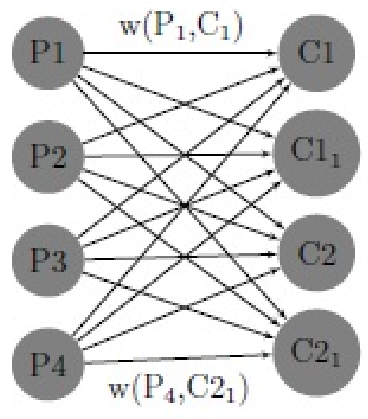 Figure: The bipartite graph matching approach used to estimate mixing components for splitting fly clusters.
Experimental Results: Stability at Scale
The performance gap between FlyTracker and the baseline (Ctrax) is stark, especially as the density of the group increases:
| Population | FlyTracker Tracks | Ctrax Tracks | Improvement |
|---|---|---|---|
| 10 Flies | 10 | 31 | Consistent Identity |
| 15 Flies | 15 | 47 | Consistent Identity |
| 49 Flies | 49 | 850 | Identity Preservation |
While Ctrax's tracks exploded by a factor of 17x due to fragmented detections, FlyTracker remained perfectly stable.
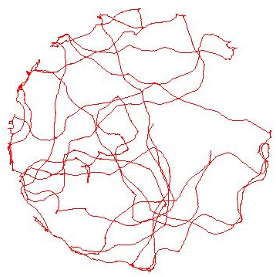 Figure: (a) A continuous track of a single fly over thousands of frames; (c) The resulting Social Interaction Network where nodes represent individual flies and edges denote classified interactions.
From Pixels to Social Insights
By extracting the position () and orientation (), the system calculates a Social Interaction Network (SIN). An "interaction" is defined by specific geometric criteria:
- Proximity: Within two body lengths.
- Orientation: The initiator must be facing the interactee (angle ).
- Persistence: The state must hold for at least 1.5 seconds.
Critical Insight & Future Outlook
The primary contribution of this work isn't just "faster tracking." It is the realization that biologically-informed constraints (knowing there are exactly flies) can drastically simplify the computer vision problem.
Limitations: Because the system relies on low-resolution silhouettes, it cannot detect subtle features like wing vibration or leg grooming. Future Work: Integrating this temporal stability with high-resolution pose estimation (like modern DeepLabCut pipelines) could provide a "Gold Standard" for ethology—combining identity stability with anatomical detail.
Conclusion
FlyTracker provides the backbone for high-throughput behavioral genomics. It proves that we can infer structured social hierarchies from seemingly stochastic movements, opening new doors for understanding the genetic basis of sociality.