
Beyond the Microphone: Privacy-Preserving Monitoring of Social Interactions
18023_Trade-offs in monitoring social interactions.
This paper introduces a privacy-preserving mobile sensing framework for monitoring face-to-face social interactions. By utilizing non-visual and non-auditory sources—specifically RSSI from Wi-Fi for distance, compass for orientation, and chest-mounted accelerometers for speech—the system achieves approximately 90% interaction detection accuracy without traditional privacy-invasive recordings.
TL;DR
This research tackles the "observer's paradox" in social science: how do we record human behavior without changing it? By replacing cameras and microphones with invisible digital proxies—Wi-Fi signal strength, digital compasses, and chest-vibration sensors—the authors provide a framework for 90% accurate social interaction monitoring that respects privacy and natural behavior.
Probing the Trade-offs of Social Observation
The study of human interaction is at a crossroads. We know that self-reporting (surveys) is notoriously inaccurate due to memory decay, yet the gold standard—video and audio recording—is often too invasive for long-term, real-world studies. People act differently when they know a lens or a microphone is "live."
The authors identify three critical trade-offs in current sensor-based methods:
- Quality of Data vs. Unobtrusiveness: Invasive sensors provide better data but distort behavior.
- Privacy vs. Utility: Audio recordings provide deep context but violate ethical norms and capture uninvolved parties.
- Spatial Flexibility vs. Granularity: Infrastructure (cameras) limits subjects to specific rooms, while mobile sensors (Bluetooth) often lack the precision to distinguish "nearby" from "interacting."
Methodology: The Non-Visual, Non-Auditory Approach
The core innovation lies in using "non-human" senses to reconstruct human presence. The authors break down an interaction into two prerequisites: Spatial Setting and Speech Activity.
1. Inferring Spatial Settings (Where and How?)
Instead of using cameras, the system leverages:
- RSSI (Received Signal Strength Indicator): By applying supervised learning to Wi-Fi signals, the system achieves a median accuracy of 0.5m in distance estimation.
- Compass Features: The standard deviation of relative body orientation () serves as a proxy for social "stability." A low suggests a stable, focused interaction.
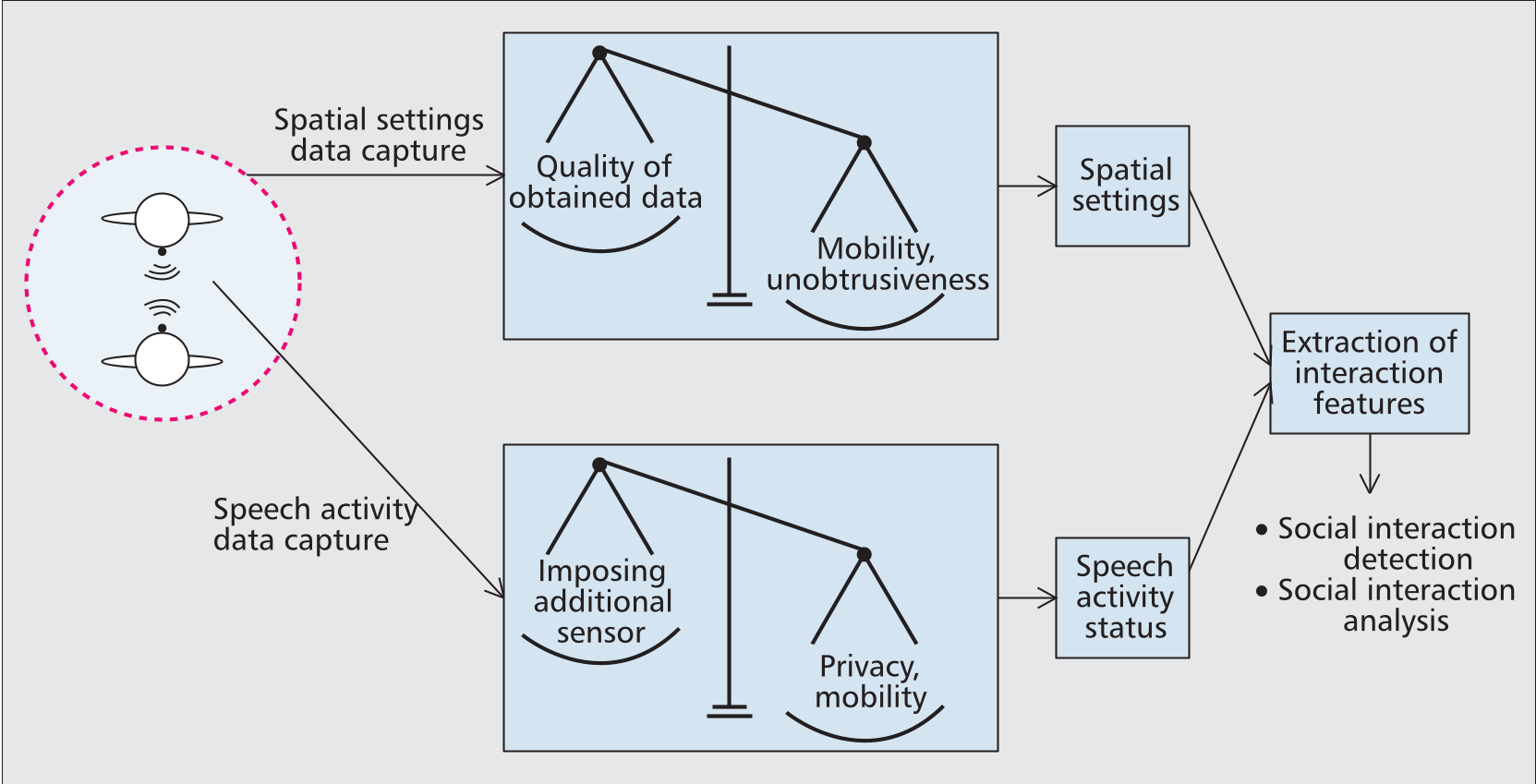 The diagram illustrates the trade-off: trading off raw information richness (like video) for higher privacy and mobility.
2. Speech Activity via Vocal Vibrations
To avoid the privacy nightmare of audio recording, the authors use a chest-mounted accelerometer.
- The Insight: During speech, vocal cords vibrate between 100-200 Hz. This physical vibration can be detected by an accelerometer on the chest, even if no sound is recorded.
- Result: This method ignores background conversations and background noise (unlike a microphone), focusing purely on the subject's active phonation.
Experimental Results and Performance
The research tested various feature combinations to distinguish between "Social Interaction" (SI) and "Non-Social Interaction" (NonSI).
| Feature Set | SI Selection Accuracy | False Positive Rate |
|---|---|---|
| orientation, distance (α, d) | 74% | 24% |
| stability, distance (σ, d) | 79% | 31% |
| Full Fusion (σ, α, d) | 89% | 26% |
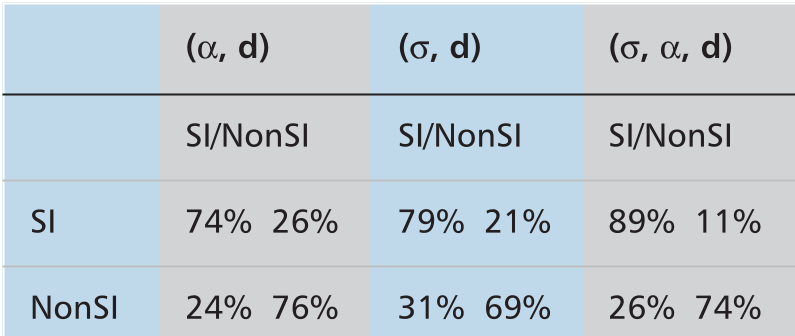
When speech activity detection (93% accuracy) was fused with the spatial model, the system achieved a robust 90% success rate in detecting face-to-face encounters.
Critical Analysis: The Road to "Invisible" Research
The primary hurdle remains the obtrusiveness of the chest-mounted sensor. While smartphones handle the spatial calculations, the accelerometer currently requires a dedicated device (like a Shimmer sensor). However, the authors argue that as consumer wearables like Fitbit and smart clothing evolve, these sensors will become "invisible" parts of our daily attire.
Limitations
- False Positives: High-intensity physical activity (running, coughing) or traveling in vibrating vehicles (buses) can mimic vocal cord vibrations.
- Hardware Placement: The orientation model assumes the phone's position on the body is known or detected.
Conclusion
This work shifts the paradigm of social behavior analysis from "capturing everything" to "capturing the right signals." By intentionally limiting the data stream to non-sensitive modalities, researchers can finally scale social studies to thousands of participants over months of time without the ethical and psychological baggage of surveillance.