
From Rules to Representations: The Evolution of Social Influence Propagation
Traditional and Deep Learning Approaches to Information and Influence Propagation in Social Networks
This paper provides a comprehensive overview of information and influence propagation in social networks, bridging the gap between traditional stochastic models like Independent Cascade (IC) and Linear Threshold (LT) and modern Deep Learning approaches. It highlights how Recurrent Neural Networks (RNNs) and graph embeddings are being utilized to predict diffusion cascades and identify influential nodes in large-scale social data.
TL;DR
Social network analysis is shifting from classical stochastic models—governed by fixed rules like Independent Cascade (IC) and Linear Threshold (LT)—to Deep Learning architectures. This paper explores how Recurrent Neural Networks (RNNs) and embedding techniques are now being used to "learn" the hidden dynamics of influence, allowing for more accurate predictions of how information spreads across massive digital landscapes.
Background Positioning
This work serves as a high-level survey and taxonomy. It positions current social network research at the intersection of traditional sociology (ROGERS’ theory of innovation diffusion) and modern machine learning (Representation Learning). It advocates for moving beyond "manual rule-setting" toward "hidden pattern discovery" using sequential modeling.
1. The Traditional Guard: IC and LT Models
Historically, researchers relied on two fundamental mechanisms to simulate "social contagion":
- Independent Cascade (IC) Model: Treats influence as a series of independent coin flips. If node A is active, it has one chance to activate neighbor B with probability . It is a memoryless process effectively used to model epidemics.
- Linear Threshold (LT) Model: Focuses on "reinforcement." A node only activates if the total influence weight from its neighbors exceeds a specific threshold . This is better suited for modeling the adoption of expensive products or controversial ideas that require "social proof."
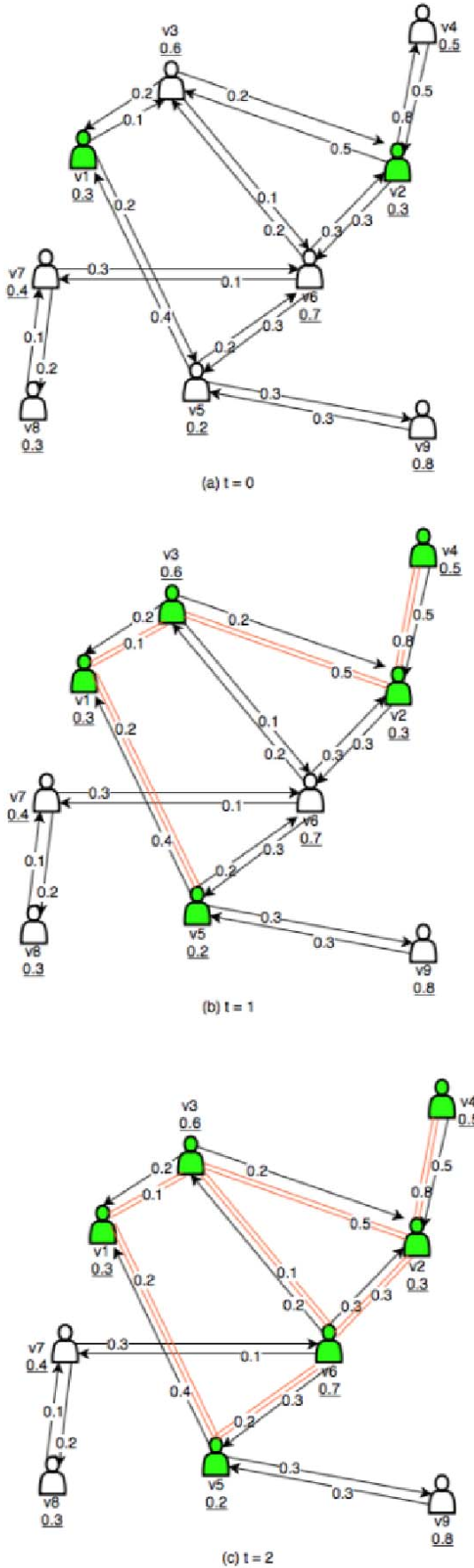 Figure 1: Traditional IC model where green nodes represent successful "activation" events.
The Insight: Why Traditional Models Fade
The limitation of these models lies in their Inductive Bias. They assume we already know the influence weights or probabilities . In reality, these values are latent and change depending on the topic, time, and user context.
2. The Deep Learning Shift: Cascades as Sequences
The paper identifies a crucial shift: Diffusion is a sequence. Just as words follow one another in a sentence, node activations follow one another in a cascade. This makes Recurrent Neural Networks (RNNs) the perfect tool for this task.
Key Methodological Breakthroughs:
- Role Embeddings (Embedded-IC): Instead of a single value, users are mapped into a latent space with "Sender" vectors and "Receiver" vectors. Influence is the dot product of these vectors.
- Subgraph Embeddings (DeepCas): This model uses random walks to sample the graph and GRUs (Gated Recurrent Units) to encode the structure of the subgraph, allowing it to predict the ultimate size of a viral cascade.
- Topological RNNs: Diffusion often forms Directed Acyclic Graphs (DAGs). Modern architectures now use specialized RNN cells that can process these multi-directional topologies rather than just simple linear chains.
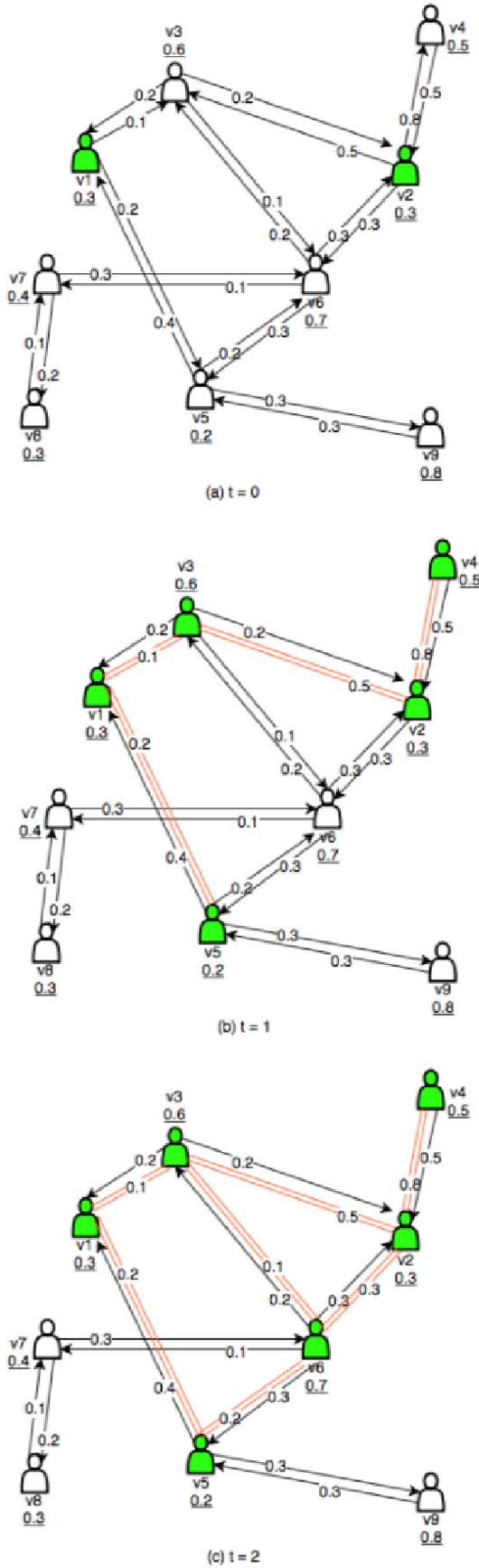 Figure 2: The LT model demonstrates how cumulative weight triggers node activation, a logic now being mimicked by neural activation functions.
3. Critical Analysis & Results
The paper notes that while Deep Learning methods (like DAG-RNN and DeepCas) significantly outperform traditional models in predicting cascade growth, they face a "Ground Truth" problem.
- SOTA Achievement: Neural approaches have successfully moved from predicting if a node will activate to when and within which topology it will activate.
- The Data Gap: Most social datasets are unlabeled. We see the "likes," but we don't always know who influenced whom definitively (the "Attribution" problem).
Takeaways for Researchers
- Viral Marketing: If you can learn the "Sender" embedding of an influencer, you can optimize the "Seed Set" with far higher precision than simple degree-centrality heuristics.
- Cross-Domain Potential: These models aren't just for Facebook. The paper suggests applications in Protein-Protein Interaction Networks and biological metabolic pathways, where one chemical reaction "triggers" a cascade of others.
Conclusion
The evolution of social network analysis is a journey from prescriptive equations to predictive representations. We are no longer defining how influence works; we are building models that observe the data and tell us how it works. The future of this field lies in solving the "Performance Measure" problem—developing better tools to verify if our predicted cascades actually match the chaos of real-world human behavior.