
Sensing the City's Pulse: Traffic Analysis via Microblog Sentiment and CGAN Data Augmentation
Traffic Condition Analysis Based on Users Emotion Tendency of Microblog
This paper introduces a semi-supervised framework for traffic condition analysis by performing sentiment analysis on Sina Weibo (microblog) data. It utilizes a Gated Recurrent Unit (GRU) classifier augmented by data generated via Conditional Generative Adversarial Networks (CGAN) to predict traffic jams based on user emotional tendencies.
TL;DR
Researchers from Xiamen University have developed a novel way to monitor urban traffic jams without relying on expensive physical sensors. By analyzing the "emotional temperature" of Sina Weibo users and using Conditional Generative Adversarial Networks (CGAN) to beef up their training data, they created a system that identifies traffic congestion with improved accuracy.
Background & Motivation: Beyond the Physical Sensor
Traditional traffic monitoring is a hardware-heavy game. Loop sensors and cameras are expensive to install and often miss the "why" behind a traffic jam. Social media, specifically microblogs like Sina Weibo, offers a "living sensor network." However, the challenge lies in data labeling: deep learning models like GRUs need massive amounts of labeled data to understand that "I'm going to be late! 😡" translates to a negative traffic state.
The authors' core intuition is that user emotions are a direct reflection of environmental stress. If we can accurately classify these emotions using semi-supervised learning, we can map the city's congestion in real-time.
Methodology: Bridging the Data Gap with CGAN
The architecture is divided into two distinctive phases: Sample Generation and Sentiment Classification.
1. The CGAN Supplement
To solve the data scarcity problem, the team employed a Conditional GAN.
- Weak Labeling: They used emoticons (like ❤️ for positive, 😭 for negative) to automatically tag millions of microblogs.
- Synthetic Augmentation: The CGAN learns the distribution of these microblogs to generate "fake" samples. These samples act as a regularizer and expand the training set for the classifier.
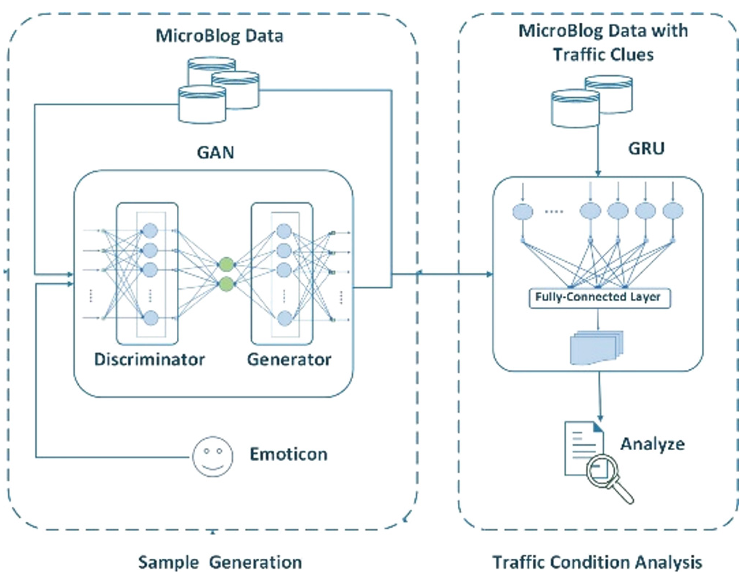 Fig 1: The dual-phase framework: CGAN for sample generation and GRU for sentiment analysis.
2. The GRU Classifier & Emotion Index
The primary model is a Gated Recurrent Unit (GRU), chosen for its ability to handle sequential text data better than standard RNNs. Once the sentiment is predicted, they compute the Traffic Emotion Index (EI):
- EI > 0.5: Suggests negative emotions (Potential Congestion).
- EI < 0.5: Suggests positive emotions (Smooth Traffic).
Experimental Results: Performance and Real-World Utility
The inclusion of CGAN-generated data proved crucial. As shown in the study, the GRU model's accuracy jumped from 57.93% (original data only) to 62.0% when supplemented with 70-iteration generative data.
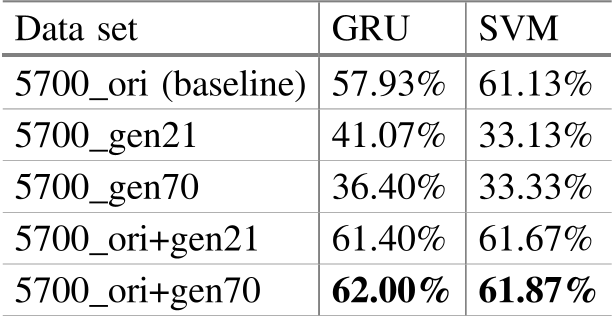 Table 1: Performance gains using the hybrid dataset.
Urban Insights
Applying the model to four major Chinese cities (Beijing, Shanghai, Guangzhou, Xi'an) revealed distinct patterns:
- Beijing & Shanghai: Consistently negative emotional indices, indicating chronic traffic woes.
- Guangzhou: Relatively better traffic conditions with more neutral/positive sentiment.
- Temporal Peaks: The model accurately identified peak congestion hours (7:00–9:00 and 17:00–19:00), correlating perfectly with standard "rush hour" metrics.
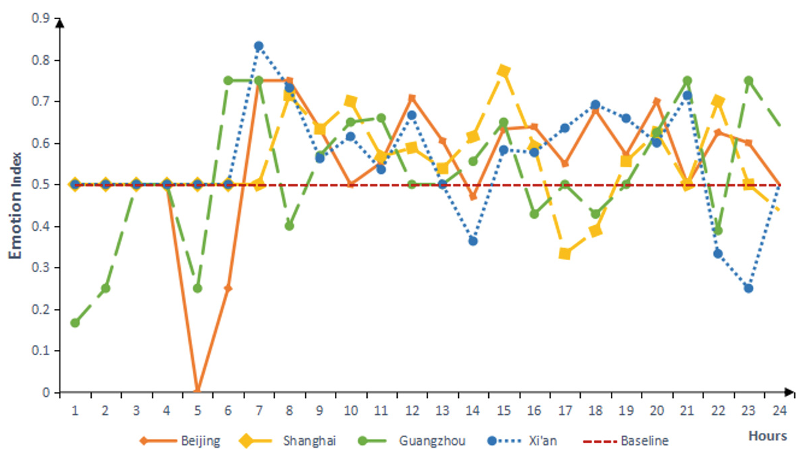 Fig 2: 24-hour Emotion Index fluctuations across four cities.
Critical Insight: The "Noise" Threshold
A fascinating finding in the ablation study (Fig 5 in the paper) is that more data isn't always better. If too much synthetic data is added, the accuracy begins to drop. This is likely because CGANs for text (mapping continuous vectors to discrete semantics) eventually introduce "semantic noise" that confuses the GRU. Finding the "Goldilocks zone" of synthetic data volume is key for practitioners.
Conclusion
This paper successfully bridges urban planning and natural language processing. By treating every frustrated commuter as a "mobile sensor," the authors provide a scalable, low-cost alternative to infrastructure-heavy traffic monitoring. While the current text generation is limited by GAN's inherent difficulties with discrete sequences, it paves the way for future integrations with more advanced generative models.
Future Directions: Moving from GRUs to Transformers or integrating real-time incident detection (accidents, construction) could make this system even more robust for smart city administrators.